
Cities With the Largest Increase in Home Prices Over the Last Decade
Which U.S. cities saw the biggest home price increases over the last decade? National home values rose more than 81% since 2016, with cities across Florida and the Sun Belt posting some of the nation’s fastest-growing home prices.

Note: This is the most recent release of our Cities With the Largest Increase in Home Prices Over the Last Decade study. To see data from previous years, please visit the Full Results section below.
While the U.S. real estate market appears to finally be cooling down, home price growth has been a defining economic trend in recent years. Over the past decade, U.S. home values grew by more than 81%, compared to average hourly earnings which saw a modest 47% increase. Consequently, housing affordability has taken a hit, while homeowners have seen substantial gains in their real estate wealth.
To examine trends in home price growth, including which U.S. locations have seen the most growth and where this price growth has most outpaced household income, Construction Coverage analyzed the latest data from Zillow, the U.S. Census Bureau, and the U.S. Department of Housing and Urban Development.
Key Findings
- Home prices have risen far faster than incomes and inflation over the past decade. Since 2016, U.S. home values have increased by more than 81%, substantially outpacing wage growth (+47%)—resulting in worsening housing affordability nationwide.
- Home price growth following the COVID-19 recession was initially rapid but has since normalized. National home prices surged 40% within just over two years after the 2020 recession before cooling to more typical long-term growth patterns by 2025, even as elevated mortgage rates continue to keep monthly housing costs high.
- Mountain West and New England states recorded the largest increases in home prices. Idaho (+137.0%) led all states in 10-year home price appreciation, followed by New Hampshire (+114.0%), Maine (+110.8%), and Utah (+109.3%), while Louisiana (+17.0%), North Dakota (+25.1%), and Alaska (+38.6%) saw the slowest growth.
- Home price growth varied dramatically at the city level. Cities like East Orange, NJ (+197.7%), Pine Hills, FL (+187.6%), and Miami Gardens, FL (+182.6%) experienced some of the nation’s largest increases, while high-cost coastal markets such as Oakland, CA (+14.0%) and San Francisco, CA (+14.1%) posted comparatively modest gains over the past decade.
How Fast Have Home Prices Grown Since the COVID-19 Recession?
Home price growth after the COVID-19 recession was unprecedented but is now regressing to historical norms
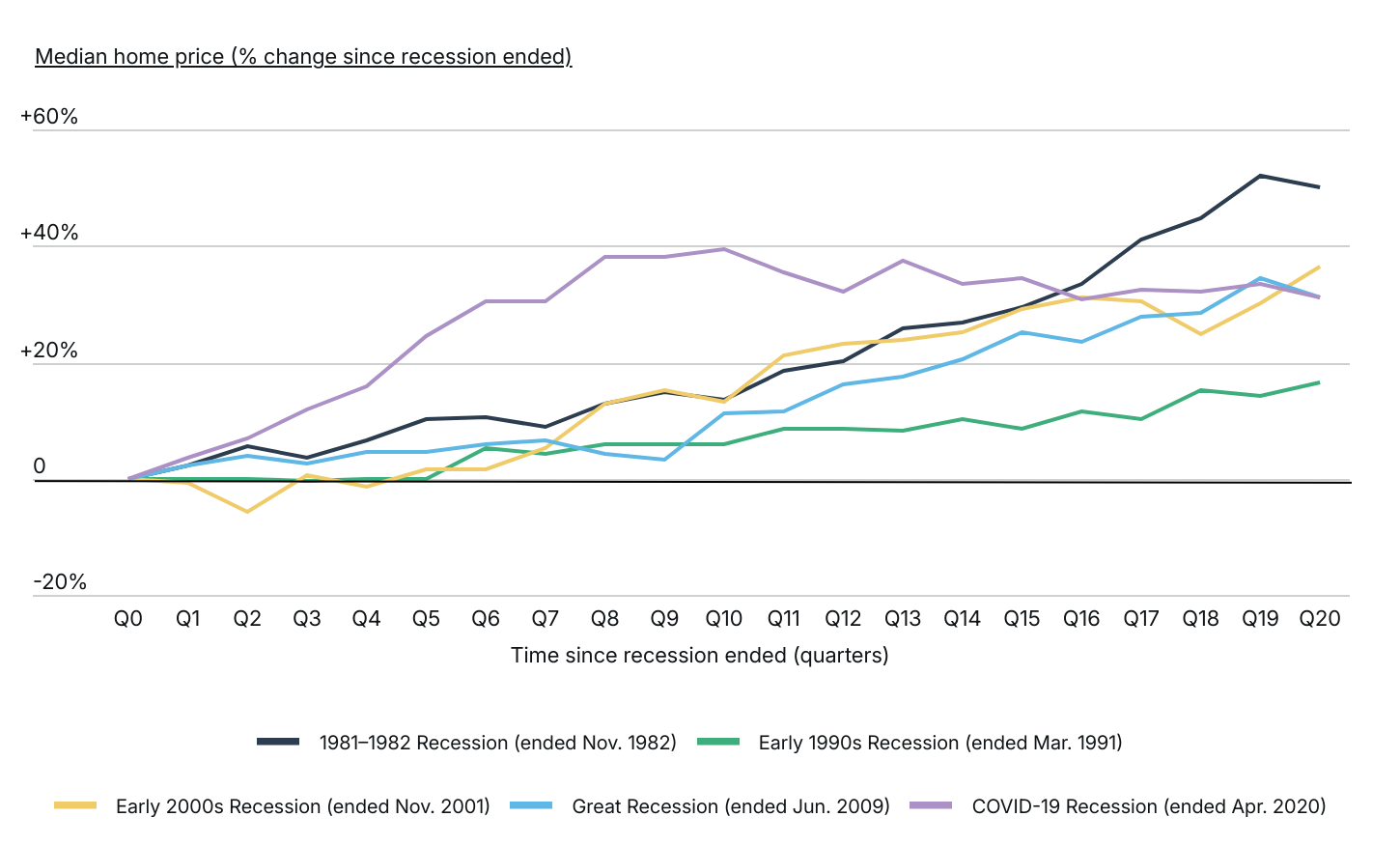
Data: U.S. Media Home Price Percentage Change Following Economic Recessions
| Quarter | 1981–1982 Recession | Early 1990s Recession | Early 2000s Recession | Great Recession | COVID-19 Recession |
|---|---|---|---|---|---|
| Q0 | 0.00% | 0.00% | 0.00% | 0.00% | 0.00% |
| Q1 | 2.18% | 0.08% | -0.79% | 2.19% | 3.41% |
| Q2 | 5.59% | 0.08% | -5.62% | 4.01% | 6.78% |
| Q3 | 3.55% | -0.33% | 0.74% | 2.43% | 11.95% |
| Q4 | 6.68% | 0.08% | -1.43% | 4.57% | 15.99% |
| Q5 | 10.10% | 0.08% | 1.64% | 4.67% | 24.63% |
| Q6 | 10.50% | 5.09% | 1.70% | 5.88% | 30.56% |
| Q7 | 9.00% | 4.25% | 5.35% | 6.44% | 30.40% |
| Q8 | 12.96% | 5.92% | 12.72% | 4.29% | 38.03% |
| Q9 | 15.01% | 5.92% | 15.32% | 3.17% | 38.13% |
| Q10 | 13.51% | 5.92% | 13.14% | 11.25% | 39.58% |
| Q11 | 18.42% | 8.42% | 21.25% | 11.39% | 35.29% |
| Q12 | 20.05% | 8.42% | 23.21% | 16.10% | 31.98% |
| Q13 | 25.65% | 8.17% | 23.85% | 17.45% | 37.31% |
| Q14 | 26.88% | 10.09% | 25.28% | 20.58% | 33.46% |
| Q15 | 29.60% | 8.42% | 29.09% | 25.10% | 34.59% |
| Q16 | 33.56% | 11.68% | 31.27% | 23.57% | 30.72% |
| Q17 | 41.06% | 10.09% | 30.52% | 27.67% | 32.58% |
| Q18 | 44.61% | 15.10% | 24.85% | 28.42% | 32.23% |
| Q19 | 52.11% | 14.26% | 30.05% | 34.39% | 33.43% |
| Q20 | 50.07% | 16.68% | 36.41% | 31.12% | 31.22% |
Recent home price increases, though intensified by the unique circumstances of the COVID-19 pandemic, reflect a broader trend of above-average growth following economic recessions. Historically, U.S. housing markets have rebounded strongly after downturns, with median prices rising by an average of 33.6% over five years (20 quarters). Following the brief 2020 recession, home prices surged by an unprecedented 40% within just over two years but have since stabilized. By the second quarter of 2025—20 quarters after the recession officially ended—cumulative growth stands at 31.2%, closely mirroring historical patterns observed over similar recovery periods.
Despite recent declines in sale prices, homebuyers still haven’t experienced much in the way of financial relief. Persistent inflation continues to erode purchasing power and drive up home prices; concurrently, mortgage rates above 6% have kept monthly mortgage payments near record highs.
The higher value the project, the greater the risk during construction
As home values continue to rise nationwide, the financial stakes tied to new residential construction and large renovation projects have grown as well. Builders risk insurance helps protect projects, materials, and equipment from losses related to fire, weather, theft, and other unexpected events during construction.
Home Price Growth by State Over the Past Decade
States in the Mountain West and New England saw the most significant home price growth over the past decade
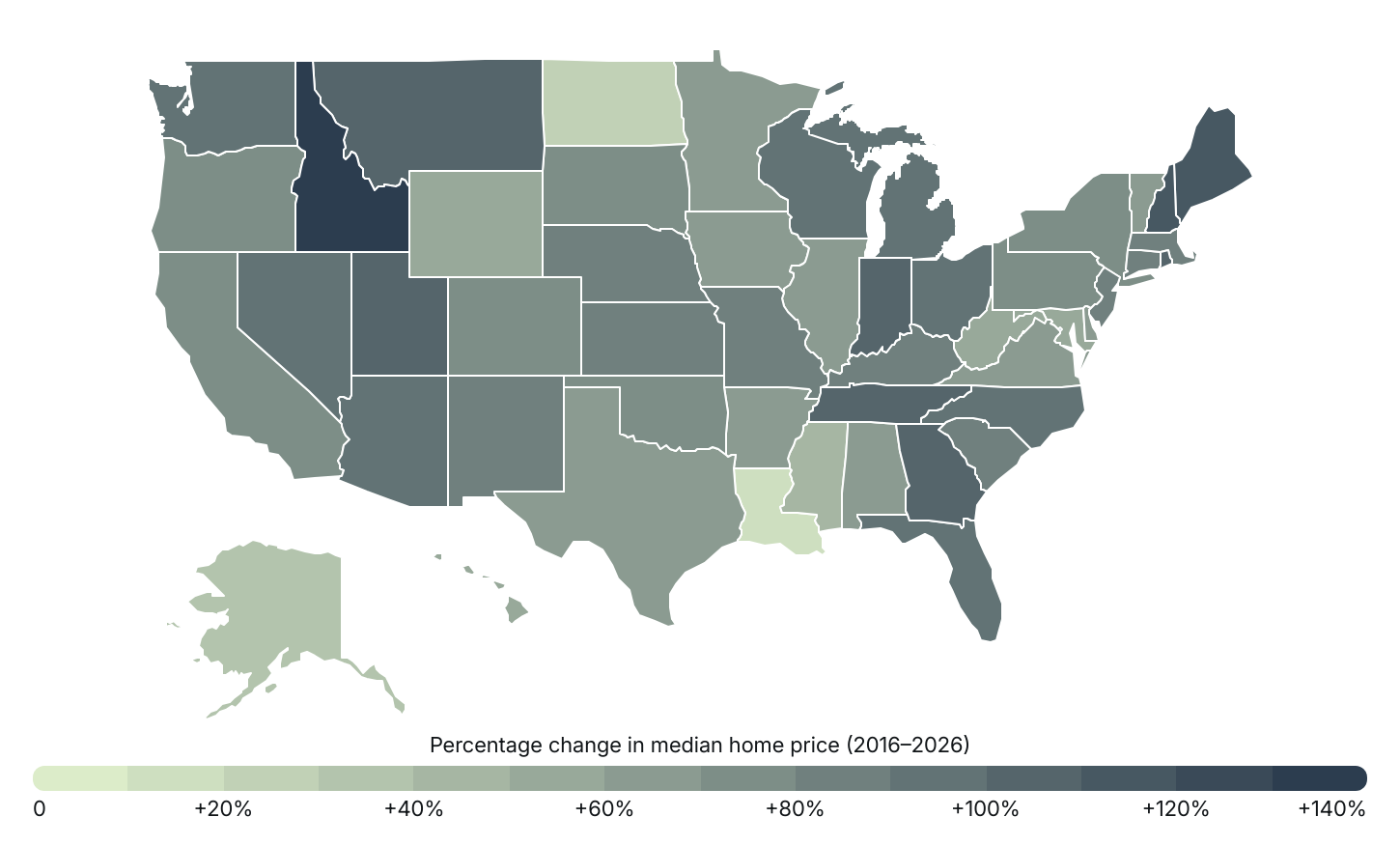
Data: Home Price Growth by State
| State | Percentage change in median home price (2016–2026) |
|---|---|
| Idaho | +137.0% |
| New Hampshire | +114.0% |
| Maine | +110.8% |
| Utah | +109.3% |
| Montana | +106.2% |
| Tennessee | +104.6% |
| Rhode Island | +103.6% |
| Georgia | +101.4% |
| Indiana | +100.2% |
| Washington | +98.9% |
| Nevada | +98.5% |
| North Carolina | +97.0% |
| Wisconsin | +95.8% |
| Arizona | +94.3% |
| Michigan | +94.3% |
| Florida | +92.6% |
| Ohio | +91.6% |
| South Carolina | +86.5% |
| Missouri | +85.8% |
| Kentucky | +85.4% |
| Nebraska | +84.8% |
| New Jersey | +84.4% |
| Kansas | +83.6% |
| New Mexico | +81.9% |
| Massachusetts | +81.4% |
| Connecticut | +80.4% |
| New York | +79.4% |
| South Dakota | +78.7% |
| California | +75.9% |
| Oklahoma | +75.5% |
| Oregon | +74.1% |
| Colorado | +71.5% |
| Pennsylvania | +71.0% |
| Minnesota | +69.4% |
| Vermont | +68.7% |
| Texas | +68.0% |
| Illinois | +67.7% |
| Alabama | +67.6% |
| Virginia | +66.6% |
| Arkansas | +65.5% |
| Iowa | +65.4% |
| Delaware | +64.3% |
| Hawaii | +56.4% |
| Wyoming | +56.4% |
| West Virginia | +55.2% |
| Maryland | +51.6% |
| Mississippi | +45.1% |
| Alaska | +38.6% |
| North Dakota | +25.1% |
| Louisiana | +17.0% |
The trajectory of economic recovery post-recession is uneven across the nation, and this trend has held true in the wake of both the Great Recession and the COVID-19 pandemic. The most substantial increases in home prices have been concentrated in Mountain West states and select states in New England. Since 2016, Idaho and New Hampshire have witnessed the most significant growth, with median home prices increasing by 137.0% and 114.0%, respectively. Other top states include Maine (+110.8%), Utah (+109.3%), Montana (+106.2%), Tennessee (+104.6%), Rhode Island (+103.6%), and Georgia (+101.4%).
Conversely, Louisiana (+17.0%), North Dakota (+25.1%), and Alaska (+38.6%) saw home price growth barely keeping pace with CPI growth over the past decade. Generally, parts of the Midwest, along with certain pockets of the South and Northeast, reported the slowest growth in home prices nationally during this period.
At the city level, locations in Florida notably stand out for their remarkable surge in home prices. For instance, in Pine Hills, FL, median home prices skyrocketed from approximately $95,000 in 2016 to nearly $273,000 as of March 2026, marking a 188% increase. In fact, 30 Florida cities reported price increases of over 100%—median home prices in those cities more than doubled in just 10 years.
Below is a breakdown of 10-year home price growth across nearly 700 U.S. cities and all 50 states. The analysis was conducted by Construction Coverage, using data from Zillow and the U.S. Census Bureau.
Cities With the Biggest 10-Year Increase in Home Price
| Top Large Cities | Change* |
|---|---|
| 1. Detroit, MI | +138.7% |
| 2. Milwaukee, WI | +138.0% |
| 3. Tampa, FL | +121.3% |
| 4. Indianapolis, IN | +119.2% |
| 5. Columbus, OH | +117.4% |
| 6. Charlotte, NC | +111.2% |
| 7. Cleveland, OH | +108.5% |
| 8. Kansas City, MO | +107.2% |
| 9. Las Vegas, NV | +104.2% |
| 10. Jacksonville, FL | +99.6% |
| 11. Phoenix, AZ | +99.3% |
| 12. Mesa, AZ | +98.9% |
| 13. Memphis, TN | +98.8% |
| 14. Tulsa, OK | +97.5% |
| 15. Arlington, TX | +92.9% |
| Bottom Large Cities | Change* |
|---|---|
| 1. Oakland, CA | +14.0% |
| 2. San Francisco, CA | +14.1% |
| 3. Washington, DC | +15.1% |
| 4. New Orleans, LA | +17.3% |
| 5. Portland, OR | +35.2% |
| 6. Chicago, IL | +38.9% |
| 7. New York, NY | +40.6% |
| 8. Boston, MA | +43.9% |
| 9. Austin, TX | +48.8% |
| 10. Minneapolis, MN | +50.1% |
| 11. Denver, CO | +53.0% |
| 12. Seattle, WA | +54.2% |
| 13. Houston, TX | +59.9% |
| 14. San Antonio, TX | +60.2% |
| 15. Virginia Beach, VA | +60.8% |
| Top Midsize Cities | Change* |
|---|---|
| 1. Kansas City, KS | +162.4% |
| 2. Buffalo, NY | +157.7% |
| 3. Paterson, NJ | +154.2% |
| 4. San Bernardino, CA | +139.9% |
| 5. Boise City, ID | +136.6% |
| 6. Grand Rapids, MI | +131.9% |
| 7. Providence, RI | +130.3% |
| 8. Knoxville, TN | +129.0% |
| 9. Spokane, WA | +127.6% |
| 10. Hialeah, FL | +125.2% |
| 11. Tacoma, WA | +121.6% |
| 12. Bellevue, WA | +121.4% |
| 13. Springfield, MA | +121.2% |
| 14. North Las Vegas, NV | +119.6% |
| 15. Akron, OH | +119.2% |
| Bottom Midsize Cities | Change* |
|---|---|
| 1. Shreveport, LA | +17.8% |
| 2. Urban Honolulu, HI | +27.9% |
| 3. Baton Rouge, LA | +30.6% |
| 4. Anchorage, AK | +31.7% |
| 5. Little Rock, AR | +36.6% |
| 6. Corpus Christi, TX | +37.4% |
| 7. Arlington, VA | +38.7% |
| 8. Santa Rosa, CA | +39.8% |
| 9. Alexandria, VA | +44.9% |
| 10. Laredo, TX | +45.4% |
| 11. Montgomery, AL | +54.0% |
| 12. Birmingham, AL | +54.6% |
| 13. Hayward, CA | +55.7% |
| 14. Lubbock, TX | +59.3% |
| 15. Roseville, CA | +60.6% |
| Top Small Cities | Change* |
|---|---|
| 1. East Orange, NJ | +197.7% |
| 2. Pine Hills, FL | +187.6% |
| 3. Miami Gardens, FL | +182.6% |
| 4. Waterbury, CT | +181.3% |
| 5. Reading, PA | +176.0% |
| 6. Ogden, UT | +171.4% |
| 7. Dayton, OH | +167.5% |
| 8. Elizabeth, NJ | +162.8% |
| 9. Caldwell, ID | +162.2% |
| 10. Bridgeport, CT | +154.1% |
| 11. Rockford, IL | +153.9% |
| 12. Nampa, ID | +153.5% |
| 13. Gary, IN | +149.4% |
| 14. Spring Hill, FL | +147.6% |
| 15. Trenton, NJ | +144.1% |
| Bottom Small Cities | Change* |
|---|---|
| 1. Kenner, LA | +0.5% |
| 2. Lake Charles, LA | +2.2% |
| 3. Lafayette, LA | +7.8% |
| 4. Miami Beach, FL | +21.0% |
| 5. Metairie, LA | +23.7% |
| 6. Jackson, MS | +28.0% |
| 7. Berkeley, CA | +30.5% |
| 8. Evanston, IL | +32.9% |
| 9. Alameda, CA | +33.4% |
| 10. Bethesda, MD | +34.2% |
| 11. Rockville, MD | +34.6% |
| 12. Beaumont, TX | +35.7% |
| 13. Bismarck, ND | +37.3% |
| 14. Palo Alto, CA | +37.3% |
| 15. Victoria, TX | +38.5% |
States With the Biggest 10-Year Increase in Home Price
| Top States | Change* |
|---|---|
| 1. Idaho | +137.0% |
| 2. New Hampshire | +114.0% |
| 3. Maine | +110.8% |
| 4. Utah | +109.3% |
| 5. Montana | +106.2% |
| 6. Tennessee | +104.6% |
| 7. Rhode Island | +103.6% |
| 8. Georgia | +101.4% |
| 9. Indiana | +100.2% |
| 10. Washington | +98.9% |
| 11. Nevada | +98.5% |
| 12. North Carolina | +97.0% |
| 13. Wisconsin | +95.8% |
| 14. Arizona | +94.3% |
| 15. Michigan | +94.3% |
| Bottom States | Change* |
|---|---|
| 1. Louisiana | +17.0% |
| 2. North Dakota | +25.1% |
| 3. Alaska | +38.6% |
| 4. Mississippi | +45.1% |
| 5. Maryland | +51.6% |
| 6. West Virginia | +55.2% |
| 7. Wyoming | +56.4% |
| 8. Hawaii | +56.4% |
| 9. Delaware | +64.3% |
| 10. Iowa | +65.4% |
| 11. Arkansas | +65.5% |
| 12. Virginia | +66.6% |
| 13. Alabama | +67.6% |
| 14. Illinois | +67.7% |
| 15. Texas | +68.0% |
*Percentage change in median home price (2016–2026)
Full Results
Methodology
The data used in the study comes from Zillow’s Zillow Home Value Index (ZHVI) and the U.S. Census Bureau’s American Community Survey. To find the cities with the largest increase in home prices over the last decade, researchers at Construction Coverage compared each location’s median home value in March 2016 and March 2026. Locations were then ordered by their respective percentage change in median home price over those 10 years, and, in the event of a tie, the location with the larger total change in home price over the last decade was ranked higher. Additionally, researchers calculated the percentage change in median household income from 2014 to 2024, the latest data available from the U.S. Census Bureau.
For relevance, only cities with complete data were included, and cities were broken into three cohorts based on population:
- Large: Cities with more than 350,000 people
- Midsize: Cities with 150,000–350,000 people
- Small: Cities with less than 150,000 people
References
- U.S. Bureau of Labor Statistics (April 23, 2026). Average Hourly Earnings of All Employees, Total Private. https://fred.stlouisfed.org/series/CES0500000003.
- Board of Governors of the Federal Reserve System (March 19, 2026). Financial Accounts of the United States. https://www.federalreserve.gov/releases/z1/dataviz/z1/balance_sheet/chart/#series:nonfinancial-assets;units:usd.
- Freddie Mac (April 30, 2026). 30-Year Fixed Rate Mortgage Average in the United States. https://fred.stlouisfed.org/series/MORTGAGE30US.
- Zillow (2026). Housing Data. https://www.zillow.com/research/data/.
- U.S. Census Bureau (2026). American Community Survey. https://www.census.gov/programs-surveys/acs.
Related Research

Cities With the Most Working-Age Residents Who Have Paid off Their Homes
The rise in mortgage rates beginning in 2022 has placed significant financial pressure on American households. These are the U.S.…

U.S. Cities With the Biggest Change in Rent Prices
More than half of all U.S. states have seen rent grow by double-digit percentages. At the metro level, the pace…

Cities Where You’re Most Likely to Find a Newly-Built Home
The median age of a home in the U.S. is now over 40 years old, underscoring the need for both…

Baby Boomer-Dominant Housing Markets
While baby boomers comprise just over 20% of the U.S. population, they account for more than 37% of homeowners nationwide.…

The Hottest Real Estate Markets in the U.S.
While home sales are down 8.3% year-over-year and price growth has cooled to just 1.1%, certain markets—especially in the Northeast—remain…

U.S. Cities With the Most Mortgage Refinances
Refinancing a mortgage can help reduce monthly payments or provide some much needed liquidity, but the proportion of households that…