


For a construction business in Florida, general liability insurance is the main line of defense against accidents and property damage. It covers medical bills, legal fees, and settlements if a job site accident injures a bystander, a crew wrecks neighboring property, or a hidden flaw causes damage years after a project is handed over.
State licensing requirements dictate exactly how much a policy needs to be able to pay out. Depending on the contractor’s specific trade and license type, the policy must cover at least $100,000 to $300,000 for physical injuries, and $25,000 to $500,000 to repair damaged property. For a small, two- or three-person crew doing low-risk work, a GL policy usually costs around $800 to $2,500 a year. However, larger operations and high-risk trades—like roofing or exterior framing—can easily see costs above $30,000 annually.
Because of the state’s severe weather and moisture risks, standard GL policies in Florida frequently exclude damage from mold, wind, and rain on unfinished projects. To close these gaps, contractors usually have to add specific coverage for mold cleanup and water damage during active exterior work. They also need long-term protection for Florida’s 7-year liability window, which leaves builders on the hook for hidden defects years after a job ends.
This guide is for Florida general contractors, residential builders, and specialty trade professionals who need a clear, direct breakdown of DBPR licensing requirements, 2026 cost benchmarks, and how to navigate the specific policy exclusions unique to the state.
Florida Contractor General Liability Insurance Summary
Here is a summary of the contractor general liability insurance requirements, average costs, and important coverage gaps for Florida contractors. For deep explanations of each topic, read on to the detailed explanations below.
Standard General Liability Requirements
General liability insurance pays for medical bills, legal defense, and property repairs if site work injures a bystander or damages someone else’s property.
To issue a license, the Florida Department of Business and Professional Regulation (DBPR) requires contractors to carry specific coverage minimums based on their license division—which is the state’s official category for the trade.
| License Division | Bodily Injury Coverage | Property Damage Coverage |
|---|---|---|
| Division I General, Building | $300,000 | $50,000 |
| Division I (Residential) & Division II Roofing, HVAC, Plumbing | $100,000 | $25,000 |
| ECLB Electrical, Alarm | $300,000 | $500,000 |
Commercial Requirements: Although these minimums allow a business to operate legally in Florida, commercial clients enforce stricter standards. Most commercial developers and general contractors require subcontractors to hold at least $1,000,000 in coverage.
2026 Annual Costs
General liability insurance prices are driven primarily by a company’s size (annual revenue and payroll) and the physical risk of the trade. Here is what typical baseline premiums look like in Florida:
| Risk Level | Example Trades | Annual Est. |
|---|---|---|
| Low Risk | Finish Carpentry, Drywall | $800 – $2,200 |
| Moderate Risk | Electricians, Plumbers | $1,800 – $5,500 |
| High Risk | General Contractors | $5,500 – $11,000 |
| Very High Risk | Roofers, Exterior Framing | $14,000 – $32,000+ |
Important Coverage Gaps
Florida law enforces a strict 7-year defect window, leaving builders on the hook for hidden construction flaws well after a job finishes. Because standard policies rarely extend through this entire timeline, contractors have to specifically structure their coverage to handle it.
Beyond this long-term liability, standard policies also frequently strip out coverage for major physical hazards unique to the state. Contractors usually need specific add-ons to cover:
- Mold and Water Damage: Most standard policies completely deny claims for mold cleanup or moisture damage.
- Open Roofs: Standard coverage usually won’t pay for interior water damage if a storm hits before a building is dried in.
- Condos and Multi-Family: Policies frequently restrict or completely ban work on multi-unit condo buildings or large tract subdivisions.
Top General Liability Insurers in Florida
A handful of large national carriers control the largest share of Florida’s commercial liability market. These companies primarily underwrite large commercial developers, multi-state contractors, and heavy infrastructure projects:
| Carrier | FL Market Share | Primary Focus |
|---|---|---|
| Chubb | 5.29% | Large commercial & institutional |
| Markel | 5.09% | Artisan trades & specialty risks |
| Berkshire Hathaway | 4.29% | Heavy civil & commercial |
| Travelers | 3.80% | Mid-to-large general contractors |
Related Resource: If you need an overview of how general liability policies work, average costs, and what they explicitly cover and exclude, see our complete guide: What is General Liability Insurance?
Table of Contents

Get a General Liability Insurance Quote With ERGO NEXT
General Liability Insurance Requirements for Florida Contractors
General liability insurance is the main requirement to activate and keep a Florida contractor license.
License holders must maintain proof of continuous coverage listing the DBPR Construction Industry Licensing Board as a certificate holder. If a policy lapses, the contractor may be vulnerable to DBPR disciplinary action, license suspension, and losing the ability to pull local building permits.
DBPR State Licensing Rules
The Florida Department of Business and Professional Regulation (DBPR) sets minimum coverage amounts based on a contractor’s specific trade. Florida issues two main classes of licenses: Certified Contractors (who can work anywhere in the state) and Registered Contractors (who are limited to specific counties or cities).
Regardless of whether a license is Certified or Registered, the DBPR dictates the required insurance based on the trade’s specific Division:
- Division I (Prime Contractors): This covers General, Building, and Residential contractors who oversee structure-level projects. General and Building contractors carry the highest bodily injury requirements ($300,000), whereas Residential contractors carry a lower minimum limit ($100,000).
- Division II (Specialty Trades): This covers trades like roofing, plumbing, and HVAC that handle specific systems. Their minimum liability limits are generally lower than Division I.
- ECLB (Electrical & Alarm): Electricians operate under a completely separate board within the DBPR. They carry uniquely high property damage requirements ($500,000) due to the severe risk of fire and high-voltage utility damage.
Contractors must meet these baseline minimums before the state will issue or renew a license:
| DBPR License Classification | Eligible Trades | Bodily Injury Limit | Property Damage Limit |
|---|---|---|---|
| Division I (General & Building) | General, Building | $300,000 per occurrence | $50,000 per occurrence |
| Division I (Residential) & Division II (Specialty) | Residential, Plumbing, HVAC, Roofing, Pool/Spa, Underground Utility | $100,000 per occurrence | $25,000 per occurrence |
| Electrical Contractors (ECLB) | Electrical, Alarm System | $300,000 per occurrence | $500,000 per occurrence |
While these numbers represent the absolute legal floor to keep a license active, very few contractors actually carry limits this low. In practice, local municipalities and commercial clients almost always force contractors to buy more coverage.
City & County Requirements
Meeting the DBPR minimums keeps a license active, but it doesn’t automatically mean a contractor can pull a permit locally.
For standard jobs entirely on private property (like a kitchen remodel or a backyard pool), city building departments usually just verify the contractor’s DBPR license status and workers’ comp coverage through the state database.
However, if a project touches public property, the rules change entirely. When a contractor needs to block a sidewalk, park a crane in the street, or dig near city utilities, they have to pull a public right-of-way permit. Because the city could get sued if a bystander gets hurt in that public space, local public works departments demand much higher liability limits than the state requires.
| Jurisdiction | Standard Private Permits | Public Right-of-Way Permits |
|---|---|---|
| Miami-Dade County | DBPR license & workers’ comp verification. | $300,000 to $1,000,000 limit. County must be named as an additional insured. |
| Orange County | DBPR license, workers’ comp, & local surety bond ($5,000) for some trades. | $1,000,000 limit. County Commissioners must be named as an additional insured. |
| City of Tampa / Hillsborough | DBPR license & workers’ comp verification. | $1,000,000 limit. City/County must be named as an additional insured. |
Commercial Subcontract Requirements
Commercial developers and prime general contractors demand the highest coverage levels of all. For trade subcontractors (like commercial electricians, steel erectors, or concrete crews), DBPR minimums are effectively obsolete.
Commercial general contractors use their subcontracts to aggressively transfer risk down the chain. If a subcontractor causes an accident, the GC wants to make sure the sub’s insurance pays for the damage—not their own.
To enforce this, GCs often use specialized construction software for general contractors to automate their compliance tracking. When these systems scan a subcontractor’s certificate of insurance (COI), they are verifying much more than just basic coverage. If the document doesn’t include specific required clauses, the sub won’t be allowed on the site, and their progress payments will be withheld. Here are some of the most commonly required policy modifications required by GCs and commercial contracts:
- Higher Limits: Standard commercial contracts require at least $1,000,000 per occurrence and a $2,000,000 total policy limit. Major projects often require a $5,000,000 umbrella policy stacked on top of that.
- Additional Insured Status: The contract will require the subcontractor to officially add the GC and the property owner as an additional insured to their policy. This ensures that if the sub’s work triggers a lawsuit, the sub’s insurance defends the GC too.
- Primary and Noncontributory Wording: Primary and noncontributory wording provides a legal promise that if a claim happens, the subcontractor’s insurance pays first, and the GC’s insurance doesn’t have to chip in a single dollar. GCs demand this to keep their own insurance premiums from going up.
- Waivers of Subrogation: A waiver of subrogation is a clause that blocks the subcontractor’s insurance company from suing the GC or property owner to recover costs after paying out a claim. Carriers often charge an extra fee to add this waiver to a policy.
Trade contractors looking to bid on commercial work have to build these elevated insurance costs into their estimates right out of the gate.
Related Resource: To learn more about the coverage general contractors and commercial contracts require, read our complete guide to General Liability Insurance Requirements.
General Liability Insurance Costs for Florida Contractors
General liability costs in Florida depend entirely on the type of work a contractor does and the size of their operation.
Insurance companies price these policies by looking at two main factors: the physical hazards of the specific trade, and the company’s projected annual payroll and gross revenue. Low-risk trades operating inside finished buildings carry very little risk of causing severe property damage, so their costs stay low. On the other hand, trades that alter a building’s exterior, work at heights, or manage multiple subcontractors carry a much higher risk, driving premiums up significantly.
Florida General Liability Costs by Trade
The table below shows estimated annual premiums for various Florida trades, factoring in typical payroll and revenue numbers for each risk level:
| Trade | Risk Level | Example Annual Payroll / Revenue Base | Typical Annual Premium Range | Primary Cost Drivers |
|---|---|---|---|---|
| Interior Carpenter | Low | $65,000 Payroll / $150,000 Revenue | $800 – $1,400 | Interior work only; no structural impact or weather exposure. |
| Drywall | Low-Mod | $85,000 Payroll / $220,000 Revenue | $1,200 – $2,200 | Interior operations; limited risk of causing water damage. |
| Electrician | Mod | $120,000 Payroll / $350,000 Revenue | $1,800 – $3,400 | Hidden fire hazards; high-voltage utility property damage. |
| Plumbing | Mod-High | $150,000 Payroll / $450,000 Revenue | $3,000 – $5,500 | Concealed leaks; major water damage and mold claims. |
| General Contractor | High | $200,000 Sub Costs / $800,000 Revenue | $5,500 – $11,000 | Managing subcontractors; multi-trade oversight; job site control. |
| Roofing Contractor | Very High | $180,000 Payroll / $600,000 Revenue | $14,000 – $30,000+ | Open roof water intrusion; severe property damage. |
Estimated Costs and Premium Audits: The premiums listed above are just upfront estimates based on projected revenue. Actual premiums vary based on historical claims, exact location, and the specific insurance carrier.
At the end of the year, the insurance company will also conduct an audit to compare those estimates against actual financial statements. If the business grew, the carrier will bill for the extra liability risk they covered during the year.
How to Lower Insurance Costs
While Florida is an expensive market, small operations and independent contractors have a few practical ways to control their general liability costs:
- Avoid Mixing High-Risk Trades: Because of the state’s extreme weather exposure, Florida carriers are highly sensitive to exterior work. If an interior carpenter takes on an occasional roof repair, the carrier may reclassify the entire business under a high-risk roofing code, pushing premiums past $15,000. Small crews should avoid mixing high-risk exterior tasks into their standard services.
- Use Direct Digital Platforms: Large commercial carriers often enforce minimum premiums that price out a one-to-three person crew. Low-risk interior trades can bypass these high starting costs by buying standard policies through direct digital platforms like ERGO NEXT or biBERK.
- Collect COIs from 1099 Subcontractors: Even small businesses occasionally hire 1099 independent contractors for short-term help. If a business fails to collect a Certificate of Insurance (COI) from these workers, the insurance company assumes the liability risk and will charge the primary contractor for it during the end-of-year audit.
Get a General Liability Insurance Quote With ERGO NEXT
Related Resource: Because of the state’s extreme weather and litigation environment, Florida rates are often much higher than the rest of the country. See how your premiums compare to national averages in our guide: General Liability Insurance Costs
What Florida General Liability Insurance Covers
A standard commercial general liability policy is built around two primary components: bodily injury and property damage. Together, they pay for legal defense and settlement costs when active job site operations harm an outside party or damage someone else’s property.
Because this coverage strictly protects the public, it does not pay for injured employees, company vehicles, or a contractor’s damaged tools.
Bodily Injury & Property Damage
These two coverages apply to accidents that happen both while a contractor is actively working on a site (ongoing operations) and after a job is finished (completed operations).
- Bodily injury applies when a member of the public—like a prospective homebuyer or a municipal inspector—gets hurt on the job site. The policy covers their emergency medical treatment, lost wages, and the resulting legal defense.
- Property damage pays to repair or replace property belonging to clients, neighboring landowners, or other trades if it gets wrecked during construction.
Workmanship Exclusions: General liability does not guarantee workmanship. Policies explicitly exclude the cost of repairing a contractor’s own defective work. If a roofer incorrectly fastens structural underlayment, the policy will not pay to re-lay the shingles. It will, however, cover the drywall and flooring ruined by rain that penetrated the defective assembly.
Products & Completed Operations
While bodily injury and property damage cover accidents on an active site, Products and Completed Operations (PCO) coverage protects the business after a project is finished and handed over to the owner.
This is critical in Florida. Because of the climate, building envelope failures, window seal breaches, and subterranean waterproofing flaws often remain hidden inside walls for years before causing visible damage.
Under Florida law, contractors are legally liable for these hidden construction defects for a full seven years. The state starts this seven-year countdown based on whichever of the following milestones happens first:
- Temporary Certificate of Occupancy (TCO): If a TCO is issued so the owner can occupy the space early, the clock starts that day—even if the crew is still working on punch-list items.
- Final Certificate of Occupancy (CO) or Certificate of Completion (CC): The day the authority having jurisdiction issues the final CO, or the date a CC is issued for projects or improvements that do not require an occupancy permit.
- Abandonment of Construction: If a project is never finished, the clock starts the exact day work permanently stops on the site.
Commercial liability policies operate on an “occurrence” basis. This means coverage is triggered by the policy that is active when the physical damage actually occurs, not the policy that was active when the original work was performed.
If a contractor builds a home in 2024, but a hidden pipe fitting fails and floods the house in 2028, the 2028 policy is the one that responds. Because of this, Florida contractors have to maintain continuous PCO coverage across that entire seven-year window to stay protected against past jobs.
Related Resource: For a deep dive into how GL coverage works and what standard policies include, see our complete guide: What Does General Liability Insurance Cover?
Florida-Specific Policy Exclusions
Standard general liability policies in Florida routinely contain exclusions that strip out coverage for the state’s most common building hazards. If a claim triggers one of these exclusions, the insurance company will deny the claim, leaving the contractor to pay for the damages entirely out of pocket.
Mold, Fungi, & Bacteria
Most standard policies in Florida explicitly refuse to pay for any property damage or bodily injury caused by mold, fungi, or bacteria.
In a subtropical climate, a minor plumbing leak or a poorly sealed window can spawn mold in just a few days. While the insurance company might pay the initial water damage claim to replace the wet drywall, this exclusion allows them to deny the massive bill that follows for air quality testing, containment barriers, and mold removal.
To close this gap, trades that deal heavily with water—like plumbers, HVAC techs, and restoration crews—usually have to buy a specific add-on (called a mold buyback endorsement) or a standalone pollution policy to get this coverage back.
Open Roof & Windstorm Exclusions
An open roof exclusion completely removes coverage for interior water damage if rain or wind hits while the roof or exterior is actively under construction.
If an afternoon storm rolls in while a roof deck is exposed, water can ruin interior ceilings and floors in minutes. If the policy has an absolute open roof exclusion, the insurance company will deny the entire interior damage claim.
Rather than accepting this absolute exclusion, roofers and framers generally work with a broker to secure a conditional exception—commonly referred to in the Florida market as a “Tarp Warranty” or Tarpaulin Endorsement. This provision keeps the coverage active, but only if the contractor can prove they covered the exposed structure with a secured tarp or waterproof barrier before the storm hit.
Condominium & Multi-Family Exclusions
These exclusions restrict or completely ban a contractor from working on multi-unit condo buildings or large subdivision tracts.
Because Florida allows collective defect lawsuits, insurance carriers want to avoid the massive financial risk of an entire Homeowner Association (HOA) suing over a single structural mistake. To avoid that exposure, standard policies usually limit coverage to projects with four or fewer attached units.
Subcontractors bidding on multi-family developments typically handle this by buying a specific condominium add-on from their broker. Alternatively, they can verify that the developer has purchased an Owner-Controlled Insurance Program (OCIP)—or that the general contractor has secured a Contractor-Controlled Insurance Program (CCIP)—that covers all subcontractors on that specific project.
Top General Liability Insurance Companies in Florida
The commercial insurance landscape is strictly divided between massive national carriers that underwrite complex commercial developments and specialized providers that insure independent trade contractors.
Largest Contractor Insurance Providers in Florida
A handful of legacy insurance groups control a commanding portion of the commercial liability market in the state. These carriers primarily underwrite infrastructure projects, multi-story commercial buildings, and large institutional developments.
Comparison of Largest Liability Insurance Carriers in Florida
Comparison of Largest Liability Insurance Carriers in Florida
| Insurance Carrier / Group | Florida Market Share (Other Liability) | Direct Written Premium (Florida) | Primary Market Target | Typical Underwriting Minimums |
| Chubb | 5.29% | $505M | Large institutional builders, high-value commercial, engineering infrastructure | High asset thresholds; strict historical loss controls |
| Markel | 5.09% | $486M | Artisan contractors, specialty casualty, hard-to-place E&S risks | Highly flexible E&S minimums; accepts varied risk profiles |
| Berkshire Hathaway | 4.29% | $409M | Heavy civil, commercial contractors, E&S specialty trades | Focuses on large accounts and high-hazard E&S placements |
| Travelers | 3.80% | $363M | Mid-to-large general contractors, heavy civil, multi-state commercial | $10,000+ minimum premiums; formal safety programs required |
| Fairfax Financial | 3.54% | $338M | E&S construction, commercial general contractors, specialty trades | Frequently utilizes E&S placements for high-risk trades |
| W.R. Berkley | 3.23% | $309M | Mid-to-large commercial, regional contractors, specialty excess | E&S focus for trade contractors; strict risk engineering |
| Auto-Owners | 3.06% | $292M | Small-to-midsize regional contractors, artisans, light commercial | Focuses on clean accounts with favorable loss history; often bundled in BOP |
| AIG | 2.97% | $283M | Large national contractors, wrap-ups (OCIP/CCIP), heavy civil | Large account risk engineering; high minimum premiums |
| CNA | 2.59% | $247M | Mid-to-large commercial contractors, specialty trades, artisan builders | Dedicated construction risk control; formal safety programs required |
| AXA | 2.43% | $232M | Large commercial, wrap-ups (OCIP/CCIP), heavy civil infrastructure | Large account risk engineering; rarely writes small artisan trades |
Methodology: The premium figures above are based on the NAIC’s “Other Liability” reporting category. While General Liability makes up the vast majority of this premium volume, these figures also include premiums from commercial umbrella and management liability policies.
Best GL Insurance for Independent Contractors
Market share alone does not determine which insurer is the best fit for a contractor. While some large carriers, including Chubb and Travelers, offer dedicated small-business programs, others focus more on larger firms and complex construction projects. Providers like ERGO NEXT and biBERK specialize in small-business insurance and allow contractors to get quotes and buy coverage online. Contractors with higher-risk operations may need a broker to find specialty coverage through the excess and surplus (E&S) market.
Compare General Liability Insurance Quotes from Top Carriers
Please enter a valid 5-digit zip code.
Related Resource: If you are ready to compare quotes and find the right coverage for your specific trade, check out our continuously updated rankings of the Best General Liability Insurance Companies
DBPR Certificate of Insurance Requirements
While the DBPR relies on a digital affidavit for the standard license application process, they still require the Construction Industry Licensing Board to be officially listed as the Certificate Holder on the contractor’s actual insurance policy. Furthermore, if a contractor is selected for a random audit, they must produce an ACORD 25 form configured exactly to state standards.
Certificate Holder Details
When an insurance provider generates the proof of coverage, they must fill out the Certificate Holder field at the bottom of the form. This address block links the active policy to the contractor’s specific license profile and ensures the state is notified if the policy cancels.
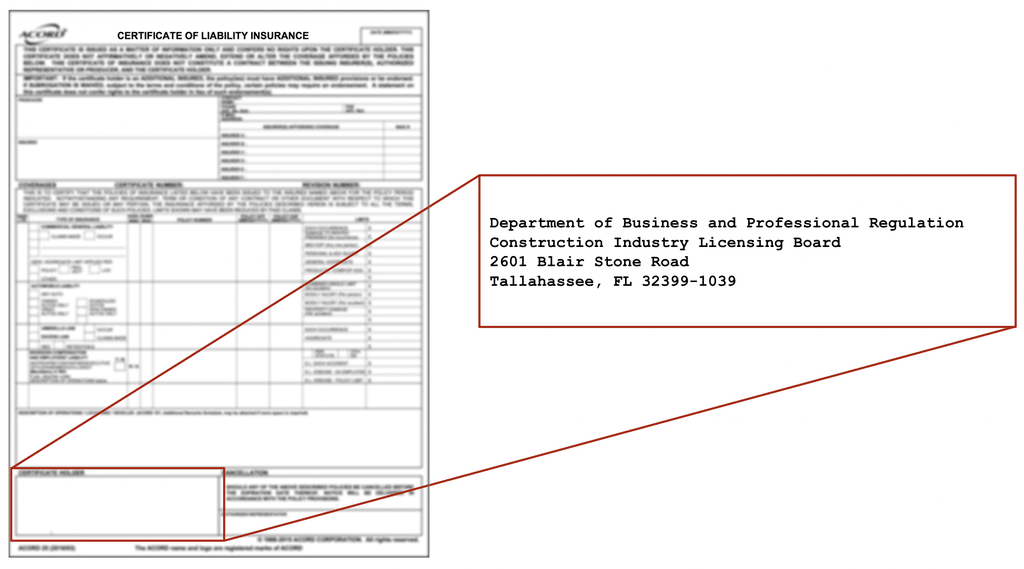
To ensure compliance, the contractor’s insurance agent must enter the recipient address in that box exactly as follows:
Department of Business and Professional Regulation
Construction Industry Licensing Board
2601 Blair Stone Road
Tallahassee, FL 32399-1039
Note: Electrical and alarm contractors must address their form to the Electrical Contractors’ Licensing Board (ECLB) using the same physical address.
Verifying the Certificate of Insurance
Before a contractor submits their license application or renewal, they should verify these three details to prevent compliance issues:
- Match business names: The Named Insured on the ACORD 25 certificate must identically match the corporate entity registered with the Florida Division of Corporations (Sunbiz).
- Verify policy limits against state minimums: The document must explicitly display active policy numbers, effective dates, and per-occurrence liability limits that meet or exceed the statutory floor for the specific DBPR license category.
- Complete the insurance affidavit: Florida’s DBPR requires applicants to complete a signed insurance affidavit attesting to coverage on their MyFloridaLicense portal application.
Other Required Florida Construction Insurance
Because general liability only covers third-party damage, it leaves a contractor’s employees, work trucks, and the unfinished building completely unprotected. To close these gaps, the Florida Division of Workers’ Compensation, state vehicle laws, and project lenders require construction businesses to carry several additional policies:
- Workers’ Compensation: While standard Florida businesses only need workers’ comp if they have four or more employees, the state enforces a strict “one or more” rule for the construction industry. Operating without it triggers unannounced site audits and immediate stop-work orders. Up to three business owners can file a state exemption (Form DWC-250) to keep themselves off the policy and lower the premium, but the business must still cover all other field laborers.
- Builders Risk: Usually required by project lenders or property owners, builders risk policies protect unfinished buildings and staged materials against fire, theft, and wind. In Florida, these policies typically carry steep percentage-based deductibles for hurricanes (often 2% to 5% of the total project value) and frequently deny claims for wind-driven rain unless the storm physically breached the roof or windows first.
- Commercial Auto & Truck: Standard personal auto policies almost always refuse to pay out if a vehicle is wrecked while hauling materials to a job site. A standard commercial auto policy covers the business’s everyday fleet of pickups and cargo vans. However, if a contractor operates heavy haulers, flatbeds, or dump trucks, they will need a dedicated commercial truck policy. Most contractors also add an endorsement for Hired and Non-Owned Auto (HNOA), which protects the company if an employee causes a severe accident while running a quick job site errand in their own personal car.
Frequently Asked Questions
Do I need insurance for a handyman business in Florida?
Florida does not issue a statewide handyman license, so there is no state-level insurance mandate to operate. However, Florida law restricts unlicensed handymen strictly to minor, non-structural tasks like interior painting or basic drywall patching. Even though the state doesn’t force a handyman to buy commercial liability insurance, operating without it is a massive financial risk. If a minor repair accidentally triggers a hidden pipe leak or an electrical fire, the handyman is personally on the hook for thousands of dollars in property damage, which will be paid directly out of their own pocket.
Can I activate my DBPR license without general liability insurance?
No. The Florida DBPR will not issue, activate, or renew a Certified or Registered contractor license without verified proof of general liability insurance. While insurance carriers are not legally required to notify the DBPR if a policy cancels, the DBPR monitors compliance through applicant affidavits and random audits. If a contractor is caught operating without the required liability insurance, they face administrative discipline—including fines, potential license suspension, and the loss of local permitting privileges.
Does general liability cover interior water damage if a hurricane hits while my site is exposed?
Under a standard Florida policy, usually no. Because of the state’s extreme weather, insurance carriers routinely attach an “open roof” exclusion to their policies. If an afternoon squall hits while the structure is opened up, the carrier will deny the interior water damage claim entirely. Contractors doing structural or exterior work have to specifically ask their broker for a Tarp Warranty (or Tarpaulin Endorsement), which keeps coverage active as long as the contractor can prove they tarped or secured the exposed area before the storm hit.
References & Additional Resources
- Florida Department of Business and Professional Regulation (DBPR). The primary state regulatory agency governing the Construction Industry Licensing Board and enforcing mandatory commercial liability insurance minimums for all certified and registered contractors in Florida.
- Florida Statutes Section 95.11(3)(c). The official Florida state law outlining the seven-year statute of repose for latent construction defect claims, dictating exactly how long builders remain legally liable for hidden property damage.
- Florida Division of Workers’ Compensation. The state agency within the Department of Financial Services responsible for enforcing statutory employer coverage mandates, auditing active job sites, and issuing corporate officer exemption certificates under Chapter 440 of the Florida Statutes.
- National Association of Insurance Commissioners (NAIC). The central regulatory support organization that compiles commercial casualty underwriting data, market share statistics, and financial solvency profiles for property and casualty insurers operating throughout Florida.
Related Guides
Contractor general liability insurance is a standard coverage that protects a business by paying for third-party injuries, property damage, and…
The Hartford, ERGO NEXT, and Hiscox are the best general liability insurance providers for contractors in 2026. Progressive, Thimble, and…
A standard $1M/$2M general liability policy for a small-to-mid-sized contractor typically costs between $750 and $2,500 annually. [cc_cta placement="hero" resolution="auto"…
Contractor general liability insurance covers financial losses resulting from third-party bodily injury, third-party property damage, advertising injury, and damages arising…

While state licensing boards may only require $50,000 to $100,000 in general liability coverage for contractors, most commercial construction contracts…

In California, any contractor performing work valued at $1,000 or more per project must hold an active license from the…
While general liability covers physical "occurrences" (accidents) and professional liability covers "wrongful acts" (errors), the distinction between the two has…

Based on our evaluation of coverage limits, replacement cost options, and claims processing speeds, the best contractors tools and equipment…
Commercial auto insurance requirements are governed by three distinct authorities: state DMVs require basic split limits for vehicle registration, the…
The best commercial auto insurance companies in 2026 are Progressive for newly licensed contractors, ERGO NEXT for specialty trades wanting…