
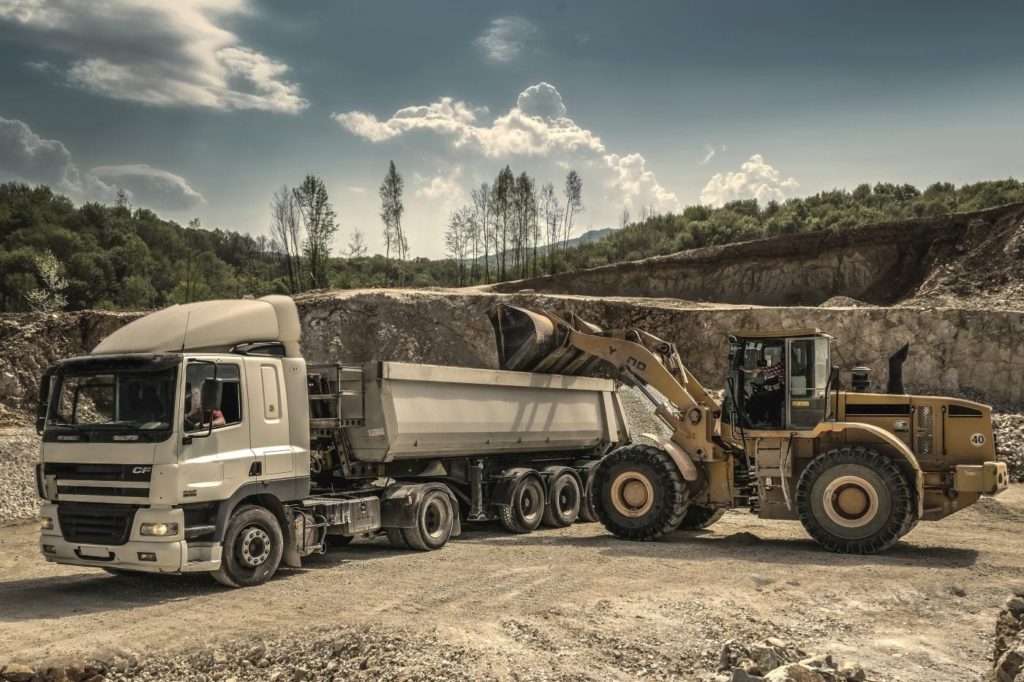


This guide is for construction businesses, heavy civil contractors, and material haulers operating heavy-duty vehicles (Class 7–8). This includes dump trucks, flatbeds, boom trucks, concrete mixers, and heavy-duty towing combinations. These policies are designed to cover heavy payloads, complex vehicle upfits, and specialized job-site operations.
This guide is not for logistics companies hauling consumer goods for hire, interstate freight motor carriers, or businesses operating standard light-duty pickups and cargo vans. If your business operates standard Class 1–6 passenger vehicles or vans for daily job-site commuting, see our guide to Best Commercial Auto Insurance.
The Best Commercial Truck Insurance Companies
| Company | Best For | AM Best Rating | Get a Quote |
|---|---|---|---|

Progressive
|
Top pick for small fleets; one of the largest selections of commercial truck policies with great quoting tools | A+ | |

The Hartford
|
High-risk drivers and large fleet management; top-ranked for customer satisfaction | A+ | |

Sentry
|
Best customer experience with highly customizable policies; 34-year streak of A+ financial ratings | A+ |
*We may earn a commission when you click through these links.
Selection Criteria: How We Ranked the Leading Carriers
We evaluate carriers using four core criteria: eligibility and appetite for heavy construction risks (Class 7–8), ability to manage state and federal (MCS-90) filings, claims handling for complex job-site accidents, and financial strength. Preference is given to insurers that understand the difference between hauling consumer freight and hauling construction materials, as well as those equipped to handle permanent vehicle modifications (upfits).
To see the complete methodology, see below.
Key Takeaways
- For newly formed LLCs and independent owner-operators: Standard insurers typically require three years of continuous coverage before writing Class 7–8 trucks. Progressive underwrites new ventures directly and handles the electronic MCS-90 filings required to cross state lines.
- For general contractors with mixed fleets: Standard auto liability is restricted to transit and does not cover job-site operations, such as a boom truck deploying outriggers to lift materials. Travelers bundles Commercial Auto with General Liability to prevent disputes over which policy applies when an accident occurs during operation.
- For specialized trades with modified trucks: Standard auto policies often value vehicles based on the original factory build, which excludes expensive aftermarket hydraulic additions. Nationwide uses Stated Amount valuation to ensure permanent upfits—like concrete pumps, welding rigs, and crane bodies—are included in the payout after a total loss.
- For heavy civil and machinery haulers: Transporting 80,000-pound excavators requires specific inland marine coverage. Great West Casualty focuses entirely on heavy transit to insure high-value machinery while it is loaded, chained, and in transit.
- For scaling firms bidding commercial jobs: Municipal and private contracts demand strict insurance documentation before allowing subcontractors on site. The Hartford automatically builds mandatory contract endorsements (such as Waiver of Subrogation) into their standard auto policies so contractors can generate compliant certificates without delays.
Related Resource: If you need a high-level overview of how these heavy-duty policies work, common regulatory mandates, and 2026 cost benchmarks before comparing quotes, see our comprehensive guide: What is Commercial Truck Insurance?
Related Truck Insurance Guides



Table of Contents
Commercial Truck Insurance Company Reviews
Progressive: Best for New Ventures & Independent Owner-Operators
Best For
Newly formed LLCs (under 2 years in business) and independent owner-operators purchasing their first heavy-duty truck.
Service Model
Direct online, independent agents, or brokers.
Financial strength
A+ (Superior) by AM Best
Key Advantage
Progressive will quote new construction businesses and heavy-duty vehicles (Class 7-8) that standard insurers automatically decline.
Primary Limitation
Because they accept unproven operators, baseline premiums for new accounts are usually higher to offset the lack of driving and insurance history.
Overview
Progressive is often the only starting point for a contractor who just bought their first heavy-duty truck. Standard fleet carriers typically require a business to have at least three years of continuous commercial insurance history to prove they run a stable, safe operation before they will even offer a quote. If an independent operator just bought a tri-axle dump truck, a hot-shot rig, or a concrete mixer, those standard carriers will refuse to cover them. Progressive fills this gap because their pricing models are built to insure new businesses, newly licensed CDL drivers, and owner-operators directly.
Progressive also simplifies the paperwork required to operate across state lines. When a commercial vehicle exceeds 26,000 lbs GVWR and crosses a state border, the federal government requires specific proof of liability insurance. Progressive’s system integrates directly with the Federal Motor Carrier Safety Administration (FMCSA) to file the mandatory MCS-90 endorsement electronically, keeping the truck legally compliant and preventing DOT roadside suspensions.
To help offset the higher baseline premiums for new ventures, Progressive offers telematics programs like Smart Haul. This program plugs into a truck’s Electronic Logging Device (ELD) to track actual driving habits like speed and braking. This allows a safe but unproven operator to lower their rates based on real-world data. Most contractors use Progressive for their first few years to build up a clean insurance history before moving their fleet to a standard carrier.
Travelers: Best for Mixed Construction Fleets

Best For
Mid-to-large general contractors operating a diverse mix of vehicle classes, from supervisor pickups to heavy mobile equipment.
Service Model
Independent agents and brokers.
Financial strength
A++ (Superior) by AM Best.
Key Advantage
Travelers covers vehicles that operate as machinery on a job site and allows contractors to bundle complex fleets with General Liability.
Primary Limitation
Strict eligibility. Travelers requires at least three years of continuous prior coverage, clean fleet safety records, and does not quote newly licensed independent truckers.
Overview
Travelers works well for the reality of an established general contractor. A growing GC rarely operates just one type of vehicle. A typical fleet might include five light-duty pickups for project managers, a medium-duty box truck for tools, a water truck for site prep, and two heavy boom trucks. Managing different insurance policies across multiple carriers for different vehicle weights is an administrative headache. Travelers has a broad enough underwriting appetite to cover that entire mixed fleet under a single policy, simplifying renewals and billing.
The main advantage Travelers offers is how they handle mobile equipment. There is a rigid legal line between a vehicle driving on a highway and a vehicle acting as machinery on a job site. If a water truck rear-ends a car on the highway, it is a Commercial Auto claim. If that same water truck is actively spraying down a job site for dust control and accidentally floods a neighboring property, it is a General Liability claim.
When an accident happens in that transition phase between driving and operating, having Auto and General Liability policies with two separate insurance companies often leads to disputes over which carrier has to pay, delaying the payout. By bundling both policies with Travelers, a GC avoids those inter-carrier disputes because one company handles the entire defense, regardless of how the truck was being used at the exact time of the incident.
Great West Casualty: Best for Heavy Machinery Haulers
Best For
Heavy civil contractors, structural steel haulers, and flatbed/lowboy operators transporting oversized machinery.
Service Model
Independent agents and select specialized brokers.
Financial strength
A+ (Superior) by AM Best.
Key Advantage
Deep expertise in heavy trucking claims involving the transport of oversized machinery like excavators and bulldozers.
Primary Limitation
They are a pure trucking and heavy transit carrier; they do not write standard contractor vehicles (like F-150s or passenger vans), meaning GCs with mixed fleets cannot place all their vehicles here.
Overview
Great West Casualty focuses entirely on heavy transit. If a construction business operates lowboys, step-decks, or heavy flatbeds to move 80,000-pound excavators, asphalt pavers, or structural steel between job sites, Great West is built for that specific exposure. Standard commercial auto insurers generally do not deal with the mechanics of heavy load securement, chain binder regulations, or overweight state permitting. Great West underwrites strictly for these heavy variables.
The financial risk of hauling heavy equipment is exceptionally high. If a standard box truck rolls over, the claim is relatively straightforward. If a lowboy trailer rolls over on a highway interchange, the claim involves the truck, the trailer, the expensive heavy machinery chained to the deck, and the environmental cleanup of spilled diesel and hydraulic fluid.
Great West’s Inland Marine coverages are tailored to ensure contractor-owned equipment is fully covered while loaded and in transit. Furthermore, their claims adjusters specialize in heavy trucking. They know exactly which heavy-duty rotator cranes to dispatch to right a flipped excavator and clear a highway quickly. This rapid, specialized response minimizes additional liability for the contractor and gets the highway reopened faster.
The Hartford: Best for Mid-to-Large GCs (Bundling)
Best For
Established general contractors looking to lower their overall insurance costs by bundling their heavy fleet with Workers’ Compensation.
Service Model
Independent agents and brokers.
Financial strength
A+ (Superior) by AM Best.
Key Advantage
Broad form endorsements that automatically include commonly required construction contract coverages like Waiver of Subrogation.
Primary Limitation
The Hartford focuses on total account underwriting; they are rarely competitive if a contractor is only looking for a standalone auto policy.
Overview
The Hartford targets larger commercial builders. When a contractor reaches 15 or 20 heavy vehicles, quoting each truck individually based on its specific weight and class becomes inefficient. The Hartford utilizes fleet rating, which evaluates the safety protocols, driver training programs, and historical accident rates of the entire company to price the policy as a whole. If a contractor pairs their commercial auto policy with The Hartford’s Workers’ Compensation program, the overall premium savings for the business are often substantial.
The Hartford also streamlines contract compliance, which directly impacts a contractor’s ability to get paid. When bidding on municipal projects or large commercial builds, project owners attach strict insurance requirements to the contract before a sub is allowed on site.
Contractors routinely have to provide a Certificate of Insurance (COI) that proves their insurance company will not sue the project owner for damages (Waiver of Subrogation) and that their policy will pay out first in the event of a shared claim (Primary and Non-Contributory wording). Buying these endorsements individually for every single job costs money and delays a contractor from getting on site and pulling their first draw. The Hartford automatically builds these endorsements into their construction auto forms so contractors can generate compliant COIs instantly.
Nationwide: Best for Heavily Upfitted Work Trucks

Best For
Skilled trade contractors (electrical, concrete, heavy utility) operating trucks with expensive, permanent chassis modifications.
Service Model
Independent agents and brokers.
Financial strength
A+ (Superior) by AM Best.
Key Advantage
Valuation methods that ensure expensive custom upfits (welding rigs, crane bodies, concrete pumps) are fully insured alongside the base truck chassis.
Primary Limitation
Strict underwriting standards for heavy dirt-hauling. They are more competitive for utility and service trucks than they are for tri-axle dump trucks.
Overview
Nationwide works well for contractors whose vehicles carry tens of thousands of dollars in built-in equipment. A bare Class 7 truck chassis might cost $65,000, but it is entirely useless to a trade contractor until it is modified. Once that chassis is upfitted with a PTO-driven hydraulic crane, reinforced service body, and integrated welding rig, the actual replacement cost of the working vehicle jumps well over $140,000.
This creates a massive coverage gap with standard insurers. Many standard commercial auto policies limit physical damage payouts to the “Actual Cash Value” of the original factory vehicle. That means if the truck is totaled in a rollover, the insurance company applies heavy depreciation to the chassis and largely ignores the value of the custom modifications. The resulting check will not be enough to replace the truck.
Nationwide is willing to insure heavy work trucks using “Stated Amount” valuation. This means the contractor and the insurer agree on the total value of the truck upfront, ensuring the policy covers the vehicle exactly as it operates in the field, including the cost of all permanent upfits. For trade contractors, this prevents severe out-of-pocket costs after a total loss.
National Indemnity Company (NICO): Best for High-Risk & Heavy Commercial

Best For
Demolition firms, high-hazard material haulers, and heavy fleets that have been dropped by standard carriers due to poor driving records or bad DOT safety scores.
Service Model
Wholesale brokers (Excess & Surplus lines).
Financial strength
A++ (Superior) by AM Best.
Key Advantage
NICO writes policies for heavy fleets with a history of frequent claims or severe driving violations that standard markets refuse to touch.
Primary Limitation
Premiums are exceedingly high. Policies are meant to be temporary “bridge” coverage until the business cleans up its driving record.
Overview
Commercial auto insurance is strict, especially for heavy trucks that cause massive damage in collisions. If a company experiences a cluster of at-fault accidents, employs drivers with severe violations (like speeding in work zones or DUIs), or generates poor out-of-service scores during DOT roadside inspections, standard insurers like Travelers or Progressive will issue a non-renewal notice and drop the coverage entirely.
National Indemnity Company (NICO) exists for this exact scenario. Operating in the Excess & Surplus insurance market, NICO is not bound by the same state regulations as standard carriers, allowing them to price and cover heavy risks that other companies reject.
While the premiums are intentionally high, NICO provides the mandatory auto liability limits and federal filings required to keep trucks legally on the road. This prevents a contractor from having to park their fleet, lay off their crews, and shut down operations. Typically, a business will stay with NICO for one or two years while they fire bad drivers, implement strict safety training, and rebuild a clean driving record. Once the bad violations fall off their DOT history, the contractor can reapply for standard insurance.
Sentry: Best for Safety Programs & Scaling Fleets
Best For
Mid-sized heavy fleets (10–50+ trucks) that want to use telematics and driver coaching to actively lower their long-term premiums.
Service Model
Direct to business and specialized independent agents.
Financial strength
A+ (Superior) by AM Best.
Key Advantage
Dedicated fleet safety consultants who work directly with contractors to analyze driving data and build formal corporate safety programs.
Primary Limitation
Not designed for small, 1-to-3 truck operations looking for a basic baseline premium.
Overview
When a construction business scales past 10 heavy vehicles, insurance costs transition from a basic overhead expense into a major line item that directly impacts project bidding margins. Sentry targets this growing fleet market by pairing insurance policies with active safety programs. Rather than just collecting a premium and waiting for a claim to happen, Sentry assigns dedicated safety consultants to help contractors identify bad driving habits and prevent accidents before they occur.
Sentry helps construction owners integrate fleet tracking devices and inward/outward-facing dashcams into their trucks. By analyzing that daily data—looking for hard-braking incidents, rapid acceleration, and speeding—Sentry helps management identify risky drivers and retrain them before they cause a wreck.
This creates a financial partnership rather than just a vendor relationship. For fleets that successfully use these programs to reduce their accident frequency, Sentry offers highly competitive renewals. They also offer loss-sensitive dividend programs, which means if the contractor keeps claims below a certain threshold, Sentry will actually refund a portion of the premium at the end of the policy year.
Acuity: Best for Regional Contractors and Custom Policies
Best For
Regional contractors, heavy trades, and family-owned construction firms (primarily in the Midwest and Western US) looking for localized claims handling.
Service Model
Independent agents.
Financial strength
A+ (Superior) by AM Best.
Key Advantage
Localized construction expertise and contractor-friendly claims adjustments.
Primary Limitation
Geographic restrictions. Acuity does not write nationwide, making them unviable for large GCs with projects spanning across the entire country.
Overview
Acuity focuses on regional construction markets rather than national scale. Unlike massive national carriers that route policyholders through centralized call centers during an emergency, Acuity uses regional claims adjusters. If a dump truck slides off an icy road in the Midwest, an Acuity adjuster actually understands the local job-site conditions, regional weather hazards, and knows the local heavy towing companies required to get the truck out.
Acuity’s commercial auto forms are also customized for the operational delays caused when a work truck goes down. When a heavy vehicle is damaged, the crew is sidelined, which jeopardizes project timelines and revenue. Acuity policies frequently include automatic extensions for temporary substitute vehicles, ensuring contractors can rent a replacement heavy truck immediately to keep the job site running while their vehicle is in the shop.
They also offer broad Hired & Non-Owned Auto coverage. This protects the business from liability if an employee causes a wreck while driving their personal pickup truck to grab emergency supplies or parts from a vendor during a job.
Top Commercial Truck Insurance Carrier Comparison
The table below compares the top commercial truck insurers based on their specific underwriting appetites, financial strength, and operational advantages. Because risk profiles vary heavily by trade, finding the right carrier requires matching a fleet’s specific vehicle classes, custom upfits, and contract requirements directly to the insurer’s capabilities.
| Carrier | Best For | Service Model | AM Best Rating | Primary Construction Advantage |
| Progressive | New Ventures & Owner-Operators | Direct, Agents, Brokers | A+ (Superior) | Immediate electronic FMCSA filings and willingness to underwrite zero-loss-history CDL drivers. |
| Travelers | Mixed Construction Fleets | Independent Agents & Brokers | A++ (Superior) | Eliminates job-site coverage gaps by bundling Commercial Auto and General Liability under one carrier. |
| Great West Casualty | Heavy Machinery Haulers | Specialized Agents & Brokers | A+ (Superior) | Specialized heavy-rotator claims response and tailored Inland Marine coverage for 80,000-lb equipment. |
| The Hartford | Mid-to-Large GCs (Bundling) | Independent Agents & Brokers | A+ (Superior) | Automatically builds broad form endorsements (like Waiver of Subrogation) into the base policy for instant COIs. |
| Nationwide | Heavily Upfitted Work Trucks | Independent Agents & Brokers | A+ (Superior) | Utilizes Stated Amount valuation to fully cover expensive, permanent hydraulic additions (cranes, pumps). |
| National Indemnity (NICO) | High-Risk & Heavy Commercial | Wholesale Brokers (E&S) | A++ (Superior) | Provides mandatory bridge coverage for heavy fleets with severe DOT violations or high claims frequency. |
| Sentry | Safety Programs & Scaling Fleets | Direct & Independent Agents | A+ (Superior) | Deploys active fleet safety consultants and offers loss-sensitive dividend programs for reduced accident rates. |
| Acuity | Regional Contractors & Custom Policies | Independent Agents | A+ (Superior) | Uses localized claims adjusters and provides automatic coverage extensions for temporary substitute heavy vehicles. |
Understanding Commercial Truck Insurance
Operating heavy construction vehicles requires different insurance than standard commercial autos. While a standard auto policy covers a vehicle driving from point A to point B, a commercial truck policy covers heavy payloads, specialized chassis modifications, and the legal transition that occurs when a truck parks and functions as job-site machinery.
For a complete dive into policy mechanics, read our overview guide: What is Commercial Truck Insurance?
What Does Commercial Truck Insurance Cover?
A commercial truck policy consists of liability limits, physical damage valuation, and cargo endorsements to protect the business.
| Coverage Type | What It Protects | Real-World Construction Application |
| Primary Auto Liability | Pays for third-party bodily injury and property damage caused by a company truck on public roads. | Covering the medical bills and vehicle replacement if a dump truck rear-ends a passenger car on the highway. |
| Physical Damage (Collision) | Pays to repair the truck chassis and permanently attached upfits after an at-fault accident or rollover. | Rebuilding a custom crane body or replacing a wrecked concrete mixer chassis after a rollover. |
| Physical Damage (Comprehensive) | Covers non-collision damage, including theft, vandalism, fire, and weather events. | Replacing a truck stolen from a job site overnight, or repairing glass shattered by falling job-site debris. |
| Hired & Non-Owned Auto (HNOA) | Covers liability for vehicles the business uses but doesn’t own. | Protecting the business if a GC rents a water truck for a week, or if an employee uses a personal heavy-duty pickup to haul company materials and causes a crash. |
| Inland Marine (Contractor’s Equipment) | Protects heavy machinery, tools, and materials while in transit or stored on the job site. | Reimbursing the business if a lowboy trailer flips, destroying the $250,000 excavator chained to the deck. |
Types of Construction Trucks Covered (Class 7 & 8)
Commercial truck insurance generally applies to medium- and heavy-duty vehicles (FHWA Class 7 and 8) exceeding 26,000 lbs, as well as specialized vehicle combinations. Insurance carriers categorize and price these vehicles differently based on their body type, upfits, and payload hazards:
- Heavy Material Haulers (Dump Trucks & Roll-Offs): These vehicles present high rollover risks due to high centers of gravity and shifting payloads (like aggregate, dirt, or demolition debris). Underwriters require specific commodity classifications (e.g., sand and gravel vs. hazardous waste) to price the physical damage and liability exposure accurately.
- Heavy Transit & Equipment (Flatbeds & Lowboys): Standard box trucks carry enclosed cargo, but flatbeds haul exposed, oversized, and ultra-heavy loads (like structural steel or 80,000-pound excavators). The insurance focus here is heavily weighted toward high-limit Inland Marine coverage to protect the value of the machinery chained to the trailer.
- Mobile Equipment (Boom, Bucket & Concrete Trucks): These vehicles feature expensive, permanently mounted PTO-driven hydraulics. These assets require Stated Amount valuation to cover the crane or pump body, rather than just the base chassis. They also carry the highest risk of job-site liability claims once outriggers are deployed.
- Heavy Towing Combinations (Hot Shots & Dump Trailers): A heavy-duty pickup (Class 3-4) is normally covered under standard commercial auto. However, when that pickup hitches to a heavy tandem-axle gooseneck or dump trailer, the Gross Combined Weight Rating (GCWR) often pushes past 26,000 lbs. This reclassifies the vehicle as a commercial truck subject to federal FMCSA filings.
For a complete breakdown of policy mechanics, read our Commercial Truck Insurance Coverage Guide.
What Does Commercial Truck Insurance NOT Cover? (Exclusions)
A common liability gap for a construction fleet occurs when a heavy truck stops driving and starts working.
Standard Commercial Auto policies cover vehicles in transit but exclude damages resulting from job-site operations. Once a vehicle is parked and utilized for its primary operational function, it is legally reclassified as mobile equipment, and coverage transitions to the Commercial General Liability (GL) policy.
Example: If a contractor is delivering a roll-off dumpster and the driver misjudges the reverse angle, backing the truck’s bumper into the client’s retaining wall, that is a Commercial Auto Liability claim. However, if the driver parks the truck, lowers the bin, and the weight of the dumpster cracks the concrete driveway during the unloading process, the Auto policy will deny the claim. That damage falls under Completed Operations, and the General Liability policy must pay for it.
Similarly, a boom truck or bucket truck is covered by an Auto policy while driving down the highway. When the operator deploys the hydraulic outriggers on a job site to lift materials, standard auto liability stops. If the boom drops a pallet of roofing shingles onto a parked car, it is a General Liability claim. Understanding this boundary is why bundling Auto and GL with a single carrier is standard practice for mixed fleets.
To better understand the boundaries between what is and is not covered, read our breakdown of Commercial Truck Insurance Exclusions.
Standard Coverage Requirements (DOT & FMCSA)
State DMVs determine the minimum liability limits required to register a vehicle, but heavy construction trucks are heavily regulated by federal law. Private construction contracts typically demand a $1,000,000 Combined Single Limit (CSL) before allowing trucks onto a job site. However, the federal government requires specific filings based on the weight of the vehicles in operation.
Federal Weight Thresholds: Local contractors often assume federal trucking laws only apply to long-haul freight carriers. However, under Federal Motor Carrier Safety Administration (FMCSA) regulations, any vehicle operating in interstate commerce weighing over 10,000 lbs requires a USDOT number.
When a single vehicle—or vehicle combination—reaches a Gross Combined Weight Rating (GCWR) of 26,001 pounds or more and crosses state lines, the insurance requirements escalate. For example, if a landscaper in an F-350 (14,000 lbs) tows a skid-steer on a heavy tandem-axle trailer (14,000 lbs), the combined weight is 28,000 lbs. If they cross a state line to perform a job, they must file an MCS-90 Endorsement with their insurance carrier. The MCS-90 guarantees the insurance company will pay a minimum of $750,000 for public liability, environmental restoration, and bodily injury in the event of an accident. Hauling hazardous materials (like certain site-prep chemicals or bulk fuel) pushes that federal requirement to $1,000,000 or $5,000,000.
Learn more about federal vs. state compliance in our Commercial Truck Insurance Requirements Guide.
How Much Does Commercial Truck Insurance Cost?
Insuring Class 7 and Class 8 construction vehicles is a large operational expense. Because of their sheer mass, heavy trucks cause severe damage in an accident, leading to higher baseline premiums than standard commercial auto policies.
For an established contractor with a clean driving record operating in a moderate-cost state, annual benchmarks per truck generally fall into these ranges:
| Vehicle Classification | Estimated Cost Range (Annually per Truck) |
| Medium-Duty Box Trucks (Class 4–6) | $2,500 – $4,500 |
| Heavy-Duty Dump Trucks (Class 7–8) | $5,000 – $9,000+ |
| Concrete Mixers & Pump Trucks | $6,000 – $10,000+ |
| Tractor-Trailers (Lowboys / Flatbeds) | $8,000 – $14,000+ |
Primary Cost Factors:
- Operating Radius: A local dirt hauler staying within a 50-mile radius pays less than a regional equipment hauler crossing multiple state lines.
- Driving & Claims History: Carriers review three to five years of commercial driving records and past claims. A single at-fault accident or a driver with a recent DUI can double premiums or trigger a non-renewal.
- Cargo & Operations: Hauling hazardous materials, oversized loads, or operating in heavily congested urban centers increases liability exposure and premium costs.
See exact benchmarks by vehicle type and trade in our Commercial Truck Insurance Cost Guide.
Buyer’s Guide: How to Choose the Ideal Commercial Truck Policy
Selecting a carrier for heavy construction vehicles requires matching a company’s operational footprint with an insurer’s underwriting appetite. Choosing a carrier with the wrong capabilities can leave a contractor underinsured or unable to secure the DOT authority required to keep trucks on the road.
Vehicle Weight Class (GVWR) Limits
Commercial auto policies are strictly segmented by vehicle weight. Many standard-market insurers cap their underwriting appetite at 26,000 lbs Gross Vehicle Weight Rating (GVWR)—the exact threshold where commercial driver’s licenses (CDLs) and heavy trucking regulations apply.
If a contractor attempts to insure a 60,000-lb tri-axle dump truck or a concrete mixer on a light-duty auto policy, the application may initially pass through an automated system. However, when the carrier conducts a routine underwriting audit and discovers the true weight class, they will issue a mid-term cancellation. This forces the contractor to immediately source a heavy-specialty carrier to prevent a lapse in coverage that would ground the fleet.
Valuation of Upfits and Modifications
Heavy construction trucks rarely roll off the assembly line ready to work. They typically consist of a standard factory chassis paired with a specialized aftermarket upfit, such as a concrete pump, crane, or heavy-duty dump body. When buying a policy, contractors must understand exactly how the insurer values these modifications, as it dictates the final payout if the truck is totaled.
Standard commercial auto policies default to Actual Cash Value (ACV) for physical damage claims. Under ACV, the insurer calculates the current replacement cost of the vehicle and subtracts depreciation based on age, wear, and mileage. The primary risk for contractors is that standard ACV calculations often apply strictly to the factory chassis. If the permanent hydraulic upfit is not explicitly scheduled, the insurer will exclude it from the claim entirely.
To protect the full investment, buyers must verify the carrier offers Stated Amount or Agreed Value coverage. These valuation methods require the contractor to provide documentation (such as purchase invoices or equipment appraisals) to establish the total combined value of the chassis and the attached equipment before the policy is bound.
Example: A contractor might buy a bare Class 8 truck chassis for $120,000 and add a $150,000 custom concrete pump. If the vehicle rolls over and is a total loss, a standard ACV policy will only pay the depreciated value of the bare chassis, leaving the contractor to absorb the loss of the pump. A Stated Amount policy ensures the carrier bases the claim payout on the full $270,000 value of the completed working unit.
Interstate Authority and Electronic Filings
When a commercial vehicle exceeds 10,000 lbs and crosses state lines, the Federal Motor Carrier Safety Administration (FMCSA) requires the insurance carrier to guarantee public liability coverage. For vehicles over 26,000 lbs or those hauling hazardous materials, this requires filing an MCS-90 endorsement and BMC-91X forms directly with the federal government.
Contractors must select an insurance carrier with the infrastructure to process these filings electronically. Carriers deeply integrated with the FMCSA can submit proof of coverage instantly. If a contractor chooses a carrier that relies on manual paper filings, administrative delays frequently result in the DOT suspending the company’s operating authority. A suspended DOT number means the trucks cannot legally leave the yard until the paperwork clears the federal system.
Contract Compliance and Endorsements
Commercial project owners and large general contractors dictate the insurance terms subcontractors must carry before stepping onto a job site. These contracts routinely demand specific policy modifications, such as Additional Insured status, Waivers of Subrogation (WOS), and Primary and Non-Contributory (PNC) wording.
Buyers must evaluate how a trucking insurance carrier prices and applies these endorsements. Standard carriers often require the contractor to request and pay for these endorsements individually for every new contract, which slows down the onboarding process and increases administrative overhead. Carriers specializing in construction fleets typically offer these coverages on a “blanket” basis. A blanket endorsement automatically applies the required coverage to any entity that requests it in a written contract, allowing the contractor to generate instant Certificates of Insurance (COIs) and start work without waiting for underwriter approval.
Heavy Claims and Recovery Infrastructure
Standard auto insurance carriers rely on standard towing networks. If a superintendent’s F-150 breaks down, a standard flatbed tow truck can resolve the issue. If a rolled-over, fully loaded dump truck or a lowboy hauling an excavator blocks a highway, standard towing networks are useless.
Heavy truck accidents require specialized recovery infrastructure. Clearing a Class 8 wreck often involves dispatching 50-ton rotator cranes to right the vehicle, coordinating with local hazmat teams for spilled diesel and hydraulic fluid, and utilizing heavy-duty wreckers to transport the chassis. Contractors need an insurer with a dedicated heavy-equipment claims department and established vendor networks. Without this, the contractor is left coordinating the recovery themselves while highway authorities accumulate hourly closure fines against the business.
Driver Eligibility and MVR Tolerance
An insurance carrier’s willingness to cover specific drivers directly dictates a contractor’s ability to hire and expand. Every commercial auto carrier maintains a set of underwriting guidelines regarding acceptable Motor Vehicle Records (MVRs).
Standard insurers maintain rigid driver requirements, typically demanding three to five years of completely clean driving history and refusing to cover drivers with less than two years of active CDL experience. If a contractor operates in a tight labor market and needs to hire newly licensed CDL drivers or drivers with minor infractions, they must purchase a policy from a carrier with higher MVR tolerance. Attempting to hide a high-risk driver on a strict policy will result in the carrier excluding that driver from coverage or non-renewing the entire fleet policy at the end of the term.
Frequently Asked Questions
What is trucker insurance?
Trucking insurance (formally known as commercial truck insurance) refers to a specialized suite of coverages used by trucking businesses, independent drivers, or companies that use trucks for heavy-duty haulage or for-hire services. It provides financial and legal protection from bodily injury and property damage in the event of an accident. It also provides coverage for specialized cargo (typically through inland marine policies) and trucking equipment from damage and theft.
What insurance do I need for a truck business?
By law, commercial trucks are required to hold a minimum amount of liability coverage based on the vehicle’s weight rating and the type of cargo being transported. This primary liability insurance covers bodily injury and property damage done to others as a result of an accident. Additionally, motor carriers transporting household goods are legally required to hold cargo insurance, which insures the freight that a trucker transports from one place to another. While not required by federal law for other types of freight, cargo insurance is almost always required by contract to secure loads from brokers and shippers. In addition to the insurance that is legally required, truck businesses also benefit from having physical damage, medical payments, general liability, non-trucking liability, and trailer interchange coverage.
How can I lower the cost of commercial truck insurance?
As a result of the size of the vehicles being driven and the value of the cargo being transported, truck insurance tends to be expensive. Fortunately, there are a few things you can do to lower the cost of your insurance. The single best strategy for keeping your insurance costs low is to maintain a safe driving history, avoiding accidents and moving violations. The next best option is to shop around and take advantage of all available discounts offered by the insurance carriers. For example, some insurers provide steep multi-line discounts for customers that maintain multiple policies with them. Additionally, insurers like Progressive offer “paid-in-full” discounts of 13% or more for customers that pay their premium in full each coverage period, rather than paying in monthly installments. Another effective way to save is by enrolling in telematics programs, such as Progressive’s Smart Haul, which rewards safe driving data from electronic logging devices (ELDs) with significant premium reductions. Finally, you can lower your premiums by adjusting your coverage limits and deductibles. Lower coverage limits and higher deductibles will lower the total cost of your insurance, but you might end up paying more out of pocket in the event of a claim.
Do I need Motor Truck Cargo insurance if I only haul my own heavy equipment?
No. Motor Truck Cargo insurance is explicitly designed for for-hire truckers and logistics companies hauling goods owned by third parties. Contractors hauling their own excavators, tools, or lumber instead require an Inland Marine (Contractor’s Equipment) endorsement.
Does my commercial truck policy cover my boom truck while it is lifting materials?
Typically, no. Once a vehicle deploys outriggers or begins operating strictly as machinery on a job site, it is legally classified as “mobile equipment.” Liability arising from its operation in this state is excluded from standard auto policies and must be covered by a Commercial General Liability policy.
What is an MCS-90 endorsement?
The MCS-90 is a federal endorsement attached to a commercial truck policy, required by the FMCSA for vehicles over 26,000 lbs operating across state lines (or vehicles of any size hauling hazardous materials). It acts as a financial guarantee to the public, ensuring that the insurance company will pay for damages or environmental restoration caused by the truck in an accident, even if the insured violated policy conditions.
Can I bundle heavy commercial truck insurance with my other business policies?
Yes. Mature construction fleets often bundle their heavy commercial auto with their Workers’ Compensation, General Liability, and Inland Marine policies. Carriers like Travelers and The Hartford utilize “fleet rating” methodologies that heavily discount the commercial auto premium when the entire account is consolidated under one insurer.
References & Additional Resources
- AM Best. A global credit rating agency specializing in the insurance industry, providing Financial Strength Ratings (FSR) that assess insurers’ financial stability and claims-paying ability.
- J.D. Power. A consumer research and data analytics firm that publishes the U.S. Small Commercial Insurance Study, measuring customer satisfaction, service quality, and claims performance.
- Federal Motor Carrier Safety Administration (FMCSA). A U.S. Department of Transportation agency that regulates interstate commercial motor carriers, enforcing the 26,001 lb GCWR threshold and MCS-90 requirements.
- Federal Highway Administration (FHWA). Establishes vehicle classification definitions (Class 1–8), used to define medium to heavy-duty commercial truck categories.
Detailed Methodology: How We Evaluate Commercial Truck Insurance Carriers
Detailed Methodology
We evaluate carriers using four core criteria: eligibility and appetite for construction risks, servicing speed and documentation support, customer service and claims handling, and financial strength.
1. Servicing Speed and Documentation Support
Commercial auto insurance requires ongoing updates. Construction businesses frequently need:
- Proof of insurance for job sites
- Driver additions or removals
- Vehicle changes
- Endorsements to meet contract requirements
We evaluate how efficiently a carrier issues documentation and processes policy changes. Delays or errors in servicing can prevent contractors from starting work, accessing job sites, or receiving payment. Insurers with streamlined servicing platforms and responsive support score higher in this category.
2. Customer Service and Claims Handling
Price is only one part of value. How a carrier handles claims and supports policyholders during disputes matters more over time. We review:
- Overall customer service experience
- Claims reporting process and responsiveness
- Complaint trends
Commercial auto claims often involve bodily injury or third-party property damage. Carriers must be able to manage complex liability exposures efficiently and professionally.
3. Financial Strength
Commercial auto losses can take years to resolve, particularly when litigation is involved. We limit recommendations to insurers with an AM Best Financial Strength Rating of A (Excellent) or higher. Financial stability ensures that the carrier has the capital reserves necessary to defend long-tail claims and pay judgments tied to past policies.
A policy’s value ultimately depends on the strength of the company behind it.
4. Eligibility and Appetite for Construction Risks
Not all insurers actively write construction businesses. Some limit certain trades. Others restrict towing exposure, upfitted vehicles, new ventures, or multi-driver fleets. We assess:
- Whether the carrier consistently insures construction and service trades
- Willingness to write newer businesses
- Fleet eligibility thresholds
- Tolerance for common contractor exposures such as trailers, ladder racks, lift gates, and heavier pickups
Carriers that regularly write construction risks—rather than treating them as exceptions—score higher in this category.
No carrier is universally best. Some are well suited for small light-duty fleets. Others are better equipped for larger operations or more complex exposures. Our reviews reflect how each insurer performs across these four criteria and which types of construction businesses are most likely to benefit from their strengths.
Related Guides
Commercial auto insurance is a policy designed to cover liability and physical damage for vehicles used in business operations. [cc_button…
The best commercial auto insurance companies in 2026 are Progressive for newly licensed contractors, ERGO NEXT for specialty trades wanting…
In 2026, commercial auto insurance for a light-duty vehicle typically costs $250 to $400 per month. Because pricing is not…
Commercial auto insurance requirements are governed by three distinct authorities: state DMVs require basic split limits for vehicle registration, the…
Commercial auto insurance covers the vehicles owned or used by your business. It protects the company from liability claims if…
The main difference between commercial vs. personal auto insurance is intent: personal policies cover daily commuting, while commercial policies cover…

Based on our evaluation of coverage limits, replacement cost options, and claims processing speeds, the best contractors tools and equipment…

The Hartford, ERGO NEXT, and Hiscox are the best general liability insurance providers for contractors in 2026. Progressive, Thimble, and…
The best builders risk insurance companies for 2026 are Nationwide for general contractors, State Farm for homeowners and owner-builders, and…