
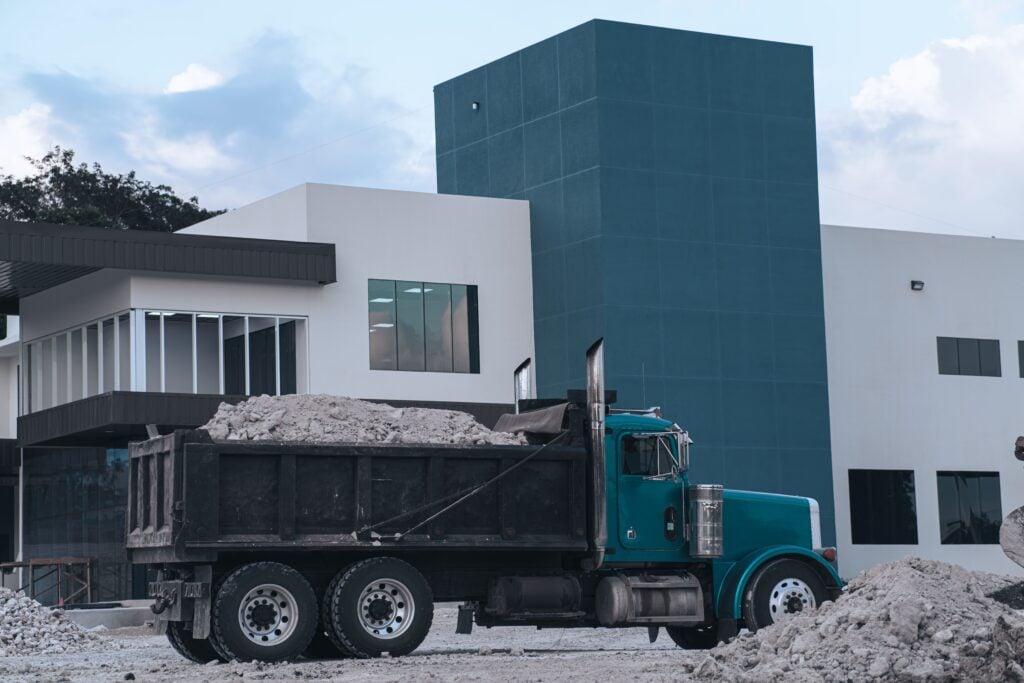


Once a work truck or truck-and-trailer combination crosses specific statutory weight thresholds, regulatory oversight shifts from the local DMV to the Federal Motor Carrier Safety Administration (FMCSA) and state transportation agencies. For construction businesses, getting this wrong isn’t just a paperwork problem. The penalties include immediate out-of-service orders, grounded fleets, and full balance-sheet exposure when a liability claim hits a policy that wasn’t structured for the vehicle’s actual classification.
This guide is for construction business owners, trade contractors, and fleet managers who are adding heavy utility trucks, dump trucks, or equipment-hauling trailers to their operations. It covers the precise financial and regulatory obligations required to maintain active fleet compliance across state lines and on strictly managed commercial job sites.
Key Takeaways
- Vehicle weight determines federal obligations: Reaching 10,001 pounds in GVWR or Gross Combination Weight Rating (GCWR) triggers commercial motor vehicle classification, a mandatory USDOT number, and federal safety equipment requirements. Crossing 26,001 pounds mandates a commercial driver’s license (CDL) and enrollment in the FMCSA Drug & Alcohol Clearinghouse.
- Hauling company-owned tools provides specific filing exemptions: Trade contractors transporting their own materials and machinery across state lines are exempt from the federal public liability filings mandated for for-hire freight haulers, though they must still adhere to federal safety inspection rules.
- Contractual requirements exceed federal minimums: The FMCSA sets a $750,000 combined single limit (CSL) floor for standard interstate freight haulers, but commercial project owners and general contractors routinely enforce a $1,000,000 CSL and require excess liability coverage before permitting heavy vehicles on site.
- State rules vary widely and add another compliance layer: Intrastate weight triggers, Form E filings, and minimum liability requirements differ by state. Fleets crossing state lines must verify obligations in every jurisdiction where they operate, rather than relying strictly on federal standards.
Table of Contents
Related Truck Insurance Guides


Federal Truck Insurance Requirements (FMCSA)
Federal truck insurance requirements apply to commercial motor vehicles that transport hazardous materials or operate as for-hire carriers in interstate commerce. The FMCSA establishes these financial responsibility baselines under Title 49 of the Code of Federal Regulations (CFR) to ensure regulated carriers maintain sufficient liability coverage. Private motor carriers—construction contractors hauling their own non-hazardous tools, equipment, or materials across state lines—are generally exempt from these federal insurance minimums.
That said, contractors frequently misjudge their federal status. Crossing state lines in a vehicle (or vehicle-and-trailer combination) with a GVWR or GCWR of 10,001 pounds or more means operating in interstate commerce, which triggers other federal safety requirements like the USDOT number, even if the insurance filing minimums don’t apply.
Determining an operation’s exact regulatory tier requires tracking actual Gross Vehicle Weight (GVW) and Gross Combination Weight (GCW) alongside the manufacturer’s GVWR and GCWR, because federal regulations apply to whichever weight is greater. Federal oversight scales up in two distinct jumps: the 10,001-pound safety threshold and the 26,001-pound heavy vehicle tier. Misreading these triggers exposes a fleet to immediate out-of-service orders and severe liability gaps during commercial transit.
Commercial Truck Regulatory & Insurance Requirements
A quick reference of regulatory and insurance requirements as a commercial fleet vehicle’s weight increases.
Under 10,001 lbs
Light DutyRegulatory & Insurance Impact:
- Typically falls under standard state motor vehicle liability rules.
- Often sufficiently covered by a standard commercial auto or business auto policy.
- A USDOT number is generally not expected or required for interstate travel at this weight tier.
10,001 to 26,000 lbs
Medium DutyRegulatory & Insurance Impact:
- A USDOT number is commonly required when operating across state lines (interstate commerce).
- Driver qualification files and active medical physical cards are routinely expected.
- Often subject to strict federal cargo securement standards and documented daily vehicle inspections.
- A $750,000 FMCSA liability minimum frequently applies if hauling materials for-hire.
26,001+ lbs
Heavy DutyRegulatory & Insurance Impact:
- A Commercial Driver’s License (CDL) is generally necessary for operators.
- Often triggers mandatory FMCSA Drug and Alcohol Clearinghouse registration and testing programs.
- May necessitate filing the Federal Heavy Highway Vehicle Use Tax (Form 2290) for vehicles scaling at 55,000+ lbs.
- Apportioned registration (IRP) and ongoing fuel tax reporting (IFTA) are frequently expected.
Private Carrier Exemption
Contractors hauling their own tools, equipment, and materials across state lines typically operate as Private Motor Carriers. This classification can exempt businesses from specific federal public liability filings, though USDOT numbers and regular safety inspections are still commonly expected.
The Contractual Reality
While federal minimums commonly establish a $750,000 Combined Single Limit (CSL) floor, General Contractors and commercial project owners routinely mandate a $1,000,000 CSL plus an Excess Liability layer before permitting heavy trucks and equipment delivery vehicles on site.
This document provides general educational information, not insurance or legal advice. Construction Coverage is not a licensed insurance agency, agent, or broker. Confirm your specific requirements with a licensed insurance agent.
USDOT Number Requirements (10,001+ lbs GVWR)
A GVWR or GCWR of 10,001 pounds or more establishes a vehicle as a commercial motor vehicle under 49 CFR Part 390 when operated across state lines. At that threshold, the operation must register for a USDOT number and maintain the following standards:
- Vehicle Identification: Display the USDOT number on both sides of the power unit in high-contrast lettering legible from 50 feet.
- Safety Equipment: Carry a fire extinguisher with a UL rating of 5 B:C or higher and three bidirectional emergency reflective triangles.
- Documentation: Keep systematic maintenance records and file vehicle condition reports whenever safety defects are discovered.
- Cargo Securement: Meet federal working load limit standards under 49 CFR Part 393 for all transported materials.
Once a USDOT number is active, federal insurance obligations depend on what the vehicle hauls. Trade contractors transporting company-owned equipment and materials to their own job sites operate as private motor carriers. For example, a mechanical contractor hauling copper pipe, ductwork, and gang boxes on an interstate utility truck to complete a plumbing contract is a private motor carrier.
Operating as a private carrier still requires maintaining driver qualification files and adhering to federal vehicle safety inspections, but it exempts the business from federal financial responsibility filings (including the $750,000 public liability minimum under 49 CFR Part 387).
Hauling for external parties eliminates this exemption. If that same contractor uses their truck to haul excavated soil or deliver structural fill for an outside party in exchange for compensation, the operation becomes for-hire carriage. That shift requires federal operating authority in the form of a Motor Carrier (MC) number, designation of a legal process agent via Form BOC-3, and direct insurance company evidence proving compliance with statutory public liability minimums.
CDL & Highway Tax Requirements (26,001+ lbs GCWR)
Crossing the 26,001-pound threshold triggers a significant escalation in regulatory oversight. Operations at this weight tier must manage four distinct compliance categories:
- Commercial Driver’s License (CDL): Under 49 CFR Part 383, any operator driving a single vehicle with a GVWR of 26,001 pounds or more must hold a valid CDL. When towing equipment, if the combined weight rating exceeds 26,000 pounds and the trailer alone has a GVWR over 10,000 pounds, the driver requires a Class A CDL.
- Medical Certifications: While the CDL mandate triggers at 26,001 pounds, any driver operating a vehicle over 10,000 pounds must maintain an active medical certification from the National Registry of Certified Medical Examiners. CDL holders submit this electronically to the federal CDLIS database rather than carrying a physical paper card.
- Drug & Alcohol Clearinghouse: Fleet operators must enroll in this FMCSA database before putting drivers on the road. The business is legally required to run pre-employment queries, conduct annual driver audits, and establish a formal DOT-compliant random testing program managed internally or through a consortium.
- Federal Highway Use Tax: Vehicles with a taxable gross weight of 55,000 pounds or more must file IRS Form 2290. State agencies will not renew commercial registration without a stamped Schedule 1, making this an absolute requirement for heavy civil contractors operating dump configurations and lowboys.
Minimum Federal Liability Limits
Federal regulations establish hard insurance floors for interstate commercial transportation, and they require these minimums to be structured as a Combined Single Limit (CSL). Unlike personal auto policies that split coverage caps between bodily injury and property damage, a CSL pools all third-party liabilities into a single dollar amount per occurrence.
The FMCSA establishes three tiered insurance floors based on this CSL structure:
- $750,000 CSL: Required for for-hire motor carriers transporting non-hazardous property and general freight in interstate commerce using vehicles with a GVWR of 10,001 pounds or greater.
- $1,000,000 CSL: Required for for-hire and private carriers transporting oil listed in 49 CFR 172.101, hazardous waste, hazardous materials, or hazardous substances defined in 49 CFR 171.8, where the $5,000,000 threshold does not apply.
- $5,000,000 CSL: Required for for-hire and private carriers transporting bulk hazardous substances in cargo tanks, portable tanks, or hopper-type vehicles exceeding 3,500 water gallons; bulk Division 2.1 or 2.2 gases; Division 2.3 or 6.1 Hazard Zone A materials; Division 1.1, 1.2, or 1.3 explosives; or highway route-controlled quantities of radioactive materials.
These are absolute regulatory baselines, not practical commercial limits. Operating with only the bare legal minimum exposes a contracting company to severe financial disruption if a multi-vehicle highway collision generates claims that exceed those thresholds.
Federal Insurance Filings (MCS-90 & BMC-91)
The federal government requires direct verification from the underwriting insurance company that coverage is active. To satisfy this, the insurer submits an electronic BMC-91 or BMC-91X filing directly to the FMCSA licensing and insurance portal. A motor carrier cannot obtain or maintain active interstate operating authority until the federal database processes this certification.
Alongside the BMC-91, carriers must navigate the MCS-90 endorsement. Issued under the Motor Carrier Act of 1980, the MCS-90 is a financial surety guarantee attached to a commercial auto liability policy, not an expansion of coverage. It ensures third parties receive compensation for bodily injury, property damage, or environmental restoration caused by a commercial motor vehicle.
If an incident involves an unlisted vehicle, an excluded driver, or an unendorsed pollution spill, the insurance company must pay the final judgment to the injured party up to the statutory limit—even if the underlying policy explicitly excludes the claim.
Once the insurer satisfies that public claim, the endorsement grants them a legal right of reimbursement against the motor carrier. The insurer will initiate action to recover the indemnity funds directly from the contractor’s assets. Because the MCS-90 does not govern defense obligations, this reimbursement applies to the settlement amount, not the legal defense costs. Maintaining a perfectly accurate policy schedule with designated vehicles, compliant drivers, and appropriate pollution endorsements is the only way to avoid direct financial exposure under these federal filings.
State-Level Truck Insurance Requirements (Intrastate)
Staying within state lines doesn’t exempt a heavy truck from serious regulatory oversight. State agencies—including the California DMV, the Texas Department of Motor Vehicles (TxDMV), and the New York State Department of Transportation (NYSDOT)—enforce their own safety frameworks and commercial insurance mandates. While many states adopt Title 49 CFR safety standards through federal safety grants, their registration triggers, vehicle classifications, and minimum liability thresholds vary considerably from one jurisdiction to the next.
The table below outlines the intrastate commercial vehicle weight thresholds and filing requirements across several high-volume construction markets:
Commercial Truck Insurance Requirements by State (Data)
| State | Governing Agency | Intrastate Trigger | Required Filing | Minimum Liability | State-Specific Notes |
|---|---|---|---|---|---|
| Alabama | Alabama Public Service Commission (APSC) | For-hire commercial vehicles | Form E | $300,000 (< 10,001 lbs) $750,000 (≥ 10,001 lbs) | APSC requires an active Form E to maintain for-hire operating authority, and lapses result in immediate revocation. |
| Alaska | Alaska DOT&PF | Commercial vehicles > 10,000 lbs | Form E | $500k BI / $200k PD (General Freight) $1,000,000 (Heavy Equipment) | Alaska splits Bodily Injury and Property Damage for intrastate freight, though most commercial carriers simply fulfill this with a standard $750,000 Combined Single Limit (CSL) policy. |
| Arizona | Arizona DOT (ADOT) | Commercial vehicles > 10,000 lbs | COI / Form E | $750,000 CSL (General Freight) | While light intrastate vehicles not hauling hazmat can theoretically carry lower state auto limits, anything over 10,000 lbs generally defaults to the federal standard to pass broker and contract requirements. |
| Arkansas | Arkansas DOT (ARDOT) | Intrastate for-hire carriage | Form E & Form H | $50k/$100k/$30k (Light vehicles) $750,000 CSL (Heavy trucks) | Uniquely, ARDOT requires intrastate Common Carriers of property to file a Form H proving a minimum of $5,000 in cargo insurance. |
| California | California DMV | ≥ 10,001 lbs, OR 3+ axles, OR hazmat | DMV 65 MCP | $300,000 (< 10,001 lbs) $750,000 (≥ 10,001 lbs) $1M – $5M (Hazmat) | California does not use the national Form E. Insurers must submit the state-specific DMV 65 MCP certificate directly to the DMV to maintain an active Motor Carrier Permit. |
| Colorado | Colorado Public Utilities Commission (PUC) | > 10,000 lbs | Form E (Online) | $750,000 CSL (General Freight) $1M – $5M (Hazmat) | Colorado adopts federal FMCSA standards for intrastate freight. The PUC requires insurers to file Form E electronically, and a lapse results in an immediate suspension of operating authority. |
| Connecticut | Connecticut DMV | ≥ 18,001 lbs | State Reporting | $750,000 CSL (Heavy Trucks) $1.5M (9-15 Passengers) | Connecticut uses a unique weight threshold. A vehicle operating strictly intrastate is only required to report commercial insurance to the DMV if its GVWR is 18,001 lbs or higher (unlike the 10,001 lb interstate rule). |
| Delaware | Delaware DMV / Motor Carrier Services | > 26,000 lbs | Form E | $750,000 CSL (Heavy Trucks) $1M – $5M (Hazmat) | Delaware excludes purely intrastate vehicles weighing 26,000 lbs or less from strict federal financial responsibility limits, unless they are transporting placarded hazardous materials or 16+ passengers. |
| Florida | Florida Highway Safety and Motor Vehicles (FLHSMV) | ≥ 26,001 lbs | Form E / State COI | $50,000 CSL (26,000–34,999 lbs) $100,000 CSL (35,000–43,999 lbs) $300,000 CSL (≥ 44,000 lbs) | Florida regulates intrastate insurance minimums based on progressive vehicle weight brackets. While these state limits are notably low, most commercial freight contracts still require operators to hold a $750,000 policy. |
| Georgia | Georgia Department of Public Safety (DPS) | > 10,000 lbs | Form E | $100,000 / $300,000 BI (Intrastate minimum) | Georgia law mandates that intrastate box trucks and commercial vehicles over 10,000 lbs carry at least $100k per person / $300k per accident in bodily injury. However, vehicles crossing state lines jump back to the federal $750,000 requirement. |
| Hawaii | Hawaii Public Utilities Commission (PUC) | For-hire commercial vehicles | PUC Form E | $250k / $750k BI + $250k PD | Hawaii enforces strict split limits for intrastate property carriers rather than a Combined Single Limit (CSL). They also require an additional $10,000 Personal Injury Protection (PIP) policy per vehicle. |
| Idaho | Idaho Transportation Department (ITD) / PUC | > 10,000 lbs | Form E | $750,000 CSL (General Freight) $1M – $5M (Hazmat) | Idaho adopts federal safety and liability standards for intrastate motor carriers. Note that while insurance triggers at 10,001 lbs, commercial registration rules begin earlier at 8,000 lbs. |
| Illinois | Illinois Commerce Commission (ICC) | ≥ 10,001 lbs | Form E | $300,000 (≤ 10,000 lbs) $750,000 (≥ 10,001 lbs) | The ICC requires an electronic Form E filing. For operators of small non-hazmat commercial vehicles under 10,001 lbs (like a hotshot or cargo van), the liability minimum is reduced to $300,000. |
| Indiana | Indiana Department of Revenue (DOR) | ≥ 10,001 lbs | Form E & IOA-1 | $300,000 (≤ 10,000 lbs) $750,000 (≥ 10,001 lbs) | For-hire intrastate carriers must secure a Form IOA-1 operating acknowledgment from the DOR, backed by an active Form E filing from a state-registered insurance provider. |
| Iowa | Iowa DOT (Motor Carrier Services) | ≥ 10,001 lbs | Form E | $300,000 (< 10,000 lbs) $750,000 (≥ 10,001 lbs) | Iowa strictly tracks intrastate authority. If a carrier’s Form E lapses for a vehicle over 10,000 lbs, the state immediately assumes the carrier is operating uninsured and will revoke its intrastate operating authority. |
| Kansas | Kansas Corporation Commission (KCC) | For-hire intrastate commerce | Form E (via NOR) | $100k/$300k/$50k (State legal floor) $750,000 CSL (Practical standard) | KCC requires insurers to file Form E electronically. While state law technically allows a split limit of $100k/$300k/$50k, almost all commercial brokers and shippers demand at least a $750,000 to $1,000,000 policy to actually tender freight. |
| Kentucky | Kentucky Transportation Cabinet (KYTC) / Motor Carriers | ≥ 10,001 lbs | Form E | $750,000 CSL | Kentucky rigidly adopts FMCSA standards for its intrastate operators. Proof of liability (Form E) must be on file with the KYTC to receive and maintain a Kentucky Intrastate For-Hire operating certificate. |
| Louisiana | Louisiana Public Service Commission (LPSC) | For-hire and waste hauling | Form E | $750,000 CSL | The LPSC actively monitors compliance. Specialized intrastate operations, such as waste-hauling dump trucks, are strictly required under RS 45:163 to carry no less than $750,000 CSL to keep their common carrier certificates active. |
| Maine | Maine Bureau of Motor Vehicles | Intrastate property carriers | Form E | $350,000 CSL | Maine is one of the few states that allows a significantly lower general freight liability minimum strictly for intrastate commerce. However, crossing state lines immediately triggers the federal $750,000 CSL requirement. |
| Maryland | Maryland Motor Vehicle Administration (MVA) / PSC | ≥ 10,001 lbs | Form E | $300,000 (< 10,000 lbs) $750,000 CSL (≥ 10,000 lbs) | Maryland operates as a mandatory insurance state. The MVA enforces a tiered structure where lighter commercial vehicles (under 10,000 lbs) can maintain a $300k limit, while heavy trucks must carry the standard $750,000. |
| Massachusetts | Massachusetts Department of Public Utilities (DPU) | ≥ 10,001 lbs | Form E | $750,000 CSL | Massachusetts strictly adopts the federal FMCSA standards for intrastate operations. A Form E must be filed by an insurer to maintain active operating authority for vehicles over 10,000 pounds. |
| Michigan | Michigan Public Service Commission (MPSC) | For-hire commercial vehicles | Form E | $250k / $500k / $10k (State Default) $750,000 CSL (≥ 10,001 lbs) | Beyond liability limits, Michigan strictly requires every commercial auto policy to include Personal Injury Protection (PIP) and Property Protection Insurance (PPI) due to the state’s unique no-fault laws. |
| Minnesota | Minnesota DOT (MnDOT) | For-hire intrastate commerce | Form E | $300,000 CSL (< 10,000 lbs) $750,000 CSL (≥ 10,001 lbs) | MnDOT uses a tiered liability system based on vehicle weight. Light commercial vehicles (under 10,000 lbs) can operate with a $300,000 CSL, but heavy trucks must carry the standard $750,000. |
| Mississippi | Mississippi Public Service Commission (PSC) | ≥ 10,001 lbs | Form E | $750,000 CSL | Mississippi follows the federal baseline. Any for-hire property carrier operating vehicles over 10,000 lbs must keep an active Form E on file with the PSC to avoid immediate suspension. |
| Missouri | Missouri DOT (MoDOT) Motor Carrier Services | For-hire intrastate commerce | Form E | $100k / $300k / $50k (Non-hazardous) $1,000,000 (Hazmat) | Uniquely, Missouri allows intrastate operators hauling non-hazardous property (like sand, gravel, or aggregate) to carry significantly lower split limits rather than a standard CSL. However, if hauling hazardous materials in a vehicle over 10,000 lbs, the minimum jumps to $1,000,000. |
| Montana | Montana Public Service Commission (PSC) | > 10,000 lbs | Form E | $750,000 CSL (Non-hazardous) $1M – $5M (Hazmat) | Montana adopts the federal FMCSA baseline. Intrastate for-hire property carriers must keep a Form E on file with the PSC to maintain their operating certificate. Lapses lead to immediate registration suspension. |
| Nebraska | Nebraska Public Service Commission (NPSC) | > 10,000 lbs | Form E | $750,000 CSL (General freight) Form H required for household goods | While general freight carriers simply file a Form E, Nebraska strictly regulates intrastate household goods movers, requiring them to file an additional Form H to prove they carry active cargo insurance. |
| Nevada | Nevada Transportation Authority (NTA) | 10,001 lbs | Form E | $300,000 CSL (10,001–26,000 lbs) $750,000 CSL (26,001–80,000 lbs) | Nevada uses a two-tier weight system for intrastate freight. While lighter trucks can technically carry $300,000 limits, vehicles crossing the 26,001 lb threshold must carry the federal standard of $750,000. |
| New Hampshire | NH Department of Safety (DMV) | > 10,000 lbs | Form E | $750,000 CSL | New Hampshire generally mirrors federal standards for its intrastate commercial fleet, requiring a $750,000 combined single limit and a Form E to maintain valid commercial registration. |
| New Jersey | NJ Motor Vehicle Commission (NJMVC) | > 26,000 lbs | Form E | $1,500,000 CSL (Heavy commercial) 35k / 70k / 25k (Light-duty only) | Critical update: As of early 2026, New Jersey doubled its intrastate minimum liability limit for commercial vehicles over 26,000 lbs from the standard $750k up to $1.5 million, making it one of the most expensive states for intrastate trucking insurance. |
| New Mexico | NM Public Regulation Commission (PRC) | > 10,000 lbs | Form E | $750,000 CSL | The NM PRC enforces a strict 30-day cancellation window via “Form K”. If an insurer files a Form K to drop coverage, operators have exactly 30 days to file a replacement Form E before their intrastate authority is suspended. |
| New York | NY State Department of Transportation (NYSDOT) | ≥ 10,001 lbs | Form E & Form H | $750,000 CSL | NYSDOT requires all intrastate property carriers to file Form E for general liability. Notably, household goods movers and property carriers must also file a Form H to prove they carry active cargo insurance. |
| North Carolina | NC State Highway Patrol / DMV | ≥ 10,001 lbs | Form E | $750,000 CSL | North Carolina mirrors the federal FMCSA minimums for for-hire property carriers. In addition to a Form E, the state heavily cross-references commercial registrations with active Workers’ Compensation policies. |
| North Dakota | ND Department of Transportation (NDDOT) | > 10,000 lbs | Form E | $750,000 CSL | North Dakota follows the standard federal guidelines for commercial intrastate operations. Motor carriers must keep an active Form E on file with the state to avoid immediate registration suspension. |
| Ohio | Public Utilities Commission of Ohio (PUCO) | ≥ 10,001 lbs | Form E | $300,000 CSL (< 10,000 lbs) $750,000 CSL (≥ 10,001 lbs) | Intrastate carriers in Ohio must register specifically with PUCO. PUCO allows lighter commercial vehicles (like cargo vans and sprinters) to operate with $300,000 limits, while hotshots and heavy general freight must carry the standard $750,000 CSL. |
| Oklahoma | Oklahoma Corporation Commission (OCC) | ≥ 10,01 lbs (or for-hire intrastate) | Form E | $750,000 CSL | The OCC regulates intrastate motor carriers. Operators must receive an active OCC motor carrier permit backed by an electronic Form E filing before hauling property intrastate. |
| Oregon | Oregon DOT (Commerce and Compliance Division) | > 10,000 lbs | Form E | $750,000 CSL | In addition to Form E liability verification, Oregon uniquely enforces strict intrastate Weight-Mile Tax reporting and requires carriers operating vehicles over 26,000 lbs to obtain Oregon pass/registration credentials. |
| Pennsylvania | Pennsylvania Public Utility Commission (PUC) | ≥ 10,001 lbs | Form E | $300,000 (< 10,000 lbs) $750,000 CSL (≥ 10,001 lbs) | For-hire property carriers operating intrastate in PA must maintain active PUC authority. Vehicles under 10,000 lbs can carry a reduced $300k limit, but heavy trucks default to $750k. |
| Rhode Island | RI Division of Public Utilities & Carriers (DPUC) | > 10,000 lbs | Form E | $750,000 CSL | Rhode Island adopts the standard FMCSA baseline for intrastate commercial property carriers. A Form E must remain active on file with the DPUC to avoid operating certificate revocation. |
| South Carolina | SC Office of Regulatory Staff / PSC | ≥ 10,001 lbs | Form E | $750,000 CSL | South Carolina requires all for-hire motor carriers of property operating strictly within state lines to file proof of insurance (Form E) through the state regulatory portal. |
| South Dakota | South Dakota Dept. of Revenue / DOT | > 10,000 lbs | Form E | $750,000 CSL | South Dakota strictly adopts the federal FMCSA minimums for its intrastate operators. Proof of liability must be on file to maintain an active intrastate operating certificate. |
| Tennessee | Tennessee Dept. of Revenue | ≥ 10,001 lbs | Form E & Form H | $300,000 (< 10,001 lbs) $750,000 CSL (≥ 10,001 lbs) | Tennessee enforces a split-weight tier and uniquely requires intrastate general freight and household goods carriers to file both a Form E for general liability and a Form H to prove active cargo insurance. |
| Texas | Texas Department of Motor Vehicles (TxDMV) | > 26,000 lbs | Form E (TxMCCS) | $300,000 (Household < 26k lbs) $500,000 CSL (≥ 26,001 lbs) | Texas Administrative Code dictates that intrastate carriers running vehicles over 26,000 lbs only need a $500,000 limit rather than the federal $750,000. However, in practice, virtually all Texas freight brokers still demand the $750,000 standard to tender commercial loads. |
| Utah | Utah DOT (UDOT) Motor Carrier Division | ≥ 10,001 lbs | Form E | $750,000 CSL | Utah closely mirrors the federal standard. Commercial vehicles over 10,000 lbs must have an active Form E filed with UDOT; a cancellation notice from the insurer triggers immediate registration suspension. |
| Vermont | Vermont DMV (Commercial Vehicle Unit) | > 10,000 lbs | Form E | $750,000 CSL | Vermont enforces standard FMCSA liability guidelines for intrastate commercial property carriers, enforcing a $750,000 combined single limit to maintain for-hire authority. |
| Virginia | Virginia DMV (Motor Carrier Services) | ≥ 10,001 lbs | Form E & Form H | $750,000 CSL (Auto) $50,000 (Cargo minimum) | Beyond the standard $750,000 auto liability filed via Form E, Virginia explicitly mandates that intrastate carriers hold a minimum of $50,000 in Motor Truck Cargo insurance, verified via an electronic Form H filing. |
| Washington | Washington Utilities and Transportation Commission (UTC) | ≥ 10,001 lbs | Form E | $750,000 CSL | Washington strictly regulates intrastate commerce. Motor carriers must keep an active Form E on file with the UTC to maintain their intrastate operating permit and avoid immediate suspension. |
| West Virginia | Public Service Commission of West Virginia (PSC) | ≥ 10,001 lbs | Form E | $750,000 CSL | The West Virginia PSC governs intrastate motor carriers, requiring proof of $750,000 in bodily injury and property damage (BI/PD) liability via Form E to maintain valid for-hire operating authority. |
| Wisconsin | Wisconsin DOT (WisDOT) | For-hire intrastate | Form E | $300,000 (≤ 10,000 lbs) $750,000 CSL (≥ 10,001 lbs) | Wisconsin intrastate carriers must apply for an “LC Number” (Local Carrier) using form MV2843. However, the application will be rejected if the insurer has not already successfully submitted a Form E to WisDOT proving active liability coverage. |
| Wyoming | Wyoming DOT (WYDOT) / Highway Patrol | > 10,000 lbs | Form E | $750,000 CSL | Wyoming follows the federal FMCSA baseline for general freight. Carriers must file Form E for standard liability, and intrastate operators hauling hazardous materials jump to the federal $1M to $5M tiers depending on the specific class of hazmat. |
Intrastate DOT Regulations & Weight Thresholds
State transportation agencies set their own GVWR limits for commercial operating authority, state identification numbers, and mandatory insurance filings. These thresholds vary widely across jurisdictions. California and New York classify any vehicle exceeding 10,000 pounds GVWR as a commercial motor vehicle, subjecting it to direct state oversight, mandatory inspections, and formal proof of insurance. Texas and Florida reserve their most stringent motor carrier filing requirements for vehicles at or above 26,001 pounds GVWR, provided the vehicle is not hauling hazardous materials.
A concrete subcontractor operating a 16,000-pound GVWR medium-duty flatbed solely within Texas may only require a standard commercial auto policy that satisfies basic state financial responsibility laws. That exact same truck operating within California requires an active California Motor Carrier Permit (MCP), a Carrier Identification Number (CA number) issued by the California Highway Patrol, and a formal state insurance certification.
Verifying state compliance requires auditing vehicle door jamb stickers against the specific motor carrier statutes of every state where the equipment operates. Relying on federal assumptions for purely intrastate travel routinely creates operational blind spots that leave vehicles grounded at state inspection facilities.
State Insurance Filings (Form E & Form H)
Form E is the Uniform Motor Carrier Bodily Injury and Property Damage Liability Certificate of Insurance. Established to create a standardized filing process across participating states, it is submitted directly by an authorized insurance underwriter to a state transportation agency or public utilities commission. Form E serves as unalterable proof that an intrastate motor carrier maintains active commercial auto liability coverage satisfying that state’s legal financial responsibility minimums.
While interstate carriers certify coverage federally using the FMCSA’s electronic BMC-91 filing, intrastate carriers rely on Form E as the standardized state-level equivalent across state lines.
If an underlying commercial auto policy lapses or non-renews, the insurer must submit a Form K (Notice of Cancellation of Motor Carrier Insurance Policies) to the state agency. Form K gives the state 30 days of advance notice before policy termination. The carrier must secure replacement coverage and have their insurer submit a new Form E before that 30-day window expires, or the state will suspend intrastate operating authority.
Form H serves as the state-level counterpart for cargo liability, certifying that a motor carrier maintains valid motor truck cargo coverage to protect third-party freight in transit.
Overweight & Oversize Permits
Trade contractors hauling their own machinery, materials, and tools are classified as private carriers. Unless transporting hazardous materials, private carriers are generally exempt from both Form E and Form H filing requirements.
Transporting heavy machinery or structural assemblies that exceed statutory legal dimensions and bridge formula weight limits requires state-issued single-trip or annual movement permits.
While specific rules vary by jurisdiction, standard legal limits across most state highway networks cap non-permitted loads at:
- 80,000 pounds gross vehicle weight
- 8.5 feet in lateral width
- 13.5 to 14 feet in vertical height
- 48 to 53 feet in trailer length (with overall combinations capped at 65 to 75 feet)
Moving hydraulic excavators, rough-terrain cranes, production bulldozers, or precast concrete components routinely exceeds these dimensions. Before approving travel routes, state DOTs require a certificate of insurance proving commercial auto liability limits that align with standard motor carrier mandates—typically between $750,000 and $1,000,000. States also regularly require applicants to execute formal indemnity agreements holding the state harmless from highway infrastructure damage, bridge impact losses, and pavement degradation.
When transport configurations reach the superload classification—frequently defined as gross combinations exceeding 120,000 to 150,000 pounds—states often condition permit issuance on specialized structural engineering reviews and dedicated surety bonding to address the physical road risk.
Contractual Insurance Requirements for Construction Trucks
Government minimums establish the legal floor to operate on public roads, but general contractors (GCs) and project owners routinely enforce much higher insurance limits for site access.
Construction contracts are structured to protect the project owner, developer, and construction manager from third-party liabilities generated by trade contractors and delivery fleets. Due to a steady rise in massive jury awards following commercial vehicle collisions, upstream risk managers now strictly enforce higher insurance thresholds. The federal $750,000 liability baseline is functionally inadequate for private commercial work. A single severe collision can easily exceed that limit, leaving the GC and project owner financially exposed to the remaining damages.
While satisfying DOT regulations makes a vehicle street-legal, only a compliant certificate of insurance (COI) guarantees site access. Dispatching vehicles without verifying project-specific commercial auto requirements creates immediate logistical problems. If an incoming ready-mix truck, material flatbed, or heavy utility vehicle arrives without a COI matching the prime contract, site management will turn the vehicle away. This results in delayed material drops, breach of contract notices, and backcharges from the trades left waiting on the delivery.
$1,000,000 Combined Single Limit (CSL)
A $1,000,000 CSL is the baseline auto liability requirement for heavy construction vehicles entering a commercial project site. While the FMCSA allows interstate freight haulers to operate at $750,000, the $1,000,000 limit is the established industry standard for private commercial work. This applies to articulated dump trucks, flatbeds carrying structural steel, concrete mixers, and service trucks pulling tandem-axle utility trailers.
Commercial GCs mandate a CSL to maintain one comprehensive pool of funds per occurrence. They prohibit split-limit policies—structures that cap payouts at specific amounts, such as $250,000 per person, $500,000 per accident, and $100,000 for property damage. Split limits fragment financial recovery. An 80,000-pound loaded tractor-trailer involved in a multi-vehicle collision will rapidly generate claims that exceed those individual caps.
Commercial Umbrella & Excess Liability
On large-scale commercial developments, urban core construction, and municipal infrastructure projects, a $1,000,000 primary auto liability policy rarely satisfies contract requirements. Project owners and GCs routinely require excess liability limits between $2,000,000 and $5,000,000, with limits exceeding $10,000,000 on complex heavy civil or transit projects.
Excess coverage is needed when third-party judgments exhaust the primary policy limit. If a subcontractor’s lowboy transport trailer is involved in a severe highway crash generating $3,500,000 in third-party bodily injury awards, the primary auto policy pays its $1,000,000 limit and the excess liability policy covers the remaining $2,500,000. Without that excess layer, the remaining exposure falls directly on the subcontractor’s balance sheet or flows up to the GC’s policy.
An excess or umbrella policy only responds to vehicle claims if commercial auto liability is specifically scheduled as an underlying covered line. Many follow-form excess liability policies only extend over commercial general liability (CGL) and employers’ liability, completely excluding commercial auto unless the primary auto policy is explicitly endorsed.
Required Policy Endorsements
Policy endorsements formally amend standard commercial auto coverage to align with the indemnification clauses in a construction contract. General contractors enforce these endorsements to control risk allocation, ensuring a subcontractor’s insurer responds to job-related transit liabilities without pulling in the GC’s own coverage. A compliant certificate of insurance (COI) typically requires three specific commercial auto endorsements to grant a vehicle site access:
- Additional Insured: Naming the GC or project owner as an additional insured ensures the subcontractor’s insurance carrier defends and indemnifies them directly. If a subcontractor’s dump truck causes a job-site collision and the injured party sues both the subcontractor and the GC, this endorsement forces the subcontractor’s policy to cover the GC’s liability.
- Waiver of Subrogation: A waiver of subrogation prevents the subcontractor’s commercial auto carrier from seeking reimbursement from the GC after paying out a claim. Even if a site condition or supervisor decision contributed indirectly to a vehicle crash, the insurer relinquishes its subrogation rights, cutting off cross-litigation between project tiers.
- Primary & Noncontributory Language: A primary and noncontributory endorsement dictates that the subcontractor’s commercial auto policy responds first, exhausting its limits before any coverage carried by the GC or project owner is asked to contribute.
Requirements by Construction Truck Type
A standard commercial auto policy written for light utility pickups cannot adequately address the property damage exposures, environmental risks, and weight classification triggers specific to heavy construction haulers. Fleet operators must align their underwriting forms and endorsements with each truck class’s exact operational profile.
- Dump Trucks, Roll-Off Trucks, & Dump Trailers: These units face high axle-load violations under Bridge Formula B and the risk of shifting materials spilling onto active travel lanes. They require elevated property damage liability limits and specific debris removal provisions.
- Concrete Mixers & Pumps: Off-road rollovers or the discharge of caustic washout wastewater create severe environmental contamination risks. Operators require a dedicated commercial auto policy containing a commercial pollution liability endorsement for hazardous cleanup.
- Semi-Tractors & Flatbed Trucks: Transporting extreme-value machinery on non-owned trailers under reciprocal equipment-sharing agreements introduces complex physical damage exposures. Coverage requires trailer interchange endorsements and motor truck cargo limits scaled to exact machine replacement costs.
- Hot Shot Trucks (1-Ton + Gooseneck): Gross Combination Weight Ratings (GCWR) for these setups routinely exceed the 26,001-pound federal threshold, triggering full CDL and FMCSA regulations. They require a commercial policy that explicitly schedules both the power unit and the trailer for interstate transit.
- Boom, Bucket, & Utility Trucks: Expensive, permanently mounted aerial lift equipment and outrigger deployment liabilities fall outside standard auto definitions. Policies must include specific mobile equipment or inland marine endorsements to ensure the attached apparatus is covered.
- Pickups, Cargo Vans, & Box Trucks: High frequency of use by non-CDL employees and the constant transportation of unattached tools create distinct liability and theft exposures. These fleets require “Any Auto” liability designations and Contractors Equipment coverage.
- Water Trucks: Liquid surge causes a high risk of vehicle rollovers, and spraying treated dust-control chemicals introduces environmental liability. Operations require high bodily injury and property damage limits, plus pollution coverage for chemical additives.
Driver & Fleet Compliance Requirements
Commercial truck underwriters evaluate fleet management practices alongside vehicle weight ratings and operational radii. To manage bodily injury exposure, insurers impose driver qualification standards, medical certification checks, and vehicle maintenance protocols as conditions of coverage.
Commercial Driver Underwriting Risk Tiers
The table below outlines standard underwriting risk tiers that insurance carriers apply to commercial drivers and their corresponding policy impacts:
| Risk Tier | Motor Vehicle Record (MVR) Criteria (36 Months) | Operational Requirement | Underwriting Impact |
| Preferred | • 0 moving violations • 0 at-fault accidents • Minimum 3 years Commercial Driver’s License (CDL) experience | • Active medical card • Complete Electronic Logging Device (ELD) verification | • Preferred baseline premium • Eligible for maximum excess liability limits |
| Standard | • Maximum 1 minor moving violation (speed under 15 mph over limit) • 0 at-fault accidents | • Active medical card • Standard daily inspection logs on file | • Standard market rates • Standard excess liability capacity |
| Substandard | • 2 or more minor violations • 1 serious violation (speed 15+ mph over limit) • 1 at-fault accident | • Mandatory telematics tracking • Formal safety retraining program required | • Substantial premium increase • Mandatory deductibles ($2,500 to $5,000) |
| Ineligible | • Major violation (DUI, reckless driving, license suspension) • 2 or more serious violations | • Prohibited from operating scheduled commercial vehicles | • Named driver exclusion endorsement required • Policy cancellation if driver remains active |
CDL Medical Cards & MVRs
Underwriters require all drivers operating scheduled vehicles over 10,000 pounds GVWR to maintain an active medical examiner’s certificate issued by a provider on the National Registry of Certified Medical Examiners. Under 49 CFR Part 391, a lapse in certification invalidates driving privileges, which breaches standard commercial auto policy warranty conditions. Insurers verify medical certification status during annual renewals.
Underwriters evaluate Motor Vehicle Records over a trailing three-to-five-year period, categorizing offenses into three tiers:
- Minor Violations: Mechanical equipment defects, lane infractions, and speeding under 15 mph over the limit.
- Serious Violations: Speeding 15 mph or more over the posted limit.
- Major Violations: Driving under the influence, reckless driving, and leaving the scene of an accident.
If an MVR discloses a major violation, underwriters require the carrier to remove the operator from the fleet schedule or execute a Named Driver Exclusion endorsement. This endorsement explicitly eliminates liability and physical damage coverage whenever the excluded individual operates a scheduled vehicle.
Telematics & Electronic Logging Devices (ELDs)
Under 49 CFR Part 395, motor carriers operating commercial motor vehicles in interstate commerce must use registered ELDs to record driver duty status, unless qualifying for an exemption such as the 150-air-mile short-haul provision. Integrated telematics hardware logs speed, idle time, GPS locations, and operational hours.
Insurers use telematics data to verify the operational radius declared on the policy application (local within 50 miles, intermediate from 51 to 200 miles, or long-haul exceeding 200 miles). Operating outside the scheduled radius invalidates rating classifications and can lead to post-claim coverage disputes.
Underwriters frequently condition coverage for heavy truck fleets on dual-facing dashcams and telematics suites. These systems monitor critical driving events, including hard braking, aggressive cornering, and sustained speeding, providing objective data to refute negligence claims during claim investigations.
Driver Vehicle Inspection Reports (DVIRs)
Daily vehicle inspections are governed by 49 CFR Part 396.11. Drivers must prepare a written or electronic DVIR at the end of each day if a safety-related defect is discovered. Under 49 CFR Part 396.13, drivers must complete a pre-trip inspection, review the prior DVIR, and sign it to verify that noted defects were resolved. The protocol covers service brakes, steering mechanisms, lighting, tires, coupling devices, horn, mirrors, and emergency equipment.
While 49 CFR Part 396 mandates a three-month retention window for DVIRs, underwriters review these logs during risk evaluations to confirm ongoing maintenance compliance. If an investigation reveals that unaddressed mechanical deficiencies contributed to a collision, claims can escalate from standard negligence to gross negligence. Most commercial auto liability policies contain standard exclusions that prohibit indemnification for court-awarded punitive damages stemming from gross negligence.
Choosing a Commercial Truck Insurance Carrier
Selecting a commercial auto insurer for a construction fleet requires evaluating carrier capabilities beyond baseline premium pricing. Because heavy equipment transit introduces specialized filings, high liability caps, and custom endorsements, fleet managers must evaluate potential underwriters against three operational criteria:
- Filings & Portal Integration: Confirm the insurer can process electronic federal (BMC-91) and state (Form E) filings immediately. Delays in filing processing with state DOTs or the FMCSA will ground fleet operations regardless of whether a policy is active.
- Admitted vs. Non-Admitted Status: Admitted carriers submit policy forms and rates for state approval, providing protection through state guaranty funds if the insurer becomes insolvent. Non-admitted (surplus lines) carriers offer flexible terms for hard-to-place risks—such as heavy haulers or fleets with poor loss histories—but require careful evaluation of the carrier’s A.M. Best financial strength rating (aiming for A- or higher).
- Contractual Endorsement Capability: Ensure the insurer regularly issues blanket additional insured, waiver of subrogation, and primary/noncontributory endorsements without long underwriting delays or high per-certificate fees.
Top Commercial Auto Carriers for Construction Truck Requirements
Different insurers specialize in specific fleet profiles, filing speeds, and risk tolerances. The table below outlines major commercial auto carriers known for managing complex contractor compliance and regulatory requirements:
| Company | Best For | AM Best Rating | Get a Quote |
|---|---|---|---|

Progressive
|
Top pick for small fleets; one of the largest selections of commercial truck policies with great quoting tools | A+ | |

The Hartford
|
High-risk drivers and large fleet management; top-ranked for customer satisfaction | A+ | |

Sentry
|
Best customer experience with highly customizable policies; 34-year streak of A+ financial ratings | A+ |
*We may earn a commission when you click through these links.
For detailed breakdowns of carrier financial ratings, filing capabilities, and underwriting appetites, review our dedicated guide to the Best Commercial Truck Insurance for Contractors.
Frequently Asked Questions
Do private contractors hauling their own tools need an MC number?
No. Private contractors transporting their own tools, materials, and equipment across state lines operate as private motor carriers, not for-hire haulers, and do not require an MC number. An MC number grants federal operating authority to transport property belonging to third parties for compensation, which doesn’t apply to trade contractors moving company-owned assets to execute their own scope of work. However, if the vehicle or vehicle-trailer combination has a GVWR of 10,001 pounds or more, an active USDOT number is still required.
What is the difference between a split limit & a Combined Single Limit (CSL)?
A split-limit policy establishes separate monetary caps for bodily injury per person, total bodily injury per accident, and property damage per accident, which restricts payout amounts across individual claim components. A CSL establishes one single liability dollar ceiling per occurrence that applies across all third-party bodily injury and property damage claims combined. Commercial GCs mandate a CSL because it prevents fragmented coverage payouts during multi-party collisions and provides higher available funds to satisfy severe property damage claims.
What happens if my MCS-90 filing lapses?
If the commercial auto policy carrying your MCS-90 endorsement cancels or non-renews, the insurer is legally required to notify the FMCSA by filing a Form BMC-35 thirty days before the policy terminates. On the effective cancellation date, the federal government revokes active operating authority, legally grounding interstate operations. Operating across state lines with revoked federal authority exposes the business to civil penalties of at least $13,676 per day, in addition to having vehicles and drivers placed out of service at roadside inspections.
Does getting a USDOT number automatically trigger higher insurance costs?
Obtaining a USDOT number is an administrative registration that doesn’t inherently increase your commercial auto premium. However, the operational conditions that make a USDOT number necessary — such as operating vehicles over 10,000 pounds GVWR across state lines — shift your fleet into higher-risk commercial underwriting classifications. Because underwriters must rate these vehicles in medium- or heavy-duty commercial tiers and ensure policies conform to federal safety regulations, baseline liability premiums are typically higher than those written for standard passenger-weight work trucks.
References & Additional Resources
- Federal Motor Carrier Safety Administration (FMCSA). The primary federal agency regulating commercial motor vehicles, responsible for establishing and enforcing minimum financial responsibility baselines, safety standards, and commercial insurance filings for interstate motor carriers.
- Electronic Code of Federal Regulations (eCFR) — Title 49 CFR Part 387. The official codification of federal rules governing statutory financial responsibility, establishing mandatory liability coverage limits, surety bond standards, and endorsement conditions for commercial property haulers.
Related Guides
Commercial auto insurance is a policy designed to cover liability and physical damage for vehicles used in business operations. [cc_button…
The best commercial auto insurance companies in 2026 are Progressive for newly licensed contractors, ERGO NEXT for specialty trades wanting…
In 2026, commercial auto insurance for a light-duty vehicle typically costs $250 to $400 per month. Because pricing is not…
Commercial auto insurance requirements are governed by three distinct authorities: state DMVs require basic split limits for vehicle registration, the…
Commercial auto insurance covers the vehicles owned or used by your business. It protects the company from liability claims if…
The main difference between commercial vs. personal auto insurance is intent: personal policies cover daily commuting, while commercial policies cover…

Based on our evaluation of coverage limits, replacement cost options, and claims processing speeds, the best contractors tools and equipment…

The Hartford, ERGO NEXT, and Hiscox are the best general liability insurance providers for contractors in 2026. Progressive, Thimble, and…
The best builders risk insurance companies for 2026 are Nationwide for general contractors, State Farm for homeowners and owner-builders, and…