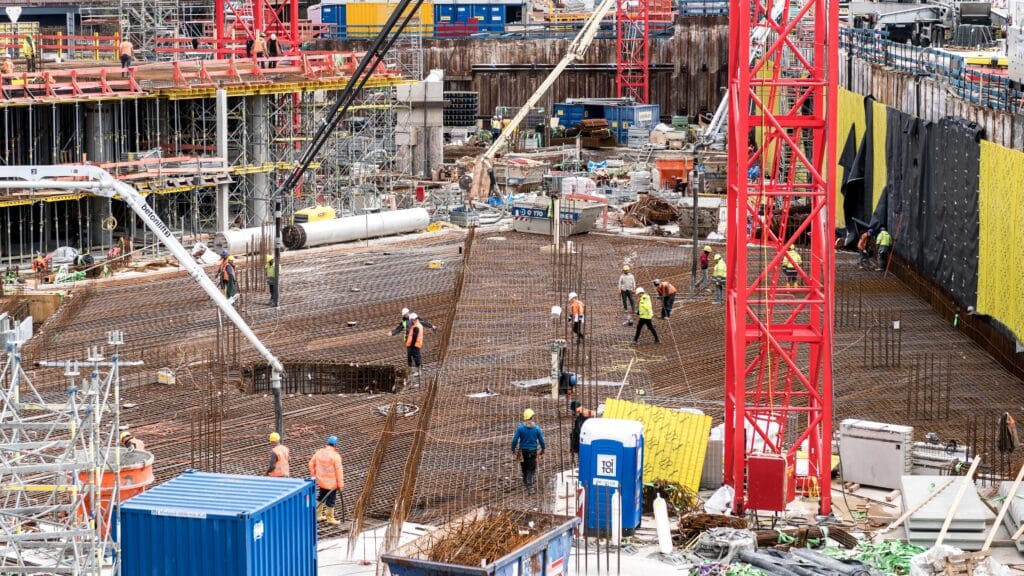


This guide is for general contractors, trade subcontractors, project risk managers, and compliance officers who need to structure, verify, and enforce contractual risk-transfer provisions in commercial and industrial project agreements.
Key Takeaways
- Standard general liability policies share losses by default. On modern construction projects, multiple independent contractors operate within the same physical footprint. When a loss occurs, standard commercial general liability policies default to sharing the cost proportionally among all available policies, forcing the general contractor’s insurance to pay for claims caused entirely by a subcontractor.
- Primary and noncontributory endorsements lock financial liability to the responsible trade. This endorsement explicitly overrides default loss-sharing rules. By mandating primary and noncontributory language, general contractors ensure the financial liability stays entirely with the subcontractor whose operations caused the claim, without seeking contribution from the general contractor’s carrier.
- The core purpose is to keep claims off the general contractor’s record. Forcing the claim onto the subcontractor’s policy preserves the general contractor’s aggregate limits and renewal premiums, and prevents them from paying out-of-pocket deductibles for someone else’s mistake.
- Certificates of insurance do not guarantee protection. Project managers and compliance teams must verify physical policy endorsements (such as ISO Form CG 20 01), ensure excess liability layers include “follow form” wording, and confirm local anti-indemnity laws actually allow the risk transfer.
Table of Contents
What Does Primary & Noncontributory Mean?
The phrase “primary and noncontributory” is a contractual directive to insurance carriers. Usually implemented through a specific policy endorsement, it establishes the exact payment priority for a claim and explicitly blocks carriers from sharing the financial loss.
Without this directive, conflicting policy language allows a downstream subcontractor’s insurance carrier to demand that the general contractor share the cost of a claim, even when the subcontractor is entirely at fault.
Primary (Who Pays First) & Noncontributory (Who Pays Alone)
Primary status and noncontributory status are two distinct mechanisms working together to isolate project risk.
Primary status dictates the operational sequence of the payout. It forces the designated policy to pay covered claims first, before any other available insurance applies. When a subcontractor secures this status in favor of a general contractor, the subcontractor’s insurer assumes first-dollar responsibility. The subcontractor’s policy pays up to its full per-occurrence limit before the general contractor’s primary policy is even considered.
Noncontributory status dictates who pays alone. While primary status forces the subcontractor’s carrier to pay first, noncontributory status legally prohibits that carrier from turning around and seeking shared financial contributions from the general contractor’s policy. The upstream contractor’s policy remains untouched until the downstream contractor’s primary limits are fully exhausted, allowing the general contractor to avoid paying deductibles or self-insured retentions on claims originating from a subcontractor’s work.
Overriding the Default Policy (ISO CG 20 01)
Standard commercial general liability policies contain an “Other Insurance” condition under Section IV of the standard ISO form. This section governs how limits apply when multiple policies cover the exact same loss. Without explicit modifications, carriers often use this section to push for equal or proportional claim splitting between the subcontractor and the general contractor.
A primary and noncontributory endorsement, such as ISO Form CG 20 01, explicitly amends Section IV. This endorsement creates a contractual obligation that supersedes the default sharing mechanisms, requiring the carrier to confirm in writing that its policy responds on a primary basis and waives all contribution rights.
| Feature | Default CGL Policy | Primary & Noncontributory Endorsement |
| Payment Sequence | Policies default to sharing the loss proportionally under “Other Insurance” conditions. | Downstream policy pays first. |
| Loss Sharing | Carriers can demand equal or pro-rata contribution from other available policies. | Pro-rata contribution is explicitly blocked; the downstream carrier waives contribution rights. |
| Upstream Impact | General contractor’s policy absorbs partial losses, triggering deductibles and inflating loss history. | General contractor’s policy remains shielded. |
| Legal Mechanism | Governed by standard Section IV policy conditions. | Enforced by a specific policy endorsement (e.g., ISO Form CG 20 01). |
Real-World Scenario: With vs. Without PNC
A claims scenario demonstrates exactly how a primary and noncontributory endorsement alters financial outcomes between general contractors and subcontractors.
Consider a commercial building renovation project. A mechanical subcontractor operates a plasma cutting torch near an unsealed wall opening. A stray spark falls into an open chase, igniting materials and causing $750,000 in property damage to an adjacent building. A worker employed by an electrical subcontractor suffers severe smoke inhalation, generating a $250,000 bodily injury claim. The total combined loss is $1,000,000.
The mechanical subcontractor carries a CGL policy with a $1,000,000 per-occurrence limit. The general contractor carries its own CGL policy with identical limits and holds additional insured status under the subcontractor’s policy.
Scenario A: Claim Settlement Without a PNC Endorsement
The general contractor tenders the $1,000,000 claim to the mechanical subcontractor’s carrier. Because the subcontractor’s policy lacks ISO Form CG 20 01, the insurer references its Section IV Other Insurance conditions. The subcontractor’s carrier asserts its right to share the loss and demands the general contractor’s carrier split the cost. Under a standard equal shares provision, the subcontractor’s insurer pays $500,000 and the general contractor’s primary carrier pays the remaining $500,000.
The general contractor absorbs a $500,000 loss despite having zero direct operational fault. This payment attaches to the general contractor’s loss history, triggering their deductible and inflating their future premium rates across general liability and excess layers.
Scenario B: Claim Settlement With a PNC Endorsement
The mechanical subcontractor’s insurer reviews the policy, confirms its obligation under ISO Form CG 20 01, and acknowledges that its coverage responds on a primary basis without contribution from the general contractor’s policy.
The subcontractor’s insurer pays the entire $1,000,000 settlement up to its per-occurrence limit. The general contractor’s CGL policy remains untouched. The general contractor pays no deductible, incurs zero paid losses on its loss runs, and maintains a clean underwriting record.
How PNC Works with Other Insurance Requirements
Construction contracts rarely rely on a single policy endorsement to transfer risk. Primary and noncontributory language works alongside other standardized construction insurance requirements to seal coverage gaps and prevent carrier disputes. Understanding how these mechanisms interact helps project managers and compliance teams enforce the right requirements before a subcontractor mobilizes.
PNC vs. Additional Insured (AI) Status
Additional insured status and primary and noncontributory endorsements are a paired system, but they perform separate functions. Additional insured status grants a general contractor access to a subcontractor’s policy. A primary and noncontributory endorsement dictates the payout order once that access is granted.
Securing additional insured status without PNC language leaves a massive financial gap. If a general contractor tenders a claim to a subcontractor’s carrier as an additional insured, that carrier will provide defense and indemnity. However, without PNC language blocking them, the carrier will look at the general contractor’s own liability policy and demand a pro-rata split of the costs.
PNC vs. Waiver of Subrogation (WOS)
A primary and noncontributory endorsement and a waiver of subrogation are frequently confused because commercial subcontracts demand both in the same insurance exhibit. They protect the general contractor from different financial exposures at different stages of a claim.
The distinction comes down to timing. A PNC endorsement operates during an active claim to establish payment order and block immediate loss sharing. A waiver of subrogation operates after a claim is paid. Once the subcontractor’s insurer settles a loss, a waiver of subrogation legally prevents that carrier from filing a lawsuit against the general contractor to recover the money it just spent.
| Feature | Primary & Noncontributory | Waiver of Subrogation |
| Operational Timing | Triggered during active claim negotiation and payment. | Enforced after claim payment and loss settlement are finalized. |
| Primary Function | Establishes payment order and blocks pro-rata loss sharing. | Waives carrier rights to recover payouts from designated third parties via lawsuits. |
| Targeted Exposure | Immediate financial exposure from shared claim payouts. | Post-payment litigation and cross-claim recovery lawsuits. |
| Standard ISO Form | CG 20 01 | CG 24 04 |
Blanket vs. Scheduled PNC Endorsements
Subcontractors secure primary and noncontributory coverage through either scheduled or blanket policy endorsements. The choice dictates the subcontractor’s annual overhead costs and how fast they can get approved to start work.
Scheduled endorsements explicitly list the name of the general contractor or the specific jobsite address on the policy form. Adding a new entity requires a formal request to the insurance broker for each individual contract. Carriers often charge a standalone policy change fee of $25 to $75 per project, and this administrative loop frequently delays jobsite mobilization.
Blanket endorsements automatically grant primary and noncontributory status to any party the subcontractor is required to protect under a fully executed written contract. Coverage triggers automatically—no named entities are required on the form itself. While carriers charge a larger annual fee for a blanket endorsement, this structure eliminates per-project processing fees and prevents administrative bottlenecks for subcontractors managing multiple active jobsites. The ability to secure these blanket provisions often depends on whether a firm purchases coverage direct, uses a local agent, or partners with a specialized construction insurance broker.
Coverage Gaps and Limitations
Securing the correct endorsement form is just the first step. Whether a primary and noncontributory endorsement actually triggers during a loss depends on strict policy conditions, contract execution dates, and how excess liability layers are structured.
Written Contract Requirements
Standard primary and noncontributory endorsements require a written subcontract to be in effect before a loss occurs. ISO Form CG 20 01 explicitly mandates that the agreement requiring this status be executed in writing.
On fast-tracked projects, subcontractors often mobilize under oral agreements, informal purchase orders, or unexecuted draft subcontracts. If work commences under an unexecuted agreement and a loss occurs, the subcontractor’s carrier will deny primary status. The general contractor’s primary policy will then be forced to respond to the claim.
Commercial carriers actively audit contract execution dates following jobsite losses and enforce blanket provisions strictly. Getting the contract signed before mobilization is the literal legal trigger for coverage.
Auto and Umbrella Policies
While primary and noncontributory requirements originate in general liability, master subcontracts routinely extend them to commercial auto and excess liability lines. For commercial auto, insurers use ISO Form CA 04 49 to mirror the general liability protections.
Note: These provisions do not apply to workers’ compensation, which is governed strictly by state law.
Umbrella and excess policies require extra scrutiny. Attaching a primary and noncontributory endorsement to a baseline general liability policy does not automatically bind a contractor’s excess policies. Standard umbrella policies contain independent conditions that default to excess coverage over all available insurance—including the general contractor’s primary policy. Without specific endorsement modifications (such as ISO Form CX 24 33) or explicit “follow form” wording, an umbrella carrier can refuse to pay until the general contractor’s primary limit is fully exhausted.
This risk is tied to how courts view policy exhaustion. In jurisdictions that favor horizontal exhaustion, courts require every available primary policy on a jobsite to pay out before any excess policy attaches. To insulate the general contractor’s primary coverage, the subcontract must explicitly mandate vertical exhaustion, ensuring the subcontractor’s primary and excess layers pay fully before the general contractor’s policies are ever tapped.
The Impact of Subcontractor Self-Insured Retentions
A self-insured retention (SIR) requires a policyholder to pay a specified dollar amount out of pocket before insurance coverage applies. Unlike a deductible, where the insurer pays the claim and seeks reimbursement later, an SIR acts as a hard threshold. The carrier has no duty to defend or indemnify the claim until the policyholder satisfies the retention with their own funds.
High SIRs on subcontractor policies create an operational roadblock for general contractors. If a framing subcontractor carrying a $100,000 SIR causes $300,000 in property damage, their insurer will not contribute to the settlement until the subcontractor pays the initial $100,000. If that subcontractor becomes insolvent or simply cannot fund the retention, the insurer will not step in to cover the gap. The general contractor’s policy is then forced to respond to handle the immediate defense needs, bypassing the protection intended by the primary and noncontributory agreement entirely.
How State Anti-Indemnity Laws Override PNC Endorsements
A master subcontract does not override state law. Even if a general contractor requires a primary and noncontributory endorsement, state insurance and anti-indemnity laws serve as the final filter. If a local statute prohibits transferring a specific type of liability to a subcontractor, the insurance requirement is void, and the subcontractor’s carrier will refuse to pay the claim.
Anti-Indemnity Restrictions
Over 45 states have enacted anti-indemnity statutes that limit or prohibit general contractors from transferring liability for their own negligence to subcontractors. Historically, general contractors used insurance requirements to shift liability that direct indemnity agreements could not legally cover. State legislatures responded by aligning insurance requirements with permitted indemnity limits.
State legal frameworks govern risk transfer in three main categories:
- Strict Anti-Indemnity States: Jurisdictions like Texas, Colorado, Oregon, Kansas, and Louisiana prohibit using insurance triggers to cover a general contractor’s sole negligence or active fault. In these states, a subcontractor’s policy cannot protect a general contractor for the portion of a loss caused by the general contractor’s own negligence.
- Intermediate States: These jurisdictions permit primary coverage for partial or contributory negligence, provided the subcontractor bears at least a percentage of fault for the incident.
- Broad Transfer States: A minority of jurisdictions permit broad risk allocation, allowing the subcontractor’s policy to respond fully even when the general contractor contributed substantially to the underlying loss.
Standard ISO forms specify that coverage cannot be broader than what is permitted by applicable state law. A contractual requirement for primary and noncontributory status is legally void to the extent it violates governing anti-indemnity statutes.
| State Classification | Anti-Indemnity Rule | Risk Transfer Outcome |
| Strict Anti-Indemnity | Voids coverage for the general contractor’s sole or active negligence. | General contractors must rely on their own policies for their portion of fault. |
| Intermediate Transfer | Permits risk transfer if the subcontractor shares fault. | General contractors are shielded, provided the subcontractor is partially liable. |
| Broad Transfer | Permits maximum risk allocation regardless of subcontractor fault. | Subcontractor policies respond fully to the loss. |
How to Verify Primary and Noncontributory Coverage
Implementing primary and noncontributory requirements requires distinct workflows depending on a firm’s position in the contracting chain. General contractors and subcontractors approach risk transfer from opposing perspectives, but both rely on standardized compliance protocols to prevent administrative delays and ensure policy endorsements actually apply when a jobsite loss occurs.
How to Show PNC on an ACORD 25 Certificate of Insurance
Primary and noncontributory status is documented through explanatory text on the ACORD 25 Certificate of Liability Insurance. Because the standard form does not have a dedicated checkbox or column for this specific provision, compliance administrators must look at the large text block titled Description of Operations / Locations / Vehicles.
This is where brokers document the requirement. Standard, acceptable wording reads:
“Commercial General Liability policy includes primary and noncontributory status in favor of [General Contractor Name] and [Project Owner Name] as additional insureds per written contract executed prior to loss.”
If the Description of Operations box is blank or contains vague language like “coverage applies per policy terms,” project managers should flag the certificate and request clarification before approving the subcontractor for site access.
Compliance Steps for Subcontractors
Insurance compliance functions as an operational requirement and a prequalification asset. General contractors favor trade partners who satisfy insurance specifications quickly without requesting coverage exceptions or contract modifications.
To verify whether existing coverage satisfies standard contract requirements, subcontractors should review their schedule of forms and endorsements with their insurance broker before bidding. Subcontractors that maintain blanket primary and noncontributory endorsements can mobilize on jobsites immediately. When a blanket endorsement is attached to a general liability policy, the primary payout priority triggers automatically for any project requiring it under an executed written contract. This structure eliminates per-project processing fees, prevents access delays, and maintains compliance across multiple active projects. Subcontractors looking to secure this automatic status should evaluate general liability insurance carriers that actively underwrite commercial construction risks and offer blanket provisions.
Verification Steps for General Contractors
Relying solely on an ACORD 25 certificate creates unhedged financial exposure for a general contractor. The certificate is an informational document that confers no legal rights and does not amend the underlying coverage.
If a broker types primary and noncontributory status into the Description of Operations block, but the insurer fails to attach the actual endorsement (such as ISO Form CG 20 01) to the policy, the certificate notation carries no legal weight. If a subcontractor causes a loss and the policy lacks the endorsement, the insurer will deny primary status regardless of what the certificate says. The general contractor’s policy will then be forced to pay the claim.
Complete compliance requires collecting the ACORD 25 certificate along with copies of the actual policy endorsement forms prior to jobsite entry.
Primary & Noncontributory Endorsement Verification Checklist
A step-by-step audit for general contractors, project risk managers, and compliance teams to verify primary and noncontributory insurance provisions prior to subcontractor mobilization.
Step 1: Contract & Agreement Execution
-
Is the master subcontract fully executed in writing prior to the subcontractor arriving on the jobsite? If NO: Standard blanket endorsements typically require a signed written contract to be in effect before a loss occurs. Unexecuted or verbal agreements may void coverage.
-
Does the written subcontract explicitly mandate both Additional Insured (AI) and Primary & Noncontributory (PNC) status? If NO: Securing additional insured status without PNC language can still allow a subcontractor’s carrier to demand proportional loss sharing from the general contractor’s policy.
-
Have you reviewed the subcontract to confirm it mandates vertical exhaustion for any umbrella or excess liability layers?
Step 2: Certificate of Insurance (COI) Review
-
Does the “Description of Operations” box clearly state that coverage applies on a primary and noncontributory basis? Acceptable wording commonly reads: “Commercial General Liability policy includes primary and noncontributory status in favor of [General Contractor Name] as additional insured per written contract.”
-
Is the general contractor (and project owner, if applicable) correctly listed as the Certificate Holder?
-
Are there any unusual remarks indicating that coverage is “subject to policy terms” without explicit confirmation of PNC status?
Step 3: Physical Endorsement Verification
-
Has the subcontractor provided a copy of the actual general liability policy endorsement (e.g., ISO Form CG 20 01 or a proprietary equivalent)? If NO: A certificate of insurance is strictly informational. The physical endorsement is generally required to prove the “Other Insurance” condition has been legally modified.
-
If commercial auto liability exposure exists, is an auto-specific PNC endorsement (such as ISO Form CA 04 49) attached?
-
If umbrella or excess coverage is utilized, does the policy contain explicit “follow form” wording or a specific excess PNC endorsement (like ISO Form CX 24 33)?
-
If the subcontractor utilizes a blanket endorsement, does the endorsement document confirm it covers entities required by a written contract?
Step 4: Advanced Risk & Statutory Checks
-
Have you reviewed the subcontractor’s policy for unusually high Self-Insured Retentions (SIRs)? If YES: An unfunded or excessive SIR can delay or block the insurer from defending a claim, potentially forcing the general contractor’s primary coverage to step in.
-
Does the project jurisdiction have strict anti-indemnity statutes? If YES: Confirm with local counsel or a licensed insurance professional. Over 45 states restrict liability transfer; a contractual requirement for PNC status may be void to the extent it violates these laws.
Interpreting Your Results
All Boxes Checked: The documentation indicates strong contractual risk transfer alignment. The general contractor is well-positioned to isolate claims to the responsible subcontractor’s policy.
Missing Physical Endorsements: Relying solely on the ACORD 25 Certificate without reviewing the actual endorsement forms (like CG 20 01) leaves significant financial exposure. Compliance teams typically delay mobilization until the broker provides the actual policy form modifications.
Unexecuted Contracts / Missing Blanket Language: Any work performed prior to a signed subcontract often falls outside the protections of a blanket PNC endorsement. Rectify contract signatures immediately to help preserve intended coverage.
This checklist provides general educational information, not insurance or legal advice. Construction Coverage is not a licensed insurance agency, agent, or broker. Confirm your specific requirements with a licensed insurance agent.
Frequently Asked Questions
What is the difference between primary & noncontributory vs. waiver of subrogation?
A primary and noncontributory endorsement dictates which policy pays first during active claim settlement. A waiver of subrogation prevents an insurer from suing third parties to recoup costs after a claim has already been paid. PNC modifies policy conditions before and during claim processing, ensuring the downstream contractor’s insurer responds first and cannot seek contribution from the upstream contractor’s policy. A waiver of subrogation operates after payment has been made, surrendering the insurer’s legal right to pursue responsible third parties for reimbursement. Both provisions are typically required together in commercial subcontracts because each closes a gap the other leaves open.
Does primary & noncontributory apply to workers’ compensation?
No. Workers’ compensation benefits are governed by state law rather than contractual liability provisions, and workers’ compensation policies do not permit additional insured status. Without an additional insured framework, primary and noncontributory endorsements cannot attach. Upstream contractors managing workers’ compensation exposure must instead require subcontractors to carry a waiver of subrogation endorsement — typically NCCI Form WC 00 03 13 — which prevents the subcontractor’s workers’ comp carrier from seeking reimbursement from the GC after paying benefits to an injured worker.
How does PNC wording appear on an ACORD Certificate of Insurance?
Primary and noncontributory status is documented in the Description of Operations section of the ACORD 25 form, since the standard form does not feature a dedicated PNC column. Brokers add explicit language to that text block while also checking the separate additional insured box for commercial general liability. Acceptable wording typically reads: “Commercial General Liability policy includes primary and noncontributory status in favor of [General Contractor] as additional insured per written contract executed prior to loss.” Keep in mind that statements on a COI are strictly informational. To confirm legally binding protection, always request a copy of the actual policy endorsement — ISO Form CG 20 01 — alongside the certificate.
Can Subcontractors get a blanket primary & noncontributory endorsement?
Yes. Subcontractors can obtain a blanket PNC endorsement that, when paired with a blanket additional insured endorsement, automatically extends coverage to any party they are contractually required to protect under a fully executed written agreement. There is no need to add individual project owners or GCs to the policy on a project-by-project basis — the blanket provision triggers primary coverage automatically, provided the subcontract requiring PNC status is signed before any loss occurs. Carriers typically charge an annual fee of $250 to $500 to attach a blanket endorsement package covering both additional insured and PNC status to a CGL policy. For active subcontractors managing multiple projects, this structure eliminates per-project processing fees and prevents costly mobilization delays.
Is CG 20 01 the only form used for primary & noncontributory status?
No. ISO Form CG 20 01 is the standard endorsement for commercial general liability, but other lines use distinct forms to achieve the same result. ISO Form CA 04 49 handles PNC status on commercial auto policies, while forms such as CX 24 33 apply to excess liability layers. Non-ISO carriers also issue proprietary manuscript endorsements with custom phrasing designed to satisfy contractual PNC mandates. When evaluating non-standard forms, risk managers must confirm that the wording explicitly waives contribution rights and overrides standard “Other Insurance” conditions. Proprietary forms that omit clear waiver language or introduce conditional restrictions can fail to provide complete financial insulation when a claim occurs.
References & Additional Resources
- Insurance Services Office (ISO). An advisory organization that develops standardized insurance policy forms, including ISO Form CG 20 01 (typically the 04 13 or 12 19 editions), which establishes uniform endorsement language to modify the “Other Insurance” condition, ensuring primary and noncontributory status for additional insureds under commercial general liability policies.
- International Risk Management Institute (IRMI). A technical research institution providing authoritative definitions, insurance analysis, and risk management guidance on contractual risk transfer mechanisms and policy conditions.
- Associated General Contractors of America (AGC). A leading national construction trade association that tracks state-specific anti-indemnity statutes and publishes guidance on risk allocation standards across commercial projects.
Related Guides

While state licensing boards may only require $50,000 to $100,000 in general liability coverage for contractors, most commercial construction contracts…

A primary and noncontributory (PNC) endorsement requires a subcontractor's insurance policy to absorb a covered claim up to its limits…

An additional insured endorsement is an insurance policy modification that extends liability coverage to a third party who is not…

A waiver of subrogation is a contractual agreement where a contractor signs away their insurance company's right to sue a…

A Certificate of Insurance (COI) in construction is a standardized one-page summary—typically issued on an ACORD 25 form—that verifies a…

The best business structure for a construction company is typically a Limited Liability Company (LLC) or an S-Corporation, as both…

Construction insurance is a suite of specialized policies designed to protect contractors, developers, and property owners from the financial risks,…