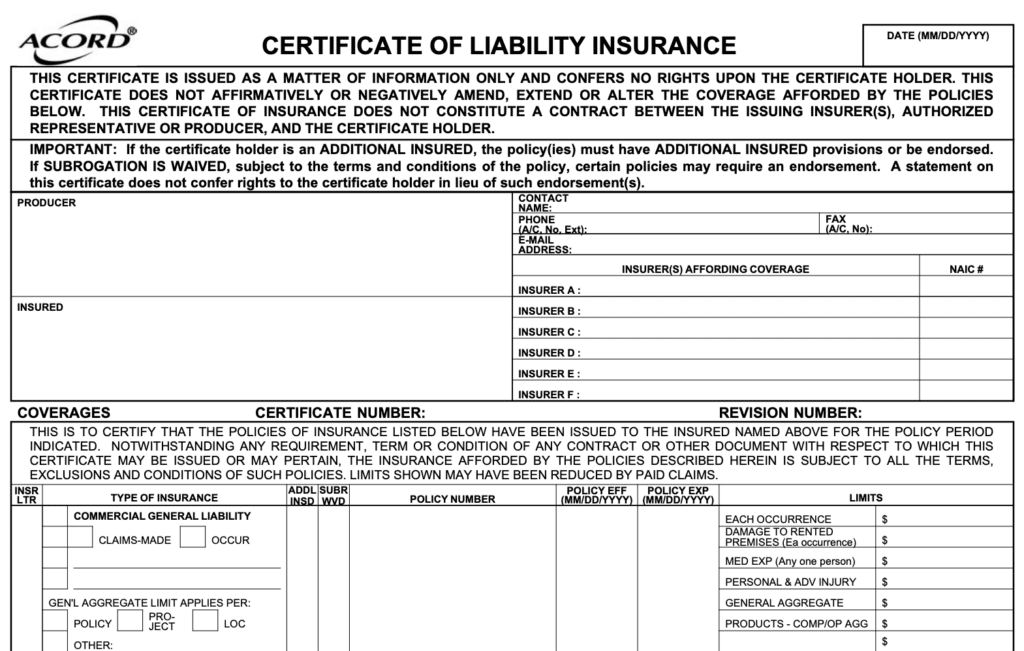


Winning a project bid establishes the commercial agreement, but physical work cannot begin until the risk transfer is verified. Because a COI is merely a snapshot of coverage rather than a binding legal contract, managing these forms incorrectly is one of the most common ways contractors absorb unbudgeted liability, face catastrophic audit penalties, or suffer delayed progress payments.
This guide is for general contractors, specialty trades, and back-office accounting teams who need to understand how COIs work, why they are required, and how to read the ACORD 25 form correctly.
Key Takeaways
- A COI is an informational snapshot, not an insurance policy. The standard ACORD 25 form reflects policy status only on the date it is issued and does not alter or guarantee the underlying coverage.
- Legal protection depends on policy endorsements, not certificate text. Additional insured status, primary and non-contributory wording, and waivers of subrogation exist only if the carrier attaches official endorsement documents to the underlying policy.
- COIs prevent massive audit penalties. General contractors who allow unverified labor on site can be hit with severe retroactive premium bills during their annual workers’ compensation audits.
- Receiving the form is only the first step. True compliance requires auditing each block of the ACORD 25 to confirm policy active dates, financial thresholds, and exact legal entity name matching.
Table of Contents
What is a Certificate of Insurance (COI)?
A Certificate of Insurance (COI) in construction is a standardized summary document that verifies a contractor’s active insurance policies, coverage limits, and effective dates. Rather than handing over a 200-page insurance policy loaded with complex legal exclusions, contractors provide this one-page summary to upstream parties (like GCs and project owners) to prove they are adequately insured for the scope of work they are about to perform.
In the United States, this document is almost exclusively issued on an ACORD 25 form (Certificate of Liability Insurance). ACORD is the global standards organization for the insurance industry, and their standardized formatting ensures that a project manager in New York and an underwriter in California can look at the exact same document and immediately locate the necessary coverage limits.
A COI is generated and signed directly by a licensed insurance broker or agent. Contractors cannot legally generate or alter their own COIs; the document must come from the producing agency as a third-party verification of the contractor’s financial backing.
What Information is Included on a COI?
While it summarizes massive legal contracts, the ACORD 25 form is highly structured. When looking at a standard COI, you will find the following core information block by block:
- Producer: The name, address, and contact information of the insurance brokerage that sold the policies and issued the certificate.
- Named Insured: The exact legal business entity name and address of the contractor who holds the insurance policies.
- Insurers Affording Coverage: A lettered list (A, B, C, etc.) of the specific insurance carriers providing the policies, along with their five-digit National Association of Insurance Commissioners (NAIC) identification numbers.
- Policy Types and Numbers: A central grid breaking down the specific lines of insurance (e.g., General Liability, Automobile, Workers’ Compensation, Umbrella) alongside their unique policy tracking numbers.
- Policy Effective and Expiration Dates: The exact calendar window during which each listed policy is active and enforceable.
- Coverage Limits: The maximum financial payout the carrier will provide for a single claim (per occurrence) and for the entire policy term (aggregate).
- Description of Operations: A text box used to list specific project names, jobsite locations, and summarize any special contractual endorsements (such as primary and noncontributory language) attached to the policies.
- Certificate Holder: The name and address of the party who requested the COI (usually the general contractor, project owner, or lender).
Limitations of a COI
While the ACORD 25 is the universal tool used to verify coverage, treating it as an absolute guarantee of policy protection is a massive operational vulnerability. The form includes an explicit legal disclaimer printed directly in the top header stating that it is issued “as a matter of information only and confers no rights upon the certificate holder.”
Before relying on a COI to grant site access, construction professionals must understand its three fundamental limitations:
- It is not an insurance policy: A COI is a reporting tool. It does not amend, extend, or alter the coverage provided by the underlying policies. If a roofing subcontractor carries an active liability policy with a specific exclusion for multi-family residential work or work over three stories, that critical exclusion will rarely appear on the standard certificate.
- It is not a binding legal contract: Simply holding a certificate with your company’s name listed at the bottom does not automatically confer any direct legal rights upon you. Contractual protections must be supported by executed policy endorsements. If a broker types a promise into the COI but the carrier never actually issues the endorsement, the COI carries no legal weight in court.
- It is not a guarantee of ongoing coverage: A COI is only accurate on the exact day it is printed. If a subcontractor defaults on premium payments, exhausts their policy limits on another project, or outright cancels their policy the week after site mobilization, the certificate holder will typically receive no notification from the carrier unless a specific notice-of-cancellation endorsement is actively on file.
Why COIs Are Required on Construction Projects
Certificates of insurance are the primary administrative tool for contractual risk transfer—ensuring that financial liability for jobsite injuries and property damage stays with the party doing the work.
Financial Backing for Indemnification
COIs verify that subcontractors have the financial backing to meet indemnification obligations without exposing upstream general contractors or project owners to direct losses. Construction subcontracts contain indemnification clauses requiring specialty trades to defend and hold harmless general contractors and project owners against claims arising from the subcontractor’s work.
Commercial real estate lenders, equity partners, and public project owners require general contractors to maintain verified insurance records for all active trades before disbursing construction draws. Unverified or underinsured subcontractors on site can prompt lenders to freeze funding, creating cash-flow delays across the project.
Avoiding Insurance Audit Penalties
There is also a direct premium cost associated with non-compliance. Insurance rating organizations, such as the National Council on Compensation Insurance (NCCI), establish strict rules for unverified labor. If an auditor finds that a general contractor used subcontractors without valid proof of workers’ compensation insurance, those workers are reclassified as direct statutory employees of the general contractor.
The auditor then levies retroactive payroll premiums against the general contractor. If a labor-material breakout is unavailable, auditors may apply a standard percentage (often 33% to 50%) to the total subcontract price, resulting in substantial back-premium bills at year-end. Failing to collect a compliant certificate before a subcontractor begins work shifts financial liability directly onto the general contractor’s balance sheet.
Protecting Against Sub-Subcontractor Risk
Specialty subcontractors frequently hire their own specialized crews or independent lower-tier trades. General contractors require COIs from these “sub-subcontractors” to prevent hidden coverage gaps. If a lower-tier trade causes a loss on site and doesn’t have verified insurance, the primary subcontractor’s own policy may actually exclude the claim—leaving the primary sub and the GC on the hook for the damages.
Common Construction Insurance Coverages Found on a COI
While specific project requirements scale up based on the complexity, scope of work, and total contract value, a standard construction COI summarizes four primary lines of foundational coverage:
- Commercial General Liability (CGL): This is the bedrock of construction insurance. A standard commercial general liability policy protects against third-party bodily injury and property damage caused by the contractor’s ongoing operations on the jobsite, as well as claims that arise from defective work after the project is finished (Completed Operations).
- Automobile Liability: A commercial auto policy covers bodily injury and property damage resulting from the operation of vehicles for business purposes. In construction, this frequently includes a requirement for “Hired and Non-Owned Auto” coverage, which protects the GC when a subcontractor’s employee causes an accident while driving their personal pickup truck to the jobsite or to pick up materials.
- Workers’ Compensation and Employer’s Liability: Workers’ compensation provides state-mandated, no-fault medical and wage-replacement benefits to employees who suffer work-related injuries. Employer’s liability (Part 2 of the policy) protects the upstream contractor from assuming direct employer liabilities if an injured worker attempts to sue outside the standard workers’ comp framework.
- Excess / Umbrella Liability: As a critical safety net in construction insurance, this policy provides additional financial capacity that sits directly above the primary CGL, Auto, and Employer’s Liability policies. If a catastrophic loss exhausts the primary $1 million policy limits, the Umbrella policy kicks in to cover the remaining damages, ensuring the project isn’t derailed by a single massive lawsuit.
Required Policy Endorsements
A standard, off-the-shelf insurance policy only covers the named contractor who purchased it. To successfully transfer risk across a multi-employer jobsite, general contractors require subcontractors to modify their base policies using specific legal endorsements. These are the three most critical endorsements to look for on a construction COI:
- Additional Insured (AI): This endorsement formally modifies the subcontractor’s policy to extend liability coverage directly to the general contractor, project owner, or architect. If the GC is sued because of a mistake the subcontractor made, additional insured status allows the GC to tender the claim directly to the subcontractor’s carrier for defense and indemnity, protecting the GC’s own insurance loss history.
- Waiver of Subrogation (WOS): Subrogation is an insurer’s legal right to sue a third party to recover costs after paying out a claim. A waiver of subrogation is a legal agreement where the subcontractor’s insurance carrier explicitly agrees not to sue the general contractor or project owner to recoup their money after paying a covered claim, stopping the cycle of jobsite litigation.
- Primary and Noncontributory (PNC): When multiple insurance policies could potentially cover the same claim, disputes arise over who pays first. Primary and noncontributory language ensures that if a claim occurs, the subcontractor’s policy pays out first (acts as primary) and covers the loss to its full limits without seeking any financial contribution from the general contractor’s own insurance policies.
Next Steps: Procurement, Auditing, and Tracking
Because the COI is the center of the construction compliance universe, different stakeholders interact with it in drastically different ways. A subcontractor views a COI as a hurdle to getting paid, while a general contractor views it as a shield against litigation. Navigating this paperwork requires distinct workflows depending on your role on the project.
For Subcontractors: Procuring a COI and Gaining Jobsite Access
For trade contractors, securing a compliant COI is a race against the clock to mobilize crews and unlock progress payments. The process requires navigating broker turnaround times, managing the direct overhead costs of scheduled endorsement fees, and ensuring strict adherence to the exact matching rule for legal entity names. Even minor discrepancies in punctuation or corporate suffixes can cause automated GC compliance software to freeze pay applications.
To avoid jobsite lockouts and payment delays, subcontractors should submit the complete insurance exhibit from their subcontract directly to their broker as soon as the bid is awarded—rather than trying to interpret the requirements themselves.
Additionally, trade contractors managing multiple jobs should ask their broker to price out “blanket” endorsement packages. While these carry a higher upfront annual fee, they eliminate per-project processing costs and allow crews to mobilize immediately upon contract execution. Trade contractors looking to streamline this process should find a general liability insurance company that actively offers blanket endorsements. Finally, always verify that the “Named Insured” box on the ACORD form matches your W-9 down to the exact comma.
For General Contractors: Auditing the ACORD 25 Form
Receiving a COI is only the first step; trusting it blindly is a massive operational liability. Project managers and field operations teams must know how to audit an ACORD 25 field-by-field. This involves verifying carrier AM Best ratings, confirming standard commercial minimum limits, cross-referencing policy dates against the project schedule, and spotting common red flags—like residential or action-over exclusions—before granting site access.
Because typed text in the description box does not actually grant coverage, auditors must look beyond the single page. Compliance teams should verify that the “ADDL INSR” and “SUBR WVD” columns are checked in the main policy grid, and then require the subcontractor to submit the physical ISO endorsement forms (such as the CG 20 10 and CG 20 37) to prove the coverage is legally bound. Finally, auditors must log the policy expiration dates; if a policy is scheduled to expire mid-project, the system must be set to flag the subcontractor for a payment hold until a renewal certificate is secured.
For GCs & Accounting Teams: Automating Tracking and Record Retention
When managing dozens of active trades across multiple projects, relying on manual spreadsheets is a recipe for an unbudgeted compliance disaster. General contractors and back-office accounting teams must establish robust systems to track mid-project policy expirations and automatically enforce payment holds when a subcontractor’s coverage lapses.
Furthermore, insurance records must be kept meticulously intact long after the project closes to defend against long-tail defect claims. Upgrading to a construction ERP software or dedicated financial platform for general contractors ensures these compliance documents are permanently tied to vendor profiles and pay applications—automatically freezing funds the moment a certificate expires.
If your team needs to streamline compliance tracking and vendor payments, compare our top-rated accounting software for general contractors:
| Company | Best For | Learn More |
|---|---|---|
Sage 100
|
Mid-market general contractors ($10M–$50M revenue) | |

CrewCost
|
Modern, growing general contractors ($5M–$250M+ revenue) | |

Premier
|
Mid-market to enterprise general contractors ($10M–$500M+) |
*We may earn a commission when you click through these links.
» Not a GC? Explore this complete guide to construction accounting software to find the right financial platform for your specific trade and business size.
Frequently Asked Questions
Do all subcontractors need to provide a COI?
Yes. Virtually all trade subcontractors operating on a construction jobsite must provide a verified COI before mobilizing or receiving progress payments. General contractors require this documentation to verify that the subcontractor has the coverage needed to support the indemnity and liability transfer provisions in the written subcontract. Allowing an unverified subcontractor on site exposes the primary contractor to significant financial risk of project losses and substantial additional premium charges during annual workers’ compensation audits.
Even sole proprietors operating without employees must submit proof of insurance or a state-sanctioned workers’ compensation exemption form. In cases where statutory exemptions apply, general contractors frequently require the trade to secure a low-cost ghost policy to generate an official ACORD 25 form. Requiring compliant certificates from every lower-tier trade ensures continuous insurance protection across the entire project.
What is the difference between an ACORD form and an insurance policy?
An ACORD certificate of insurance is a standardized informational summary; an insurance policy is the actual legally binding contract between the insured subcontractor and the insurance carrier. The ACORD 25 form provides a snapshot of active policy lines, coverage limits, and effective dates as of the document’s issuance date. The header of every standard ACORD form explicitly clarifies that the document confers zero legal rights upon the certificate holder and cannot alter or extend underlying policy terms.
The insurance policy contains the legal definitions, coverage conditions, exclusionary clauses, and endorsement schedules that govern claim payouts. Key protections—such as additional insured status, primary and non-contributory language, or waivers of subrogation—exist only when executed via policy endorsements attached to the underlying contract (although primary and non-contributory status is increasingly included within the base other insurance conditions of standard modern policy forms when required by a written contract). General contractors must audit policy endorsement forms alongside the ACORD 25 to confirm enforceable risk transfer.
Can a general contractor withhold payment for an expired COI?
Yes. Commercial subcontracts grant general contractors explicit authority to freeze progress payments and retainage disbursements if a subcontractor allows insurance coverage to lapse mid-project. Written subcontracts establish continuous insurance compliance as a prerequisite for processing pay applications. Allowing a policy to expire constitutes a contractual breach, providing legal justification for withholding disbursements—provided the general contractor issues the formal written notice often required by state Prompt Pay statutes.
If a subcontractor causes site damage or suffers a worker injury while operating under an expired policy, the general contractor’s carrier may deny coverage if the policy contains a subcontractor warranty exclusion. Even if the carrier accepts the claim, the general contractor faces retroactive payroll audit adjustments for unverified labor. Enforcing accounting holds gives subcontractors a strong financial incentive to process renewal certificates with their brokers prior to expiration.
How long does it take an insurance broker to issue a COI?
An insurance broker can often generate a standard COI the same business day, though custom endorsement requirements typically extend processing to 1 to 3 business days. For routine requests requiring standard coverage limits, brokers issue ACORD 25 forms quickly through online client management portals—and many contractors can access self-service portals to generate standard certificates independently at no additional cost.
Turnaround times extend to 3 to 7 business days when a contract requires custom policy endorsements, non-standard waiver text, or elevated umbrella limits. These non-standard requests require the broker to submit the contract’s insurance exhibit to carrier underwriters for formal review and approval of premium pricing. Subcontractors should submit insurance exhibits to their brokers immediately upon contract award to prevent mobilization delays.
What happens if a subcontractor fakes a COI?
Submitting a falsified COI is insurance fraud, and the consequences are severe: immediate jobsite removal, contract termination, and exposure to civil and criminal liability. A general contractor who uncovers an altered or fabricated certificate will typically withhold pending payments as a set-off for potential damages and may permanently ban that trade from current and future projects.
A fraudulent certificate leaves the subcontractor directly liable for defense costs and property damages resulting from jobsite losses. Insurance carriers pay claims based strictly on active policy contracts and executed endorsements, ignoring statements on a falsified document. Falsifying insurance records additionally inflicts long-term damage on a trade contractor’s commercial reputation, making it difficult to secure surety bonding or execute subcontracts with reputable general contractors. Modern compliance workflows combat fraudulent submissions by using automated OCR compliance software and direct broker verification protocols to confirm active policy numbers, limits, and carrier details independently with the issuing agency.
References & Additional Resources
- ACORD Corporation. The global standards organization for the insurance industry that establishes standardized document structures, including official usage guidelines for the ACORD 25 Certificate of Liability Insurance.
- International Risk Management Institute (IRMI). A premier research and educational organization providing authoritative technical analysis on contractual risk transfer, additional insured endorsements, and construction risk management.
- U.S. Bureau of Labor Statistics (BLS). The principal federal agency that tracks workplace injuries, fatalities, and illness metrics, contextualizing the operational necessity for rigorous workers’ compensation verification on jobsites.
Related Guides

While state licensing boards may only require $50,000 to $100,000 in general liability coverage for contractors, most commercial construction contracts…

A primary and noncontributory (PNC) endorsement requires a subcontractor's insurance policy to absorb a covered claim up to its limits…

An additional insured endorsement is an insurance policy modification that extends liability coverage to a third party who is not…

A waiver of subrogation is a contractual agreement where a contractor signs away their insurance company's right to sue a…

A Certificate of Insurance (COI) in construction is a standardized one-page summary—typically issued on an ACORD 25 form—that verifies a…

The best business structure for a construction company is typically a Limited Liability Company (LLC) or an S-Corporation, as both…

Construction insurance is a suite of specialized policies designed to protect contractors, developers, and property owners from the financial risks,…