
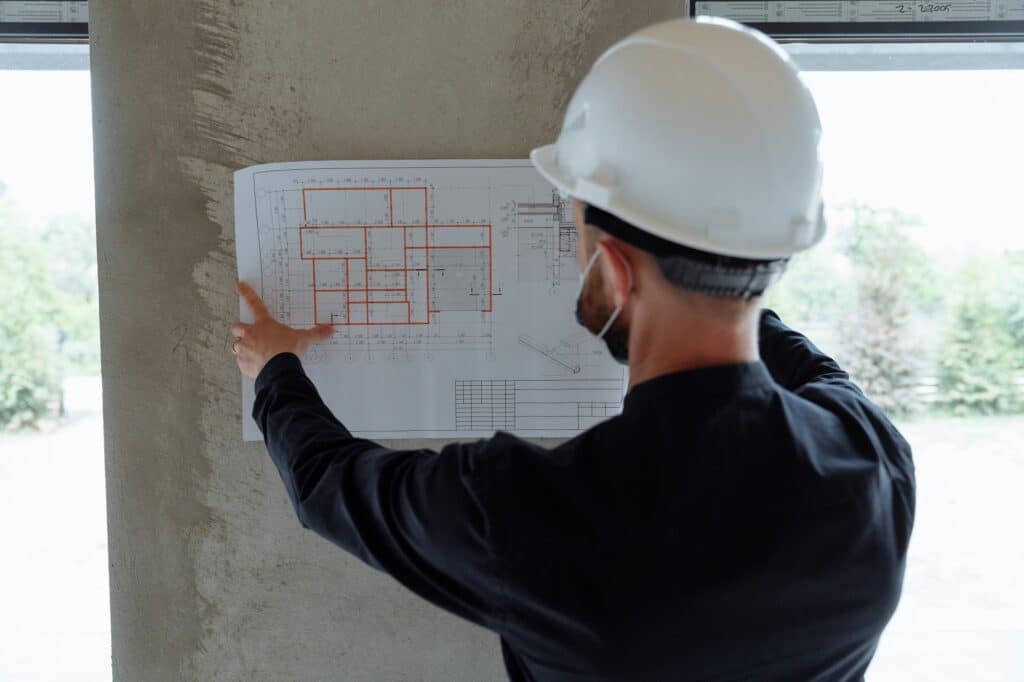

In both commercial and residential construction, the general contractor serves as the central command hub of the build. While the property owner provides the vision and the funding, it is the general contractor who navigates the chaotic logistics of bringing that design to life. Instead of a property owner trying to individually schedule excavators, framers, and electricians—or personally absorbing the liability of a job site injury—the GC coordinates the entire supply chain and workforce. By taking on this burden, the general contractor shields the owner from day-to-day operational hazards, ensures strict building code compliance, and protects the project’s bottom line.
Table of Contents
Who Acts as the General Contractor? (Individual vs. Company)
A common misconception is that a general contractor is always a single individual. In reality, the term refers to the entity holding the prime contract with the owner. Depending on the scale and complexity of the project, the GC can range from a sole proprietor renovating a kitchen to a large corporation constructing a skyscraper.
Residential Projects: The Individual GC
On smaller residential projects—such as home additions, bathroom remodels, or single-family home builds—the general contractor is often a small business owner or sole proprietor. In this context, the GC is typically “boots on the ground.” They are on-site almost daily and may “self-perform” portions of the work, such as carpentry or framing, while subcontracting specialty trades like plumbing and electrical.
Commercial & Large-Scale Projects: The GC Firm
For commercial developments, infrastructure, or large-scale residential complexes, the “general contractor” is a corporate entity (LLC or Corporation). Here, the GC does not refer to a single person with a hammer, but rather an entire team.
In this model, the firm assigns a dedicated management team to the project, typically consisting of:
- Project Managers (PMs): Handle the office side—budgets, contracts, change orders, and scheduling.
- Superintendents: Manage the field operations—coordinating subcontractors, safety enforcement, and daily logistics.
- Project Coordinators: Assist with documentation, permits, and RFI (Request for Information) tracking.
The table below outlines the primary differences between and individual GC versus a GC firm:
| Feature | Individual GC (Sole Proprietor) | GC Firm (Corporation/LLC) |
| Typical Project | Home renovations, single-family homes, small repairs. | Commercial buildings, infrastructure, large developments. |
| Management Style | “Boots on the ground.” The owner is often on-site daily and may perform some work (carpentry, etc.). | “Corporate Management.” The firm assigns a project manager and superintendent to run the site. |
| Staffing | Usually 1 person + a small crew or subcontractors. | Dedicated departments for estimating, safety, accounting, and project management. |
| Overhead Cost | Lower. (Home office, minimal staff). | Higher. (Office rent, insurance, salaries), often reflected in fees. |
» Read More: LLC vs. S. Corp for Construction Business
The Role of the General Contractor
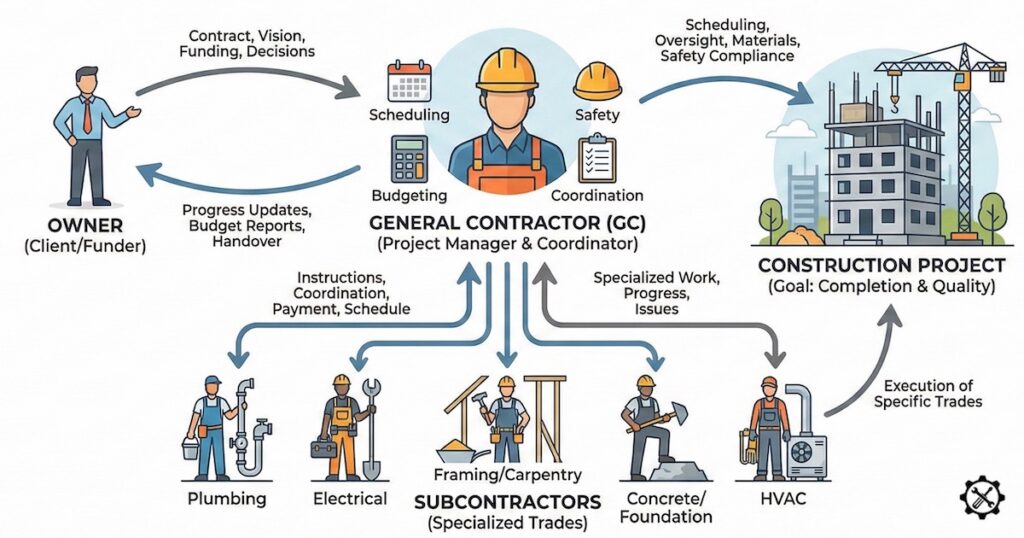
At its core, the role of a general contractor is to serve as the “project hub” for a construction initiative. Whether building a custom home or a commercial complex, the construction process involves a fragmented network of specialized professionals—architects, engineers, plumbers, electricians, and material suppliers. The general contractor sits at the center of this, acting as the single point of contact and accountability for the property owner.
While the specific daily tasks will vary by project type and phase, the general contractor’s value proposition generally falls into three primary categories:
1. The “Prime” Contract
The general contractor holds the prime contract with the property owner. This legal structure differentiates them from subcontractors. While “subs” have contracts with the GC to perform specific trades (like roofing or HVAC), the GC has a contract with the owner to deliver the entire finished project. This makes the GC the ultimate guarantor of quality and completion.
2. The Project Hub
Construction projects are communication-heavy. Without a general contractor, a property owner would need to individually manage the schedules, contracts, and disputes of dozens of separate tradespeople. The GC absorbs this complexity. They translate the owner’s and architect’s vision into clear instructions for the subcontractors and, conversely, communicate site progress and challenges back to the owner.
3. Risk Management
Perhaps the most critical function of a general contractor is risk management. By signing the primary contract with the owner, the GC assumes the financial and operational risk of the build.
- Financial Risk: If a subcontractor quotes a price but then goes over budget, the general contractor can be responsible for absorbing that cost (depending on the contract type).
- Operational Risk: If a material delivery is late or a safety violation occurs, the GC is legally and contractually responsible for resolving the issue to keep the project on track.
The following infographic illustrates how the general contractor coordinates these diverse stakeholders and responsibilities to bring a project to life.
Key Responsibilities (Day-to-Day)
For those not in the trades, a general contractor’s job might look like simple site supervision, but the role demands the same strategic thinking and operational skills found in any top-tier management setting. A successful GC must act as both financial controller and operations director—coordinating complex supply chains, managing strict budgets, and navigating the team through high-pressure situations. It is a position that requires strong decision-making and leadership rather than just trade skill.
The GC’s workflow is typically divided into three distinct phases: preconstruction, project execution, and post-construction.
1. Preconstruction (Planning & Bidding)
Before any physical work begins, the general contractor lays the groundwork to ensure the project is viable and legal. This “invisible” phase is often where a project is made or broken.
- Estimating & Bidding: This step involves estimating the total cost of the project and delivering a bid to the owner. To do this, the GC analyzes the project’s digital blueprints to quantify materials and calculate total costs, typically using takeoff software and estimating software. This process accounts for current material prices and the true labor burden of the workforce.
- Permitting & Regulatory Compliance: Once a GC secures the contract, navigating local bureaucracy is a core responsibility. The GC is responsible for pulling all necessary building permits and ensuring the planned work complies with local zoning laws and building codes.
2. Project Execution (The Build)
Once construction starts, the GC shifts into active management mode. This is the most visible phase, where the GC acts as the conductor of the orchestra.
- Subcontractor Coordination: Often leveraging construction project management software to track progress in real-time, the GC schedules the various trades (excavators, framers, electricians, etc.) to ensure they arrive in the correct order. Poor scheduling leads to “trade stacking,” where too many workers are in one area, causing delays and safety hazards.
- Vetting & Compliance: A major value for property owners is risk mitigation. The GC vets every subcontractor to ensure they are properly licensed and carry active insurance (general liability and workers’ compensation). This protects the property owner from lawsuits if a worker is injured on their property. Additionally, depending on the contract, the GC may also be responsible for securing the builders risk insurance policy to protect the structure and materials from fire, theft, or weather damage during the build.
- Supply Chain Management: The GC orders materials and equipment, timing deliveries so that supplies arrive exactly when needed—preventing theft or weather damage from materials sitting on-site too long.
- Safety: The GC is legally responsible for maintaining a safe job site, strictly enforcing OSHA standards to prevent accidents.
3. Post-Construction (Closeout)
The job isn’t done when the walls are painted. The “closeout” phase is critical for financial settlement and quality assurance.
- The “Punch List”: The GC walks the site with the owner to identify any minor defects or uncompleted tasks (e.g., a scratched floor or missing trim), which are added to the punch list. The GC then coordinates the repairs to “punch out” these items before final payment.
- Final Inspections: The general contractor is responsible for scheduling the final inspections with local building officials to ensure all work complies with code. Only after the project passes all required inspections can the property owner obtain the Certificate of Occupancy (CO), which legally allows the space to be used.
- Financial Closeout: Finally, the GC collects lien waivers from subcontractors (proving they have been paid) and submits the final invoice to the owner.
General Contractor vs. Subcontractor vs. Construction Manager
In the construction industry, titles are often used interchangeably by those outside the trade, but they represent distinct legal roles with different responsibilities and contract structures. Understanding the hierarchy is essential for knowing who is accountable for what.
- General Contractors (GC) are the builders who hold the risk and the contract for the physical work.
- Subcontractors are the specialized tradespeople hired by the GC, such as electricians, plumbers, and HVAC technicians.
- Construction Managers (CM) are the owner’s advisors, often hired to oversee the GC and the architect to ensure the owner’s interests are protected.
The table below breaks down the key differences:
| Role | Scope of Work | Contract Held With | Primary Focus |
| General Contractor (GC) | The Builder. Manages the entire project, schedule, and all trades. | Property Owner | Delivering the finished project on time and within budget. |
| Subcontractor | The Specialist. Performs a specific trade (e.g., plumbing, electric, roofing). | General Contractor | Executing their specific trade to code and quality standards. |
| Construction Manager (CM) | The Advisor. Represents the owner’s interest, overseeing the GC and design team. | Property Owner | Protecting the owner’s budget and ensuring the GC meets requirements. |
How General Contractors Get Paid (Fee Structures)
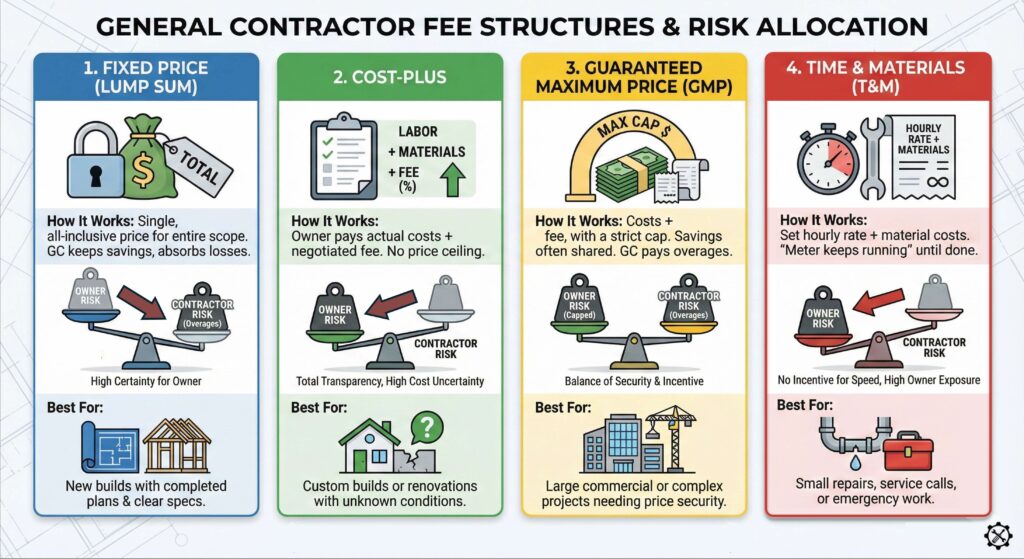
For property owners, understanding how a general contractor is paid is just as important as knowing what they build. The contract structure determines who shoulders the financial risk if material prices spike or the project takes longer than expected.
There are three primary fee structures used in the industry, each with a distinct balance of risk and reward.
1. Fixed Price (Lump Sum)
In a fixed price contract, the general contractor provides a single, all-inclusive price for the entire scope of work.
- How It Works: The owner agrees to pay $500,000 for a completed building. If the GC completes it for $450,000, the GC keeps the $50,000 difference as profit. If it costs $510,000, the GC pays the extra $10,000 out of their own pocket.
- The Risk: The general contractor carries the risk. This provides high certainty for the owner but often leads to a higher initial price tag, as the GC must “pad” the bid to account for potential unknowns.
2. Cost-Plus
In a cost-plus contract, the owner pays for the actual costs of construction (labor, materials, and subcontracts) plus a negotiated fee for the GC’s overhead and profit.
- How It Works: The owner pays every receipt dollar-for-dollar. On top of that, they pay the GC a fee (usually 10–20%). This structure is common in renovations where hidden damage (like rot behind a wall) makes a fixed price impossible to estimate accurately.
- The Risk: The property owner carries the risk. If the price of lumber doubles, the owner pays the difference. However, it offers total transparency—owners see exactly what they are paying for.
3. Guaranteed Maximum Price (GMP)
The GMP is a hybrid model that blends the safety of a fixed price with the transparency of cost-plus.
- How It Works: The owner pays for actual costs plus a fee, similar to cost-plus. However, there is a strict “cap” or maximum price. If costs exceed this cap, the GC must absorb the overage. If the project comes in under budget, the savings are often shared between the owner and GC (e.g., a 70/30 split).
- The Risk: Most of the risk is incurred by the GC. The owner is protected from catastrophic overruns, while the GC is incentivized to work efficiently to share in the savings.
4. Time and Materials (T&M)
Time and materials contracts are typically used for smaller projects, repairs, or emergency work where the full scope cannot be defined before starting.
- How It Works: The owner pays a set hourly labor rate (e.g., $85/hour) for every hour worked, plus the cost of materials (often with a markup). Unlike a fixed price where the total is set, in a T&M contract, the GC is on the clock until the job is done. This is standard for service calls—like fixing a pipe burst—where the contractor cannot know how long the repair will take until they open the wall.
- The Risk: The property owner carries the risk. Because there is no cap on the price, there is no financial incentive for the contractor to work quickly; in fact, the slower they work, the more they get paid. While often necessary when the project scope isn’t known, this is generally the least preferred structure from the owner’s perspective and not common for large-scale construction.
GC Fee Structures Summed Up
| Contract Type | How It Works | Who Carries the Risk? | Best Used For |
| Fixed Price (Lump Sum) | The GC provides one total price for the entire job. If costs go up, the GC pays the difference. | General Contractor | New construction or projects with highly detailed plans. |
| Cost-Plus | The Owner pays for all labor/material costs, plus a % fee for the GC’s profit. | Property Owner | Renovations where the scope is unknown or might change (e.g., opening old walls). |
| Guaranteed Maximum Price (GMP) | A hybrid model. The Owner pays costs + fee, but there is a “cap” that the price cannot exceed. | Shared (Primarily the General Contractor) | Large residential or commercial projects where the owner needs budget certainty. |
| Time and Materials (T&M) | The owner pays a set hourly labor rate plus the cost of materials. The “meter keeps running” until the work is finished. | Property Owner | Small repairs, service calls, or emergency work where the scope is unknown (e.g., fixing a leak). |
Qualifications: License, Insurance, and Bonding Requirements
For a property owner, checking qualifications is the primary defense against fraud and poor workmanship. For an aspiring professional, these are the “barriers to entry” required to operate legally.
Requirements vary significantly by location—some states (like California and Florida) have strict statewide licensing boards, while others (like Pennsylvania and Texas) handle requirements at the city or county level. However, the “Holy Trinity” of compliance remains the same: licensing, insurance, and bonding.
1. State & Local Licensing
A license is proof of competence. It typically proves that the contractor has passed a trade exam, understands building codes, and has a clean background check (though this is not universal across states).
- License vs. Registration: Do not confuse the two. In some jurisdictions, “Registration” just means the GC paid a fee to be on a list (tax purposes). “Licensing” means they passed a test and proved experience.
- Trade Exams: In strict states, a GC must pass a Law & Business exam plus a Trade exam to prove they understand the technical side of construction.
- Verification: Always check the license number on your state’s contractor board website. Ensure the name on the license matches the driver’s license of the person standing in front of you.
2. Insurance Requirements
Insurance protects the financial side of the project. If a GC is uninsured, the property owner can be liable for accidents that happen on their own land.
- General Liability Insurance (GL): This is the baseline. It covers third-party bodily injury (a visitor trips over a cord) and property damage (a ladder falls on your car).
- Workers’ Compensation: Mandatory in every state but Texas if the GC has employees. It pays for medical costs if a worker gets hurt. Crucial: If a GC doesn’t have this, you could be sued for the injured worker’s medical bills.
- Builders Risk Insurance: Often required for new construction or major additions. This policy covers damage to the incomplete structure itself (and materials on-site) from events like fire, theft, vandalism, or extreme weather.
3. Surety Bonds
Unlike insurance, which provides financial protection for the contractors, a surety bond provides protection for the project owner. It is a three-party agreement where a third party (the surety) guarantees that the GC (the principal) will fulfill the contract for the owner (the obligee).
- Performance Bond: Guarantees the project will be completed according to the contract. If the GC goes bankrupt halfway through, the bond pays to hire a new contractor to finish the job.
- Payment Bond: Guarantees that the GC will pay their subcontractors and suppliers. This protects the owner from having a “mechanic’s lien” placed on their house because the GC stiffed the lumberyard.
Tips for Hiring the Right GC
Finding a qualified builder is an active process. Do not rely solely on online reviews, which can be faked.
- Verify the License: Don’t just take their word; check the state board website. Look for “Active” status and check for any history of disciplinary actions.
- Check the History: Look for liens, lawsuits, or unresolved complaints. A pattern of disputes is a major warning sign.
- The “Bid” Review: Be wary of the lowest bid. If one number is 30% lower than the others, it can be a warning sign that the contractor may have missed a large portion of the scope of work, is using subpar materials, or is inexperienced.
The “Red Flag” Vetting Checklist
Use this checklist when interviewing potential contractors. If you check more than one box, proceed with extreme caution.
| Red Flag | Why It’s Dangerous |
| “Cash Only” or “Large Upfront Deposit” | Legitimate businesses take checks/cards. Asking for >30–50% upfront is often a sign of cash flow problems or a scam. |
| No Written Contract | “Handshake deals” are unenforceable in court. If they won’t put the scope, price, and timeline in writing, walk away. |
| “You Pull the Permits” | Huge Warning. The person who pulls the permit is legally responsible for the work. If a GC asks you to pull it, they are likely unlicensed or trying to dodge inspections. |
| High-Pressure Tactics | “This price is only good for today.” Professional contractors know construction is a big decision and will give you time to review. |
| Vague Answers | If they can’t explain how they will build your addition or who their subcontractors are, they likely don’t have a plan. |
How to Become a General Contractor
While many general contractors start their careers by working construction out of high school, others enter the field after completing a relevant four-year degree. Regardless of the path, the job ultimately requires a blend of field experience, technical education, and business acumen. Whether you are a tradesperson looking to level up or a student considering a degree in construction management, there are two primary pathways to this role.
Education & Experience
1. The Trade Path. This is the traditional route. An individual starts as a skilled tradesperson (often a carpenter, framer, or mason), learning the industry. Over time, they advance to foreman, managing a small crew, and then to superintendent, overseeing entire job sites. Finally, they leverage the experience to become a general contractor, either by starting their own firm or moving into a project management role at a larger company.
2. The Academic Path. For large commercial firms, the entry point is often a bachelor’s degree. Common majors include Construction Management, Civil Engineering, or Architecture. Graduates typically start as project engineers or assistant project managers, learning the business side (contracts, scheduling, and estimating) before leading their own projects.
Essential Skills
Success as a GC requires a hybrid skillset that bridges the gap between the office and the job site.
- Hard Skills: Proficiency in reading blueprints, navigating local building codes, and using scheduling software are non-negotiable.
- Problem Solving: Issues inevitably arise on a job site, ranging from scheduling conflicts and budget restraints to complex technical hurdles. A successful GC must be able to adjust quickly and create new plans that balance necessary tradeoffs.
- Soft Skills: A GC is effectively a crisis manager. Leadership, negotiation, and clear communication are critical when resolving disputes between owners, architects, and angry subcontractors.
Salary & Outlook
Compared to other jobs in the construction industry, general contractors tend to be well-compensated, but actual amounts vary wildly depending on whether you are a salaried employee or a business owner.
- Salaried Employees: For those employed by a construction firm, compensation is generally stable and predictable. Note that the Bureau of Labor Statistics (BLS) tracks General Contractors under the wider umbrella of “Construction Managers.” As of 2025, the median annual wage for this role is approximately $114,990, but experienced GCs in high-cost metro areas (like New York or San Francisco) often command significantly higher salaries.
- Business Owners (Self-Employed GCs): For firm owners, income is tied strictly to net profit. While construction is notoriously a high-volume, low-margin industry (with net profit margins typically hovering between 1.5% and 5%), owners who successfully scale their volume can generate sizeable paychecks. BLS data for “Chief Executives” in the construction sector shows:
- Job Outlook: The demand for qualified general contractors is accelerating, with employment projected to grow 9% from 2024 to 2034. This rate is three times faster than the national average, driven primarily by a nationwide need for new housing and major revitalization projects for existing infrastructure.
Conclusion & Next Steps
Whether you are a property owner planning a complex commercial build or an aspiring professional looking to enter the construction field, understanding the role of the general contractor is a good first step.
For owners, the right GC is more than just a builder; they are a partner in risk management. They stand between you and the chaotic variables of construction—legal liabilities, safety hazards, and supply chain disruptions—ensuring your vision is realized without creating a financial mess.
For career seekers, the path to becoming a general contractor offers a challenging but rewarding blend of technical expertise and executive leadership. As the industry evolves with new technologies and stricter regulations, the demand for qualified, professional GCs will only continue to rise.
- For Owners: Before signing a contract, verify your potential GC’s credentials using your state’s specific contractor licensing board.
- For Pros: If you are ready to lead your first job site, explore our guide on Best Construction Project Management Software to see how top GCs streamline operations and keep projects on track.
Frequently Asked Questions (FAQ)
Below are answers to the most common questions regarding the role, classification, and hiring of general contractors.
Can a general contractor be a corporation?
Yes. While many small-scale contractors operate as sole proprietorships, most established general contractors—especially those working on commercial or large residential projects—organize as corporations (Inc.) or Limited Liability Companies (LLC). This structure is often necessary to protect personal assets from the high liability risks inherent in construction. See our complete guide on choosing the right entity structure for your construction business for more information.
What is the average markup for a general contractor?
The industry standard markup typically ranges from 10% to 20% for new construction. However, for renovation and remodeling projects—where the risk of “unknowns” (like mold or structural damage) is higher—markups can range from 20% to 30% or more to account for the increased operational risk.
It is critical to note that markup is not net profit. Markup covers the business’s overhead costs (insurance, office rent, support staff salaries, and marketing). After these expenses are paid, the actual net profit for a general contractor typically averages between 1.5% and 5%.
Do I pay the general contractor or the subcontractors?
In almost all standard contract structures, you pay the general contractor, and the GC is responsible for paying the subcontractors. This single point of payment simplifies your bookkeeping and ensures the GC maintains leverage to enforce quality. Warning: If a GC asks you to write checks directly to subcontractors, it may be a “Red Flag” indicating they are having cash flow problems or trying to avoid tax liability.
Do I need a general contractor for a small renovation?
It depends on complexity, not just size. Hire a GC if the project requires multiple trades (e.g., a bathroom remodel needs a plumber, electrician, and tiler) or requires building permits. The coordination required usually justifies the management fee. Consider managing it yourself if the project only requires a single trade (e.g., just replacing a roof or re-tiling a bathroom). In this case, you can hire a specialized subcontractor directly.
What is a “Prime Contractor”?
“Prime Contractor” is a legal term often used in government and commercial contracts. While it is often used interchangeably with “general contractor,” a prime contractor can sometimes oversee a project so large that they hire other general contractors to manage specific portions of the work.
What is a “Main Contractor”?
“Main Contractor” is the standard term used in the United Kingdom and many international markets for a general contractor. While the terms can be used interchangeably in the U.S., some industry experts differentiate the two, defining a main contractor as overseeing the entire project, while a general contractor is more focused on daily on-site operations.
References
- Associated General Contractors of America (AGC). A construction industry association that provides data on workforce development and industry standards.
- Construction Management Association of America (CMAA). Offers detailed resources on certification and the construction management body of knowledge.
- National Association of State Contractors Licensing Agencies (NASCLA). A helpful resource for finding specific licensing requirements by state.
- U.S. Bureau of Labor Statistics Occupational Outlook Handbook. The primary government dataset tracking salary and employment growth projections across the U.S. economy.