

Best-Paying States for Women in Construction

Note: This is the most recent release of our Best-Paying States for Women in Construction study. To see data from prior years, please visit the Full Results section below.
The U.S. construction industry experienced a surge in demand in the years following the COVID-19 pandemic. The intense real estate market during the pandemic highlighted the shortage of housing stock across the United States. Between 2020 and 2022, private construction spending rose rapidly, fueled by a wave of new housing starts. In April 2022, housing starts reached their highest level in more than 15 years before declining to pre-pandemic levels as mortgage rates climbed. And just as private construction activity began to plateau, funding for public projects became available—most notably through the Bipartisan Infrastructure Law—driving growth in public-sector construction spending.
Today, however, the outlook for the construction industry is less certain amid economic headwinds, including a softening labor market, foreign import tariffs, and persistently high interest rates. Despite these challenges, construction firms continue to face severe labor shortages. The Associated Builders and Contractors, a leading industry trade group, estimated a shortfall of 439,000 workers. Meanwhile, the Bureau of Labor Statistics reported 306,000 openings for construction jobs as of July 2025.
In response to the labor shortage, the industry is increasingly drawing on a historically underrepresented segment of the population: women. Analyzing the newest data from the U.S. Census Bureau and the Bureau of Economic Analysis, researchers at Construction Coverage identified the best-paying states for women in the construction industry.
Female Employment in Construction
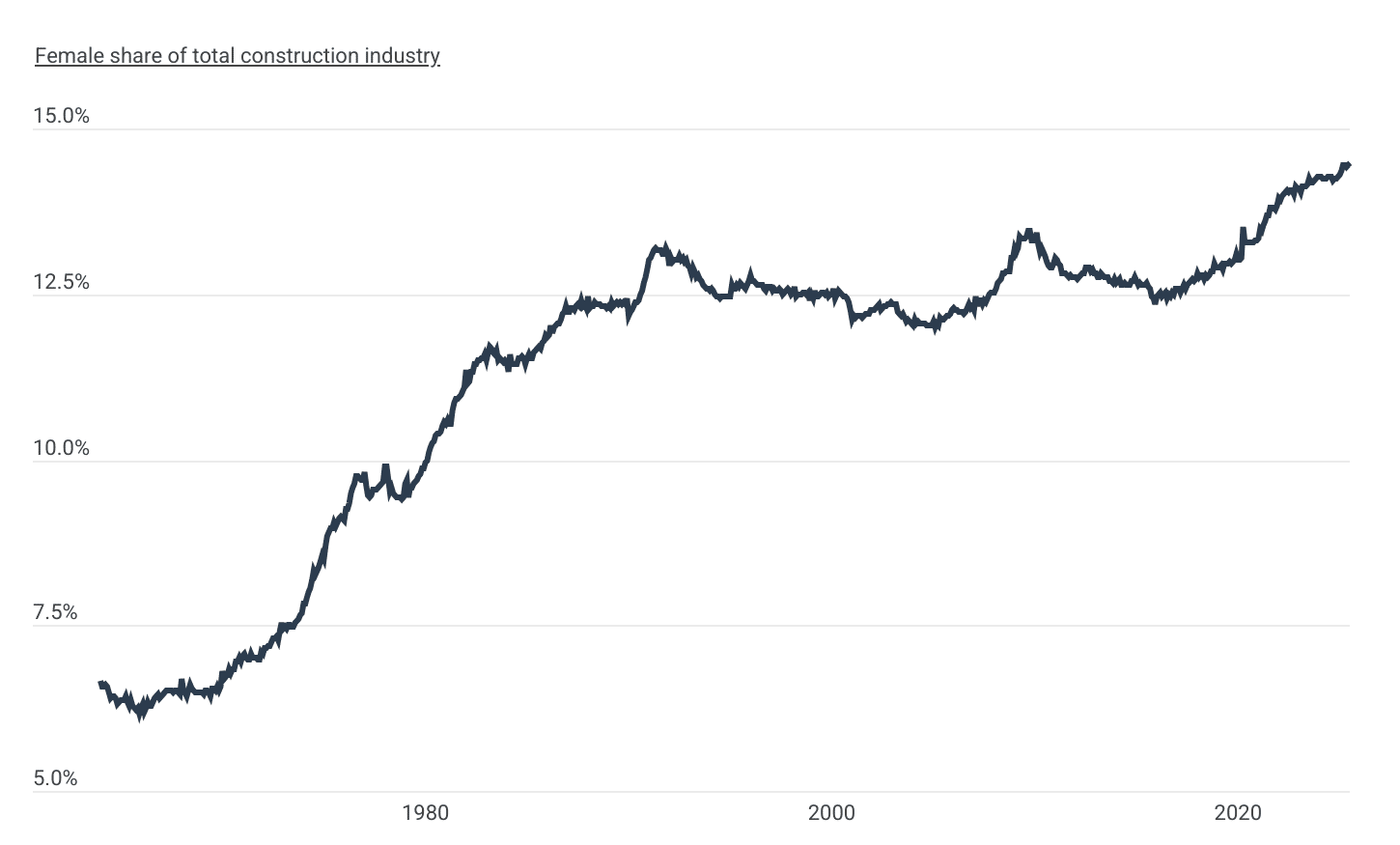
The share of women in construction employment has more than doubled since the 1960s and continues to rise
Data: Female Share of Total Construction Industry Employment Time Series
| Date | Female employment share |
|---|---|
| 1/1/1964 | 6.676% |
| 2/1/1964 | 6.577% |
| 3/1/1964 | 6.560% |
| 4/1/1964 | 6.617% |
| 5/1/1964 | 6.560% |
| 6/1/1964 | 6.482% |
| 7/1/1964 | 6.398% |
| 8/1/1964 | 6.443% |
| 9/1/1964 | 6.433% |
| 10/1/1964 | 6.406% |
| 11/1/1964 | 6.324% |
| 12/1/1964 | 6.341% |
| 1/1/1965 | 6.376% |
| 2/1/1965 | 6.357% |
| 3/1/1965 | 6.356% |
| 4/1/1965 | 6.438% |
| 5/1/1965 | 6.332% |
| 6/1/1965 | 6.282% |
| 7/1/1965 | 6.371% |
| 8/1/1965 | 6.297% |
| 9/1/1965 | 6.265% |
| 10/1/1965 | 6.228% |
| 11/1/1965 | 6.241% |
| 12/1/1965 | 6.166% |
| 1/1/1966 | 6.244% |
| 2/1/1966 | 6.325% |
| 3/1/1966 | 6.197% |
| 4/1/1966 | 6.246% |
| 5/1/1966 | 6.339% |
| 6/1/1966 | 6.283% |
| 7/1/1966 | 6.287% |
| 8/1/1966 | 6.335% |
| 9/1/1966 | 6.386% |
| 10/1/1966 | 6.437% |
| 11/1/1966 | 6.457% |
| 12/1/1966 | 6.389% |
| 1/1/1967 | 6.428% |
| 2/1/1967 | 6.452% |
| 3/1/1967 | 6.474% |
| 4/1/1967 | 6.530% |
| 5/1/1967 | 6.530% |
| 6/1/1967 | 6.526% |
| 7/1/1967 | 6.509% |
| 8/1/1967 | 6.492% |
| 9/1/1967 | 6.518% |
| 10/1/1967 | 6.520% |
| 11/1/1967 | 6.489% |
| 12/1/1967 | 6.457% |
| 1/1/1968 | 6.696% |
| 2/1/1968 | 6.506% |
| 3/1/1968 | 6.494% |
| 4/1/1968 | 6.439% |
| 5/1/1968 | 6.519% |
| 6/1/1968 | 6.601% |
| 7/1/1968 | 6.556% |
| 8/1/1968 | 6.526% |
| 9/1/1968 | 6.480% |
| 10/1/1968 | 6.476% |
| 11/1/1968 | 6.483% |
| 12/1/1968 | 6.495% |
| 1/1/1969 | 6.480% |
| 2/1/1969 | 6.462% |
| 3/1/1969 | 6.510% |
| 4/1/1969 | 6.518% |
| 5/1/1969 | 6.492% |
| 6/1/1969 | 6.441% |
| 7/1/1969 | 6.550% |
| 8/1/1969 | 6.541% |
| 9/1/1969 | 6.502% |
| 10/1/1969 | 6.563% |
| 11/1/1969 | 6.516% |
| 12/1/1969 | 6.582% |
| 1/1/1970 | 6.805% |
| 2/1/1970 | 6.697% |
| 3/1/1970 | 6.708% |
| 4/1/1970 | 6.759% |
| 5/1/1970 | 6.824% |
| 6/1/1970 | 6.793% |
| 7/1/1970 | 6.831% |
| 8/1/1970 | 6.851% |
| 9/1/1970 | 6.965% |
| 10/1/1970 | 6.950% |
| 11/1/1970 | 7.000% |
| 12/1/1970 | 6.941% |
| 1/1/1971 | 7.055% |
| 2/1/1971 | 7.074% |
| 3/1/1971 | 7.022% |
| 4/1/1971 | 6.988% |
| 5/1/1971 | 6.987% |
| 6/1/1971 | 7.076% |
| 7/1/1971 | 6.999% |
| 8/1/1971 | 7.026% |
| 9/1/1971 | 7.016% |
| 10/1/1971 | 6.982% |
| 11/1/1971 | 6.969% |
| 12/1/1971 | 7.086% |
| 1/1/1972 | 7.081% |
| 2/1/1972 | 7.150% |
| 3/1/1972 | 7.167% |
| 4/1/1972 | 7.174% |
| 5/1/1972 | 7.177% |
| 6/1/1972 | 7.231% |
| 7/1/1972 | 7.312% |
| 8/1/1972 | 7.306% |
| 9/1/1972 | 7.325% |
| 10/1/1972 | 7.281% |
| 11/1/1972 | 7.421% |
| 12/1/1972 | 7.544% |
| 1/1/1973 | 7.443% |
| 2/1/1973 | 7.467% |
| 3/1/1973 | 7.459% |
| 4/1/1973 | 7.501% |
| 5/1/1973 | 7.518% |
| 6/1/1973 | 7.465% |
| 7/1/1973 | 7.491% |
| 8/1/1973 | 7.536% |
| 9/1/1973 | 7.553% |
| 10/1/1973 | 7.609% |
| 11/1/1973 | 7.656% |
| 12/1/1973 | 7.690% |
| 1/1/1974 | 7.841% |
| 2/1/1974 | 7.819% |
| 3/1/1974 | 7.920% |
| 4/1/1974 | 8.000% |
| 5/1/1974 | 8.051% |
| 6/1/1974 | 8.177% |
| 7/1/1974 | 8.331% |
| 8/1/1974 | 8.278% |
| 9/1/1974 | 8.331% |
| 10/1/1974 | 8.384% |
| 11/1/1974 | 8.463% |
| 12/1/1974 | 8.549% |
| 1/1/1975 | 8.513% |
| 2/1/1975 | 8.714% |
| 3/1/1975 | 8.848% |
| 4/1/1975 | 8.920% |
| 5/1/1975 | 8.953% |
| 6/1/1975 | 8.962% |
| 7/1/1975 | 9.055% |
| 8/1/1975 | 8.994% |
| 9/1/1975 | 9.040% |
| 10/1/1975 | 9.116% |
| 11/1/1975 | 9.129% |
| 12/1/1975 | 9.118% |
| 1/1/1976 | 9.084% |
| 2/1/1976 | 9.249% |
| 3/1/1976 | 9.254% |
| 4/1/1976 | 9.338% |
| 5/1/1976 | 9.482% |
| 6/1/1976 | 9.581% |
| 7/1/1976 | 9.650% |
| 8/1/1976 | 9.747% |
| 9/1/1976 | 9.741% |
| 10/1/1976 | 9.712% |
| 11/1/1976 | 9.706% |
| 12/1/1976 | 9.707% |
| 1/1/1977 | 9.809% |
| 2/1/1977 | 9.616% |
| 3/1/1977 | 9.458% |
| 4/1/1977 | 9.426% |
| 5/1/1977 | 9.466% |
| 6/1/1977 | 9.541% |
| 7/1/1977 | 9.545% |
| 8/1/1977 | 9.562% |
| 9/1/1977 | 9.570% |
| 10/1/1977 | 9.618% |
| 11/1/1977 | 9.635% |
| 12/1/1977 | 9.665% |
| 1/1/1978 | 9.903% |
| 2/1/1978 | 9.906% |
| 3/1/1978 | 9.718% |
| 4/1/1978 | 9.517% |
| 5/1/1978 | 9.577% |
| 6/1/1978 | 9.477% |
| 7/1/1978 | 9.448% |
| 8/1/1978 | 9.434% |
| 9/1/1978 | 9.426% |
| 10/1/1978 | 9.445% |
| 11/1/1978 | 9.409% |
| 12/1/1978 | 9.438% |
| 1/1/1979 | 9.650% |
| 2/1/1979 | 9.683% |
| 3/1/1979 | 9.424% |
| 4/1/1979 | 9.566% |
| 5/1/1979 | 9.573% |
| 6/1/1979 | 9.622% |
| 7/1/1979 | 9.673% |
| 8/1/1979 | 9.689% |
| 9/1/1979 | 9.751% |
| 10/1/1979 | 9.784% |
| 11/1/1979 | 9.855% |
| 12/1/1979 | 9.870% |
| 1/1/1980 | 9.946% |
| 2/1/1980 | 9.989% |
| 3/1/1980 | 10.114% |
| 4/1/1980 | 10.195% |
| 5/1/1980 | 10.262% |
| 6/1/1980 | 10.284% |
| 7/1/1980 | 10.365% |
| 8/1/1980 | 10.395% |
| 9/1/1980 | 10.384% |
| 10/1/1980 | 10.428% |
| 11/1/1980 | 10.501% |
| 12/1/1980 | 10.578% |
| 1/1/1981 | 10.540% |
| 2/1/1981 | 10.604% |
| 3/1/1981 | 10.532% |
| 4/1/1981 | 10.535% |
| 5/1/1981 | 10.730% |
| 6/1/1981 | 10.856% |
| 7/1/1981 | 10.910% |
| 8/1/1981 | 10.916% |
| 9/1/1981 | 10.954% |
| 10/1/1981 | 10.972% |
| 11/1/1981 | 11.024% |
| 12/1/1981 | 11.085% |
| 1/1/1982 | 11.354% |
| 2/1/1982 | 11.160% |
| 3/1/1982 | 11.173% |
| 4/1/1982 | 11.340% |
| 5/1/1982 | 11.315% |
| 6/1/1982 | 11.439% |
| 7/1/1982 | 11.447% |
| 8/1/1982 | 11.491% |
| 9/1/1982 | 11.509% |
| 10/1/1982 | 11.523% |
| 11/1/1982 | 11.528% |
| 12/1/1982 | 11.601% |
| 1/1/1983 | 11.490% |
| 2/1/1983 | 11.630% |
| 3/1/1983 | 11.695% |
| 4/1/1983 | 11.677% |
| 5/1/1983 | 11.616% |
| 6/1/1983 | 11.583% |
| 7/1/1983 | 11.640% |
| 8/1/1983 | 11.512% |
| 9/1/1983 | 11.527% |
| 10/1/1983 | 11.489% |
| 11/1/1983 | 11.477% |
| 12/1/1983 | 11.511% |
| 1/1/1984 | 11.475% |
| 2/1/1984 | 11.338% |
| 3/1/1984 | 11.587% |
| 4/1/1984 | 11.440% |
| 5/1/1984 | 11.445% |
| 6/1/1984 | 11.449% |
| 7/1/1984 | 11.447% |
| 8/1/1984 | 11.524% |
| 9/1/1984 | 11.517% |
| 10/1/1984 | 11.547% |
| 11/1/1984 | 11.523% |
| 12/1/1984 | 11.457% |
| 1/1/1985 | 11.525% |
| 2/1/1985 | 11.583% |
| 3/1/1985 | 11.522% |
| 4/1/1985 | 11.545% |
| 5/1/1985 | 11.615% |
| 6/1/1985 | 11.652% |
| 7/1/1985 | 11.669% |
| 8/1/1985 | 11.715% |
| 9/1/1985 | 11.686% |
| 10/1/1985 | 11.750% |
| 11/1/1985 | 11.785% |
| 12/1/1985 | 11.868% |
| 1/1/1986 | 11.858% |
| 2/1/1986 | 11.868% |
| 3/1/1986 | 12.027% |
| 4/1/1986 | 11.899% |
| 5/1/1986 | 12.002% |
| 6/1/1986 | 12.040% |
| 7/1/1986 | 12.069% |
| 8/1/1986 | 12.057% |
| 9/1/1986 | 12.128% |
| 10/1/1986 | 12.192% |
| 11/1/1986 | 12.238% |
| 12/1/1986 | 12.317% |
| 1/1/1987 | 12.223% |
| 2/1/1987 | 12.227% |
| 3/1/1987 | 12.284% |
| 4/1/1987 | 12.290% |
| 5/1/1987 | 12.264% |
| 6/1/1987 | 12.308% |
| 7/1/1987 | 12.353% |
| 8/1/1987 | 12.328% |
| 9/1/1987 | 12.402% |
| 10/1/1987 | 12.330% |
| 11/1/1987 | 12.345% |
| 12/1/1987 | 12.297% |
| 1/1/1988 | 12.466% |
| 2/1/1988 | 12.282% |
| 3/1/1988 | 12.305% |
| 4/1/1988 | 12.321% |
| 5/1/1988 | 12.376% |
| 6/1/1988 | 12.336% |
| 7/1/1988 | 12.334% |
| 8/1/1988 | 12.339% |
| 9/1/1988 | 12.315% |
| 10/1/1988 | 12.315% |
| 11/1/1988 | 12.308% |
| 12/1/1988 | 12.299% |
| 1/1/1989 | 12.309% |
| 2/1/1989 | 12.296% |
| 3/1/1989 | 12.376% |
| 4/1/1989 | 12.332% |
| 5/1/1989 | 12.342% |
| 6/1/1989 | 12.382% |
| 7/1/1989 | 12.357% |
| 8/1/1989 | 12.364% |
| 9/1/1989 | 12.343% |
| 10/1/1989 | 12.381% |
| 11/1/1989 | 12.342% |
| 12/1/1989 | 12.432% |
| 1/1/1990 | 12.173% |
| 2/1/1990 | 12.223% |
| 3/1/1990 | 12.259% |
| 4/1/1990 | 12.306% |
| 5/1/1990 | 12.366% |
| 6/1/1990 | 12.370% |
| 7/1/1990 | 12.419% |
| 8/1/1990 | 12.495% |
| 9/1/1990 | 12.546% |
| 10/1/1990 | 12.680% |
| 11/1/1990 | 12.758% |
| 12/1/1990 | 12.879% |
| 1/1/1991 | 13.013% |
| 2/1/1991 | 13.045% |
| 3/1/1991 | 13.112% |
| 4/1/1991 | 13.176% |
| 5/1/1991 | 13.188% |
| 6/1/1991 | 13.174% |
| 7/1/1991 | 13.173% |
| 8/1/1991 | 13.163% |
| 9/1/1991 | 13.113% |
| 10/1/1991 | 13.112% |
| 11/1/1991 | 13.190% |
| 12/1/1991 | 13.148% |
| 1/1/1992 | 12.942% |
| 2/1/1992 | 13.053% |
| 3/1/1992 | 12.984% |
| 4/1/1992 | 13.013% |
| 5/1/1992 | 13.008% |
| 6/1/1992 | 13.024% |
| 7/1/1992 | 13.063% |
| 8/1/1992 | 13.032% |
| 9/1/1992 | 13.045% |
| 10/1/1992 | 13.000% |
| 11/1/1992 | 13.005% |
| 12/1/1992 | 12.937% |
| 1/1/1993 | 12.907% |
| 2/1/1993 | 12.813% |
| 3/1/1993 | 12.896% |
| 4/1/1993 | 12.857% |
| 5/1/1993 | 12.750% |
| 6/1/1993 | 12.773% |
| 7/1/1993 | 12.733% |
| 8/1/1993 | 12.692% |
| 9/1/1993 | 12.648% |
| 10/1/1993 | 12.613% |
| 11/1/1993 | 12.584% |
| 12/1/1993 | 12.589% |
| 1/1/1994 | 12.551% |
| 2/1/1994 | 12.594% |
| 3/1/1994 | 12.545% |
| 4/1/1994 | 12.483% |
| 5/1/1994 | 12.451% |
| 6/1/1994 | 12.458% |
| 7/1/1994 | 12.429% |
| 8/1/1994 | 12.473% |
| 9/1/1994 | 12.464% |
| 10/1/1994 | 12.478% |
| 11/1/1994 | 12.476% |
| 12/1/1994 | 12.457% |
| 1/1/1995 | 12.476% |
| 2/1/1995 | 12.635% |
| 3/1/1995 | 12.572% |
| 4/1/1995 | 12.567% |
| 5/1/1995 | 12.625% |
| 6/1/1995 | 12.610% |
| 7/1/1995 | 12.657% |
| 8/1/1995 | 12.637% |
| 9/1/1995 | 12.622% |
| 10/1/1995 | 12.591% |
| 11/1/1995 | 12.635% |
| 12/1/1995 | 12.706% |
| 1/1/1996 | 12.773% |
| 2/1/1996 | 12.705% |
| 3/1/1996 | 12.688% |
| 4/1/1996 | 12.660% |
| 5/1/1996 | 12.641% |
| 6/1/1996 | 12.631% |
| 7/1/1996 | 12.651% |
| 8/1/1996 | 12.639% |
| 9/1/1996 | 12.567% |
| 10/1/1996 | 12.547% |
| 11/1/1996 | 12.597% |
| 12/1/1996 | 12.599% |
| 1/1/1997 | 12.617% |
| 2/1/1997 | 12.548% |
| 3/1/1997 | 12.572% |
| 4/1/1997 | 12.561% |
| 5/1/1997 | 12.550% |
| 6/1/1997 | 12.567% |
| 7/1/1997 | 12.549% |
| 8/1/1997 | 12.487% |
| 9/1/1997 | 12.513% |
| 10/1/1997 | 12.562% |
| 11/1/1997 | 12.578% |
| 12/1/1997 | 12.546% |
| 1/1/1998 | 12.502% |
| 2/1/1998 | 12.523% |
| 3/1/1998 | 12.615% |
| 4/1/1998 | 12.465% |
| 5/1/1998 | 12.502% |
| 6/1/1998 | 12.496% |
| 7/1/1998 | 12.492% |
| 8/1/1998 | 12.518% |
| 9/1/1998 | 12.530% |
| 10/1/1998 | 12.504% |
| 11/1/1998 | 12.522% |
| 12/1/1998 | 12.418% |
| 1/1/1999 | 12.506% |
| 2/1/1999 | 12.444% |
| 3/1/1999 | 12.543% |
| 4/1/1999 | 12.469% |
| 5/1/1999 | 12.462% |
| 6/1/1999 | 12.494% |
| 7/1/1999 | 12.510% |
| 8/1/1999 | 12.527% |
| 9/1/1999 | 12.491% |
| 10/1/1999 | 12.515% |
| 11/1/1999 | 12.472% |
| 12/1/1999 | 12.491% |
| 1/1/2000 | 12.500% |
| 2/1/2000 | 12.585% |
| 3/1/2000 | 12.436% |
| 4/1/2000 | 12.482% |
| 5/1/2000 | 12.541% |
| 6/1/2000 | 12.526% |
| 7/1/2000 | 12.496% |
| 8/1/2000 | 12.478% |
| 9/1/2000 | 12.458% |
| 10/1/2000 | 12.430% |
| 11/1/2000 | 12.366% |
| 12/1/2000 | 12.264% |
| 1/1/2001 | 12.119% |
| 2/1/2001 | 12.162% |
| 3/1/2001 | 12.154% |
| 4/1/2001 | 12.171% |
| 5/1/2001 | 12.162% |
| 6/1/2001 | 12.178% |
| 7/1/2001 | 12.140% |
| 8/1/2001 | 12.172% |
| 9/1/2001 | 12.212% |
| 10/1/2001 | 12.213% |
| 11/1/2001 | 12.205% |
| 12/1/2001 | 12.248% |
| 1/1/2002 | 12.266% |
| 2/1/2002 | 12.267% |
| 3/1/2002 | 12.302% |
| 4/1/2002 | 12.325% |
| 5/1/2002 | 12.358% |
| 6/1/2002 | 12.267% |
| 7/1/2002 | 12.276% |
| 8/1/2002 | 12.312% |
| 9/1/2002 | 12.310% |
| 10/1/2002 | 12.334% |
| 11/1/2002 | 12.334% |
| 12/1/2002 | 12.388% |
| 1/1/2003 | 12.351% |
| 2/1/2003 | 12.359% |
| 3/1/2003 | 12.338% |
| 4/1/2003 | 12.244% |
| 5/1/2003 | 12.198% |
| 6/1/2003 | 12.182% |
| 7/1/2003 | 12.205% |
| 8/1/2003 | 12.145% |
| 9/1/2003 | 12.089% |
| 10/1/2003 | 12.117% |
| 11/1/2003 | 12.095% |
| 12/1/2003 | 12.055% |
| 1/1/2004 | 12.033% |
| 2/1/2004 | 12.109% |
| 3/1/2004 | 12.052% |
| 4/1/2004 | 12.085% |
| 5/1/2004 | 12.061% |
| 6/1/2004 | 12.065% |
| 7/1/2004 | 12.068% |
| 8/1/2004 | 12.066% |
| 9/1/2004 | 12.036% |
| 10/1/2004 | 12.025% |
| 11/1/2004 | 12.029% |
| 12/1/2004 | 12.028% |
| 1/1/2005 | 12.093% |
| 2/1/2005 | 12.009% |
| 3/1/2005 | 12.060% |
| 4/1/2005 | 12.015% |
| 5/1/2005 | 12.133% |
| 6/1/2005 | 12.123% |
| 7/1/2005 | 12.118% |
| 8/1/2005 | 12.145% |
| 9/1/2005 | 12.178% |
| 10/1/2005 | 12.172% |
| 11/1/2005 | 12.188% |
| 12/1/2005 | 12.266% |
| 1/1/2006 | 12.288% |
| 2/1/2006 | 12.265% |
| 3/1/2006 | 12.264% |
| 4/1/2006 | 12.231% |
| 5/1/2006 | 12.239% |
| 6/1/2006 | 12.235% |
| 7/1/2006 | 12.189% |
| 8/1/2006 | 12.228% |
| 9/1/2006 | 12.296% |
| 10/1/2006 | 12.341% |
| 11/1/2006 | 12.301% |
| 12/1/2006 | 12.323% |
| 1/1/2007 | 12.272% |
| 2/1/2007 | 12.457% |
| 3/1/2007 | 12.315% |
| 4/1/2007 | 12.399% |
| 5/1/2007 | 12.407% |
| 6/1/2007 | 12.346% |
| 7/1/2007 | 12.415% |
| 8/1/2007 | 12.365% |
| 9/1/2007 | 12.432% |
| 10/1/2007 | 12.479% |
| 11/1/2007 | 12.522% |
| 12/1/2007 | 12.510% |
| 1/1/2008 | 12.533% |
| 2/1/2008 | 12.572% |
| 3/1/2008 | 12.665% |
| 4/1/2008 | 12.693% |
| 5/1/2008 | 12.730% |
| 6/1/2008 | 12.810% |
| 7/1/2008 | 12.821% |
| 8/1/2008 | 12.848% |
| 9/1/2008 | 12.848% |
| 10/1/2008 | 12.846% |
| 11/1/2008 | 13.049% |
| 12/1/2008 | 13.058% |
| 1/1/2009 | 13.187% |
| 2/1/2009 | 13.140% |
| 3/1/2009 | 13.193% |
| 4/1/2009 | 13.373% |
| 5/1/2009 | 13.328% |
| 6/1/2009 | 13.328% |
| 7/1/2009 | 13.334% |
| 8/1/2009 | 13.373% |
| 9/1/2009 | 13.444% |
| 10/1/2009 | 13.453% |
| 11/1/2009 | 13.308% |
| 12/1/2009 | 13.300% |
| 1/1/2010 | 13.315% |
| 2/1/2010 | 13.418% |
| 3/1/2010 | 13.256% |
| 4/1/2010 | 13.146% |
| 5/1/2010 | 13.188% |
| 6/1/2010 | 13.144% |
| 7/1/2010 | 13.090% |
| 8/1/2010 | 12.980% |
| 9/1/2010 | 12.943% |
| 10/1/2010 | 12.890% |
| 11/1/2010 | 12.895% |
| 12/1/2010 | 12.950% |
| 1/1/2011 | 13.046% |
| 2/1/2011 | 13.025% |
| 3/1/2011 | 12.945% |
| 4/1/2011 | 12.944% |
| 5/1/2011 | 12.817% |
| 6/1/2011 | 12.826% |
| 7/1/2011 | 12.818% |
| 8/1/2011 | 12.788% |
| 9/1/2011 | 12.751% |
| 10/1/2011 | 12.777% |
| 11/1/2011 | 12.766% |
| 12/1/2011 | 12.761% |
| 1/1/2012 | 12.744% |
| 2/1/2012 | 12.738% |
| 3/1/2012 | 12.747% |
| 4/1/2012 | 12.798% |
| 5/1/2012 | 12.812% |
| 6/1/2012 | 12.827% |
| 7/1/2012 | 12.908% |
| 8/1/2012 | 12.890% |
| 9/1/2012 | 12.895% |
| 10/1/2012 | 12.848% |
| 11/1/2012 | 12.861% |
| 12/1/2012 | 12.823% |
| 1/1/2013 | 12.826% |
| 2/1/2013 | 12.759% |
| 3/1/2013 | 12.754% |
| 4/1/2013 | 12.802% |
| 5/1/2013 | 12.781% |
| 6/1/2013 | 12.741% |
| 7/1/2013 | 12.750% |
| 8/1/2013 | 12.742% |
| 9/1/2013 | 12.707% |
| 10/1/2013 | 12.696% |
| 11/1/2013 | 12.678% |
| 12/1/2013 | 12.728% |
| 1/1/2014 | 12.665% |
| 2/1/2014 | 12.702% |
| 3/1/2014 | 12.719% |
| 4/1/2014 | 12.640% |
| 5/1/2014 | 12.637% |
| 6/1/2014 | 12.669% |
| 7/1/2014 | 12.642% |
| 8/1/2014 | 12.641% |
| 9/1/2014 | 12.624% |
| 10/1/2014 | 12.702% |
| 11/1/2014 | 12.707% |
| 12/1/2014 | 12.744% |
| 1/1/2015 | 12.690% |
| 2/1/2015 | 12.624% |
| 3/1/2015 | 12.662% |
| 4/1/2015 | 12.641% |
| 5/1/2015 | 12.634% |
| 6/1/2015 | 12.653% |
| 7/1/2015 | 12.655% |
| 8/1/2015 | 12.604% |
| 9/1/2015 | 12.569% |
| 10/1/2015 | 12.464% |
| 11/1/2015 | 12.443% |
| 12/1/2015 | 12.353% |
| 1/1/2016 | 12.472% |
| 2/1/2016 | 12.500% |
| 3/1/2016 | 12.534% |
| 4/1/2016 | 12.474% |
| 5/1/2016 | 12.498% |
| 6/1/2016 | 12.521% |
| 7/1/2016 | 12.442% |
| 8/1/2016 | 12.485% |
| 9/1/2016 | 12.470% |
| 10/1/2016 | 12.517% |
| 11/1/2016 | 12.487% |
| 12/1/2016 | 12.570% |
| 1/1/2017 | 12.573% |
| 2/1/2017 | 12.571% |
| 3/1/2017 | 12.533% |
| 4/1/2017 | 12.594% |
| 5/1/2017 | 12.624% |
| 6/1/2017 | 12.583% |
| 7/1/2017 | 12.644% |
| 8/1/2017 | 12.654% |
| 9/1/2017 | 12.691% |
| 10/1/2017 | 12.715% |
| 11/1/2017 | 12.705% |
| 12/1/2017 | 12.734% |
| 1/1/2018 | 12.801% |
| 2/1/2018 | 12.751% |
| 3/1/2018 | 12.775% |
| 4/1/2018 | 12.798% |
| 5/1/2018 | 12.730% |
| 6/1/2018 | 12.781% |
| 7/1/2018 | 12.763% |
| 8/1/2018 | 12.781% |
| 9/1/2018 | 12.841% |
| 10/1/2018 | 12.843% |
| 11/1/2018 | 12.957% |
| 12/1/2018 | 12.899% |
| 1/1/2019 | 12.902% |
| 2/1/2019 | 12.901% |
| 3/1/2019 | 12.929% |
| 4/1/2019 | 12.868% |
| 5/1/2019 | 12.958% |
| 6/1/2019 | 12.957% |
| 7/1/2019 | 12.968% |
| 8/1/2019 | 12.975% |
| 9/1/2019 | 12.946% |
| 10/1/2019 | 12.988% |
| 11/1/2019 | 13.009% |
| 12/1/2019 | 13.100% |
| 1/1/2020 | 13.017% |
| 2/1/2020 | 13.009% |
| 3/1/2020 | 13.049% |
| 4/1/2020 | 13.523% |
| 5/1/2020 | 13.292% |
| 6/1/2020 | 13.284% |
| 7/1/2020 | 13.285% |
| 8/1/2020 | 13.285% |
| 9/1/2020 | 13.291% |
| 10/1/2020 | 13.286% |
| 11/1/2020 | 13.318% |
| 12/1/2020 | 13.321% |
| 1/1/2021 | 13.346% |
| 2/1/2021 | 13.492% |
| 3/1/2021 | 13.461% |
| 4/1/2021 | 13.552% |
| 5/1/2021 | 13.615% |
| 6/1/2021 | 13.677% |
| 7/1/2021 | 13.698% |
| 8/1/2021 | 13.794% |
| 9/1/2021 | 13.800% |
| 10/1/2021 | 13.816% |
| 11/1/2021 | 13.787% |
| 12/1/2021 | 13.827% |
| 1/1/2022 | 13.960% |
| 2/1/2022 | 13.930% |
| 3/1/2022 | 13.970% |
| 4/1/2022 | 14.002% |
| 5/1/2022 | 14.049% |
| 6/1/2022 | 14.059% |
| 7/1/2022 | 14.045% |
| 8/1/2022 | 14.053% |
| 9/1/2022 | 14.079% |
| 10/1/2022 | 14.020% |
| 11/1/2022 | 14.128% |
| 12/1/2022 | 14.090% |
| 1/1/2023 | 14.087% |
| 2/1/2023 | 14.043% |
| 3/1/2023 | 14.134% |
| 4/1/2023 | 14.117% |
| 5/1/2023 | 14.124% |
| 6/1/2023 | 14.164% |
| 7/1/2023 | 14.250% |
| 8/1/2023 | 14.193% |
| 9/1/2023 | 14.188% |
| 10/1/2023 | 14.215% |
| 11/1/2023 | 14.236% |
| 12/1/2023 | 14.273% |
| 1/1/2024 | 14.261% |
| 2/1/2024 | 14.258% |
| 3/1/2024 | 14.235% |
| 4/1/2024 | 14.254% |
| 5/1/2024 | 14.240% |
| 6/1/2024 | 14.263% |
| 7/1/2024 | 14.280% |
| 8/1/2024 | 14.265% |
| 9/1/2024 | 14.225% |
| 10/1/2024 | 14.248% |
| 11/1/2024 | 14.249% |
| 12/1/2024 | 14.260% |
| 1/1/2025 | 14.301% |
| 2/1/2025 | 14.365% |
| 3/1/2025 | 14.453% |
| 4/1/2025 | 14.441% |
| 5/1/2025 | 14.425% |
| 6/1/2025 | 14.432% |
| 7/1/2025 | 14.416% |
Construction has historically been a male-dominated sector. In the 1960s, only about 6% of construction industry workers were women. This figure began to rise sharply between 1970 and the early 1990s, coinciding with increasing rates of female labor force participation overall. Between then and the mid-2000s, female representation in the construction sector remained relatively steady, aside from some fluctuations during the Great Recession. However, since around 2016, the percentage of women in the construction industry has consistently increased. As of July 2025, 14.4% of all workers and 10.7% of full-time workers in the sector are women.
Construction careers extend beyond the job site.
While women represent a low share of workers in trade occupations, they are more likely to hold other types of positions within construction firms, such as roles in construction accounting or project management.
Top-Paying Occupations for Women in the Construction Industry
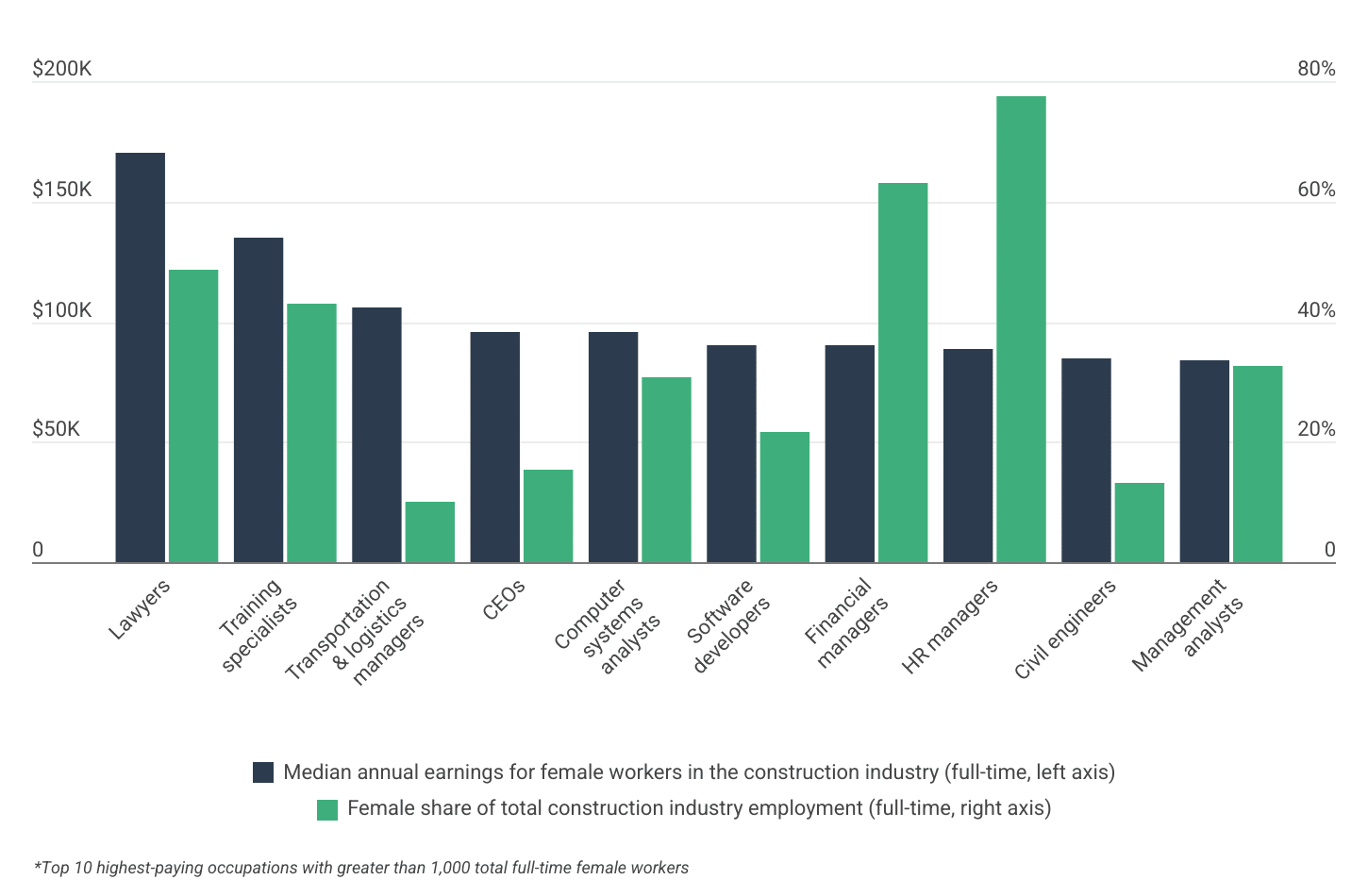
In the construction industry, women are disproportionately concentrated in high-paying jobs
Data: Top-Paying Occupations for Women in the Construction Industry
| Occupation | Median annual earnings | Female employment share |
|---|---|---|
| Lawyers | $170,000 | 48.7% |
| Training specialists | $135,000 | 42.9% |
| Transportation & logistics managers | $106,000 | 9.9% |
| CEOs | $96,000 | 15.5% |
| Computer systems analysts | $96,000 | 30.7% |
| Software developers | $90,000 | 21.8% |
| Financial managers | $90,000 | 63.0% |
| HR managers | $89,000 | 77.5% |
| Civil engineers | $85,000 | 13.3% |
| Management analysts | $84,000 | 32.5% |
While women still have low representation within construction trade occupations—such as plumbers, carpenters, masons, and electricians—they have disproportionately high representation in some of the industry’s best-paying jobs. For instance, lawyers in the construction sector are the industry’s top-paid workers, with median annual wages of $170,000 for female lawyers working full-time. Women account for more than 48% of construction industry attorneys, over four times higher than their overall representation in the sector. This trend is seen across many of the best-paying occupations for women in the construction sector, including training specialists, CEOs, computer systems analysts, software developers, financial managers, HR managers, civil engineers, and management analysts.
Due to women’s relatively high concentrations in the sector’s top-paying jobs, the median wage for full-time women working in construction exceeds that for all full-time working women in 39 states. Additionally, the gender wage gap in the construction industry is 4.9%, compared to 18.9% across all full-time workers.
Outside of occupation, location is a critical determinant of construction industry pay. Nationally, full-time female workers earn $54,044 annually in the sector, but pay varies widely by state. Additionally, regional differences in cost of living affect how far a given salary will go in a given location. To find the best-paying states, researchers at Construction Coverage analyzed data from the U.S. Census Bureau and the U.S. Bureau of Economic Analysis to rank states according to the median annual wage for full-time female workers in the construction industry, adjusted for cost-of-living differences.
The tables below provide a more detailed look at how states compare. For more information on data sources and methods, see the methodology section below.
Best- and Worst-Paying States for Women in Construction
| Top States | Wage* |
|---|---|
| 1. Alaska | $74,251 |
| 2. Massachusetts | $66,957 |
| 3. Washington | $64,158 |
| 4. Colorado | $63,715 |
| 5. Minnesota | $63,584 |
| 6. Vermont | $63,413 |
| 7. Hawaii | $62,818 |
| 8. Maine | $62,637 |
| 9. Connecticut | $62,354 |
| 10. Illinois | $62,053 |
| 11. New Hampshire | $61,712 |
| 12. New Jersey | $61,368 |
| 13. Kansas | $61,068 |
| 14. Oregon | $60,825 |
| 15. North Dakota | $60,599 |
| Bottom States | Wage* |
|---|---|
| 1. Delaware | $47,555 |
| 2. Florida | $47,958 |
| 3. Georgia | $48,777 |
| 4. Wyoming | $50,145 |
| 5. South Dakota | $50,195 |
| 6. South Carolina | $50,763 |
| 7. New Mexico | $50,792 |
| 8. Rhode Island | $51,317 |
| 9. Kentucky | $51,399 |
| 10. North Carolina | $51,660 |
| 11. Montana | $52,222 |
| 12. Nebraska | $52,279 |
| 13. Louisiana | $52,436 |
| 14. Oklahoma | $52,473 |
| 15. Utah | $53,108 |
*Median annual wage for women in the construction industry (adjusted)
States With the Most Women in Construction
| Top States | Share* |
|---|---|
| 1. Alaska | 14.7% |
| 2. Hawaii | 13.2% |
| 3. Florida | 12.4% |
| 4. Colorado | 11.8% |
| 5. Maryland | 11.7% |
| 6. Oregon | 11.6% |
| 7. Washington | 11.5% |
| 8. Virginia | 11.5% |
| 9. Arizona | 11.2% |
| 10. Nevada | 11.1% |
| 11. Georgia | 11.1% |
| 12. South Carolina | 11.0% |
| 13. Louisiana | 10.9% |
| 14. Minnesota | 10.6% |
| 15. North Carolina | 10.4% |
| Bottom States | Share* |
|---|---|
| 1. Iowa | 7.8% |
| 2. South Dakota | 7.9% |
| 3. Arkansas | 7.9% |
| 4. New Hampshire | 7.9% |
| 5. Vermont | 8.0% |
| 6. Montana | 8.4% |
| 7. Connecticut | 8.4% |
| 8. Utah | 8.5% |
| 9. West Virginia | 8.5% |
| 10. Pennsylvania | 8.5% |
| 11. New Mexico | 8.6% |
| 12. Kansas | 8.6% |
| 13. Mississippi | 8.9% |
| 14. Wisconsin | 8.9% |
| 15. Maine | 8.9% |
*Share of the construction industry that are women
Full Results
Methodology
To determine the best-paying states for women in the construction industry, researchers at Construction Coverage analyzed data from the U.S. Census Bureau’s 2023 American Community Survey and cost-of-living data from the U.S. Bureau of Economic Analysis’s 2023 Regional Price Parities dataset. States were ranked according to the median annual wage for full-time women working in the construction industry, adjusted for cost of living differences. Researchers also calculated the median annual wage for full-time working women across all occupations and the female share of total construction industry full-time employment. To improve the reliability of the results, 5-year estimates were used to calculate state-level statistics, while 1-year estimates were used to calculate national-level statistics.
References
- Library of Congress (2025). H.R.3684 – Infrastructure Investment and Jobs Act. https://www.congress.gov/bill/117th-congress/house-bill/3684.
- Mutikani, L. (September 3, 2025). US Labor Market Softening As Job Openings Hit 10-Month Low, Hiring Remains Tepid. Reuters. https://www.reuters.com/business/us-labor-market-softening-job-openings-hit-10-month-low-hiring-remains-tepid-2025-09-03/.
- Associated Builders and Contractors (January 24, 2025). ABC: Construction Industry Must Attract 439,000 Workers in 2025. https://www.abc.org/News-Media/News-Releases/abc-construction-industry-must-attract-439000-workers-in-2025.
- U.S. Bureau of Labor Statistics (September 3, 2025). Job Openings and Labor Turnover – July 2025. https://www.bls.gov/news.release/archives/jolts_09032025.pdf.
- U.S. Census Bureau (2023). American Community Survey (ACS). https://www.census.gov/programs-surveys/acs.
- Bureau of Economic Analysis (2023). Regional Price Parities by State and Metro Area. https://www.bea.gov/data/prices-inflation/regional-price-parities-state-and-metro-area.