
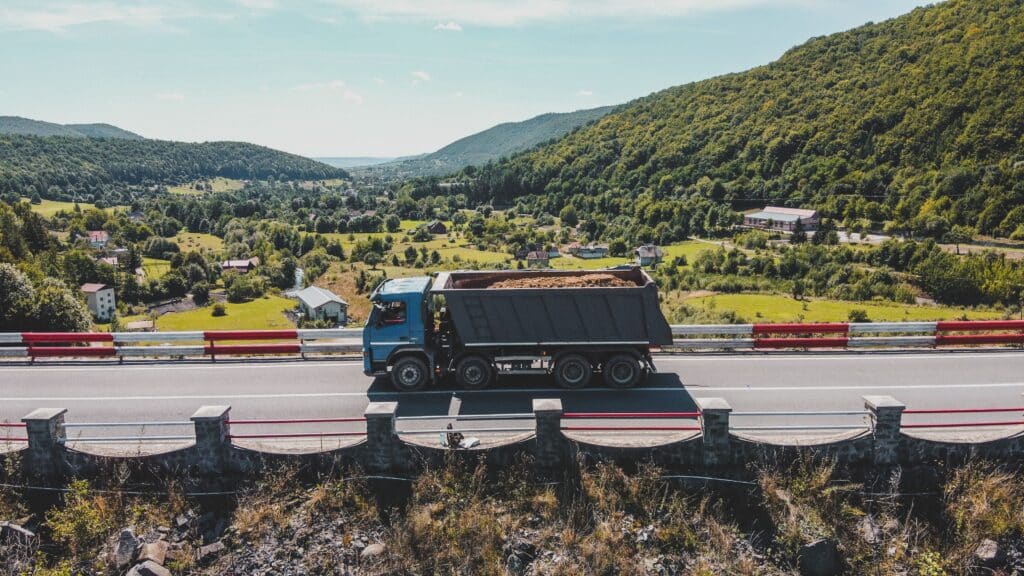


Dump truck insurance is a specialized commercial truck insurance policy designed for heavy vehicles hauling loose material like rock, dirt, and asphalt. Standard commercial auto policies routinely decline tandem and tri-axle dump trucks because raising a 20-foot bed on uncompacted soil or throwing loose aggregate on a highway carries risks standard auto insurers won’t touch. A dedicated policy covers the vehicle, the hoist, the cargo, and the liability risks unique to site work while helping contractors maintain compliance with state and federal Department of Transportation (DOT) rules.
This guide is for heavy civil, excavation, paving, and site-preparation contractors managing single units or multi-vehicle fleets.
Top Dump Truck Insurance Providers
| Company | Best For | AM Best Rating | Get a Quote |
|---|---|---|---|

Progressive
|
New Ventures | A+ | |
Acuity
|
Sand & Gravel Fleets | A+ | |

The Hartford
|
General Contractors | A+ |
*We may earn a commission when you click through these links.
Key Takeaways
- Different insurers target different hauling setups: Progressive accepts new authorities and solo operators, Acuity bundles auto and job site coverage for local aggregate fleets, and The Hartford provides the massive excess liability layers required by infrastructure prime contractors.
- Premiums range from $4,000 to $12,000+ per truck annually: Your hauling radius, vehicle weight class, and cargo dictate your price. For example, hauling hot-mix asphalt costs significantly more to insure than hauling clean fill dirt.
- Standard auto policies leave heavy equipment exposed: Standard policies exclude non-overturn frame twists, hydraulic hoist failures, and loose cargo spills. Protecting your rig requires specific endorsements.
- Gross weight triggers federal rules at 26,001 lbs: Crossing 26,001 lbs GVWR requires CDL drivers, DOT filings, and mandatory drug and alcohol clearinghouse tracking, moving a business out of standard auto insurance markets entirely.
Table of Contents
Related Guides



Dump Truck Insurance Reviews
Finding a carrier for dump trucks requires matching your gross weight, hauling radius, and cargo with an insurer that actually writes loose aggregate. Carrier appetites vary widely. An insurer that gladly covers a single tandem-axle dirt hauler might decline a commercial paving contractor running twenty tri-axles. Comparing financial stability ratings, off-road claims experience, and federal filing capabilities helps clarify which market fits a specific construction operation.
Progressive Commercial: Best for New Ventures
Best For
New ventures (under 2 years of operating authority), solo owner-operators, and fleets with drivers possessing limited CDL experience or recent moving violations.
Service Model
Direct online, independent agents, or brokers.
Financial strength
A+ (Superior) by AM Best
Claims Satisfaction
Average
Telematics
Smart Haul (for ELD users) or Snapshot ProView (offers a minimum 5% discount for non-ELD fleets).
Key Advantage
Broad underwriting appetite. Progressive accepts new authorities immediately and issues rapid federal and state DOT filings, whereas standard carriers typically decline operations lacking verified loss history.
Overview
Progressive Commercial is the most common entry point for newly established dirt and site-prep haulers. Standard insurers generally require two to three years of verified loss runs before underwriting a heavy vocational truck. Progressive bypasses this, specializing in pricing new ventures and owner-operators securing their first DOT number. They readily write single Class 7 and Class 8 dump units moving clean fill, sand, and gravel.
The quoting and binding process is highly automated. Owner-operators can generate a Certificate of Insurance (COI) and have their Form E or MCS-90 filings submitted electronically within hours. This allows a new contractor to satisfy compliance requirements and access an excavation site the next morning.
Pros and Cons
Progressive’s primary strength is accessibility. It readily insures drivers with limited CDL experience, recent violations, and newly formed LLCs. They maintain an in-house heavy truck claims network, which helps reduce repair downtime for specialized dump chassis and hoist mechanisms.
The tradeoff is premium cost and service depth. New ventures offset their lack of loss history with higher baseline rates. Additionally, Progressive’s highly automated service model is transactional; fleets handling complex, disputed job site property damage claims may lack the dedicated account advocacy provided by traditional broker-led insurers.
Financial Strength and Reputation
Backed by an A+ (Superior) rating from AM Best, Progressive has the institutional capital to pay high-severity claims. Their heavy-truck claims adjusters understand commercial vehicle geometry and frame repairs. However, their centralized processing model results in average customer satisfaction scores during complex, multi-party liability disputes compared to dedicated relationship insurers.
Policy Features
Progressive uses a modular policy structure suited for heavy aggregate haulers. Contractors can add motor truck cargo to cover hauled materials, non-trucking liability (NTL) for leased-on owner-operators, and rental reimbursement with downtime to replace lost income if a dump truck is sidelined by a covered physical damage loss.
Price and Value
- Cost tier: Economy to high risk ($–$$$)
- Savings: Paid-in-full discounts of up to 13%, plus usage-based rate adjustments for fleets utilizing Smart Haul or Snapshot ProView telematics.
Acuity Insurance: Best for Local Sand & Gravel Fleets
Best For
Local sand, gravel, and dirt haulers operating 1 to 20 power units within a localized radius.
Service Model
Independent commercial agents.
Financial strength
A+ (Superior) by AM Best
Claims Satisfaction
High
Telematics
Available through partner fleet management programs.
Key Advantage
Packages commercial auto liability, general liability, and workers’ compensation into a single direct-billed policy, eliminating costly coverage gaps between transit and job site operations.
Overview
Acuity Insurance targets regional earthmoving contractors and material haulers managing small to mid-sized fleets. Unlike carriers that isolate the dump truck auto policy from the rest of the business, Acuity excels at packaging primary auto liability with job site general liability and workers’ compensation. This integrated structure prevents disputes over whether a spill or backing incident falls under “auto” or “general liability” when operating on an active excavation pad.
Acuity utilizes a network of independent commercial agents who understand regional municipal requirements, local quarry operations, and state-specific DOT weight regulations, allowing for tailored policy structuring.
Pros and Cons
The primary operational advantage is their Truckers’ Enhancements endorsement, which bundles over 20 specific coverages—including combined truck, trailer, and cargo deductibles, plus towing and recovery—without piecemeal pricing. Their AcuitySmartPay option aligns workers’ compensation premium payments directly with payroll, aiding cash flow for seasonal site-prep contractors.
The downside is underwriting strictness. Acuity is not a market for newly licensed contractors or operators with poor driving records. They demand established operating histories, clean motor vehicle records (MVRs), and strict adherence to stated radius limits.
Financial Strength and Reputation
Acuity holds an A+ (Superior) rating from AM Best and is widely recognized for aggressive claims defense and efficient handling in the construction sector. Their adjusters understand off-road job site hazards and heavy equipment valuations, generating high retention rates among mid-sized trade contractors.
Policy Features
Their commercial truck policies accommodate trailer interchange for operators pulling pup trailers and broadened pollution coverage for loose aggregate spills. The Truckers’ Enhancements package specifically addresses common off-road hazards, covering mechanical towing and recovery extensions that are highly relevant when a loaded tri-axle bogs down in uncompacted subgrade.
Price and Value
- Cost tier: Standard to preferred ($$–$$$)
- Savings: Multi-line packaging discounts when combining commercial auto, general liability, and workers’ compensation, alongside potential safety program dividends for qualifying fleets.
The Hartford: Best for General Contractors
Best For
Mid-sized to large heavy civil engineering firms, paving contractors, and general contractors managing fleets of 10 or more units.
Service Model
Independent agents and commercial brokers.
Financial strength
A+ (Superior) by AM Best
Claims Satisfaction
High
Telematics
FleetAhead (proprietary risk management and tracking program).
Key Advantage
Provides high-capacity excess liability towers (commercial umbrellas) up to $25,000,000 and seamless integration with builders risk and project-specific policies.
Overview
The Hartford is an institutional commercial underwriter built for large heavy civil operations. When operations scale to double-digit tandem, tri-axle, or super-dump units, the risk profile shifts from standard auto liability to comprehensive project risk transfer. The Hartford absorbs these heavy exposures by bundling commercial auto liability with Owners and Contractors Protective (OCP) liability and massive commercial umbrella layers.
This carrier allows contractors bidding on state DOT infrastructure, highway paving, or large commercial site-prep projects to effortlessly satisfy the $2,000,000 to $5,000,000 excess liability minimums that project owners and municipalities universally enforce.
Pros and Cons
The Hartford’s operational strength lies in advanced risk engineering. Their FleetAhead telematics platform actively monitors heavy vehicle braking, routing, and transit speeds to reduce rollover and rear-end collision exposure, systematically lowering fleet claim frequency.
However, The Hartford is inaccessible to solo owner-operators or small local haulers. They mandate strict fleet safety protocols, dedicated safety managers, and extensive verified loss history documentation. Their underwriting process is highly scrutinized and requires significant lead time before binding coverage.
Financial Strength and Reputation
With an A+ (Superior) AM Best rating, The Hartford provides the balance sheet security demanded by tier-one project owners. Their dedicated construction risk engineering team and complex casualty adjusters are highly specialized, seamlessly managing severe multi-party highway collisions or large-scale environmental remediation claims.
Policy Features
Coverage capabilities include the Broadened Pollution Liability endorsement (CA 99 48) required for hauling hot-mix asphalt or contaminated soils, high-limit motor truck cargo, and specialized physical damage forms that account for custom chassis, auxiliary lift axles, and hardox steel dump bodies.
Price and Value
- Cost tier: Preferred / Corporate ($$$)
- Savings: Premium credits tied directly to FleetAhead telematics performance, large-deductible fleet options, and multi-line risk management discounts.
Crum & Forster: Best for Asphalt & Paving Contractors

Best For
Paving contractors and heavy civil haulers moving high-hazard environmental materials, including hot-mix asphalt and contaminated demolition soil.
Service Model
Independent commercial brokers.
Financial strength
A (Excellent) by AM Best
Claims Satisfaction
High
Telematics
Integrated fleet safety and risk engineering services.
Key Advantage
Unmatched underwriting appetite for high-hazard environmental risks, specifically providing high-capacity Broadened Pollution (CA 99 48) endorsements.
Overview
Crum & Forster excels where standard commercial auto carriers retreat: hazardous cargo and environmental exposures. Hauling hot-mix asphalt or contaminated excavation subsoil requires specialized transportation underwriting. Because standard commercial auto policies exclude cargo spills and environmental contamination, Crum & Forster structures policies around the CA 99 48 Broadened Transportation Pollution Liability endorsement mandated by general contractors and state transportation authorities for hazmat and aggregate transport.
Pros and Cons
Their main strength is specialized underwriting capacity for environmental risks that standard markets decline. Their internal risk control teams work directly with asphalt and paving fleets to establish operational protocols for high-temperature and contaminated loads.
The primary drawback is fleet size restriction. Crum & Forster targets mid-sized to large construction fleets and high-limit excess liability lines, making them inaccessible to single-unit owner-operators or small local trade contractors.
Financial Strength and Reputation
Holding an A (Excellent) rating from AM Best, Crum & Forster provides substantial balance sheet security for high-exposure risks. Their dedicated environmental and construction casualty adjusters are highly specialized, seamlessly managing complex hazmat spills, waterway contamination claims, and multi-party highway liabilities.
Policy Features
They specialize in writing the CA 99 48 Broadened Pollution Liability endorsement, high-limit commercial excess liability (umbrellas), and customized motor truck cargo forms. While the CA 99 48 endorsement covers environmental remediation if asphalt spills into a waterway or right-of-way, Crum & Forster’s risk engineers help contractors establish rapid-dispatch protocols to mitigate thermal spoilage—where asphalt cools and hardens inside the dump box following a breakdown—which standard cargo forms exclude.
Price and Value
- Cost tier: Specialty / Corporate ($$$)
- Savings: Custom-quoted pricing structures based on specific cargo hazard classifications, with large-deductible options available for established paving fleets.
Northland Insurance: Best for Heavy Haulers

Best For
Established transportation and dirt fleets operating articulated setups, including end-dumps, belly-dumps, and transfer trailers.
Service Model
Independent commercial agents.
Financial strength
A++ (Superior) by AM Best
Claims Satisfaction
High
Telematics
Access to Travelers’ comprehensive fleet risk management tools.
Key Advantage
Deep expertise in heavy transportation, operating under maximum bridge formula weights.
Overview
A subsidiary of Travelers, Northland Insurance caters to heavy transportation operators pushing maximum allowable Gross Vehicle Weight Ratings (GVWR). When a contractor scales from a standard rigid tri-axle dump truck to a heavy Class 8 tractor pulling a 40-foot articulated end-dump or a complex transfer trailer setup, the liability risk multiplies. Northland specializes in underwriting these maximum bridge formula weights.
Pros and Cons
Northland’s operational advantage is their flexibility with complex trailer configurations. They seamlessly provide the comprehensive trailer interchange and non-trucking liability (bobtail) coverages required by fleets that rely on heavy articulated equipment across regional routes.
However, their underwriting is geared strictly toward established motor carriers. They mandate strict CDL experience requirements and are not a fit for light-duty site-prep landscapers, new entrants to the commercial hauling space, or operations with poor FMCSA safety records.
Financial Strength and Reputation
Backed by Travelers, Northland carries the highest possible A++ (Superior) rating from AM Best. Because they are backed by an institutional heavyweight, their claims defense is formidable. Their transportation claims adjusters are highly specialized and understand the severe structural dynamics of articulated trailer rollovers and maximum-weight hauling collisions.
Policy Features
They offer robust trailer interchange agreements and non-owned trailer physical damage, which is mandatory for fleets routinely swapping specialized belly dumps or transfer trailers. Their policy forms also support non-trucking liability (bobtail) for independent owner-operators leased onto a larger motor carrier.
Price and Value
- Cost tier: Preferred / Corporate ($$$)
- Savings: Substantial rate improvements for fleets demonstrating rigorous driver qualification files and maintaining clean out-of-service (OOS) violation records during DOT roadside inspections.
Sentry Insurance: Best for High-Value Custom Rigs

Best For
Heavily capitalized fleet operators running expensive, highly customized tri-axle, quad-axle, or articulated dump equipment (10 to 100+ units).
Service Model
Independent commercial agents and direct sales.
Financial strength
A+ (Superior) by AM Best
Claims Satisfaction
High
Telematics
Integrated safety management programs utilizing fleet-provided telematics data.
Key Advantage
Offers agreed-value physical damage terms that accurately protect the massive capital invested in custom heavy-duty upfits, rather than settling claims based on aggressive actual cash value (ACV) depreciation.
Overview
Sentry Insurance caters to the upper tier of the heavy civil and aggregate hauling market. When contractors invest in specialized equipment—like super-dumps with auxiliary lift axles, hydraulic vibrators, and hardox steel bodies—standard commercial auto policies often fail to insure the full replacement cost of these aftermarket additions. Sentry specializes in writing stated-value and agreed-value physical damage terms that reflect the true operational value of specialized rolling stock.
Beyond physical damage, Sentry is highly regarded for its hands-on risk management. They deploy certified safety directors directly to contractors’ yards to audit loading practices, review driver telematics, and establish formal fleet safety protocols.
Pros and Cons
The primary advantage is the combination of ironclad physical damage protection and high-touch safety consulting. Contractors who adhere strictly to Sentry’s risk-control protocols can access competitive dividend-paying policy structures, effectively earning money back for maintaining low loss ratios.
The downside is accessibility. Sentry is not a market for new ventures, independent owner-operators, or fleets with undisciplined safety cultures. Their underwriting requires rigorous documentation, active safety management, and a commitment to continuous driver training.
Financial Strength and Reputation
Holding an A+ (Superior) rating from AM Best for over three decades, Sentry has the financial depth to handle catastrophic heavy-truck liability claims. Their dedicated construction safety consultants and specialized heavy equipment adjusters give them a stellar reputation among large-scale civil contractors.
Policy Features
Sentry offers comprehensive stated-value coverage, broadened pollution liability for hazardous cargo, and flexible deductible options. Their physical damage forms are explicitly designed to protect high-value auxiliary equipment and custom bodywork during severe overturn or collision events.
Price and Value
- Cost tier: Preferred ($$$)
- Savings: Substantial long-term premium savings through safety dividends and flexible deductible structures for fleets that demonstrate aggressive risk control.
Great West Casualty Company: Best for Roadside Breakdown Coverage
Best For
Established dirt and aggregate haulers operating 5 to 50+ units who need fast, specialized roadside recovery for heavy vocational trucks.
Service Model
Independent commercial agents specializing in transportation.
Financial strength
A+ (Superior) by AM Best
Claims Satisfaction
High
Telematics
Compatible with third-party ELD and camera systems; offers usage-based insights.
Key Advantage
Deep technical claims expertise in heavy truck architecture, paired with a specialized mechanical breakdown towing endorsement up to $5,000.
Overview
Great West Casualty Company focuses exclusively on the commercial trucking sector. While many carriers treat dump trucks as a difficult sub-class of general business auto, Great West underwrites them with a deep understanding of commercial hauling operations. They are particularly valuable for established mid-sized dirt fleets running specialized equipment over regional routes.
Their claims deployment network is a major operational asset. Adjusters are trained specifically in heavy truck anatomy, meaning they understand the engineering tolerances of a dump chassis, structural hoists, and heavy suspension packages, which translates to accurate damage appraisals and faster repair turnarounds.
Pros and Cons
A standout operational advantage is their Choice Coverage Plus bundle, which includes a mechanical breakdown towing endorsement providing up to $5,000 for towing and $500 for roadside labor. Since a standard commercial auto policy excludes mechanical breakdowns, this endorsement prevents contractors from absorbing the massive specialized tow bills required to extract a disabled 80,000-pound tri-axle from a highway or excavation pit.
The main drawback is their underwriting rigidity. Great West requires strict driver qualification standards and an established commercial safety record. They are not a viable option for new authorities, drivers with recent CDL suspensions, or fleets with poor loss histories.
Financial Strength and Reputation
Great West holds an A+ (Superior) rating from AM Best. Because they specialize entirely in transportation, their reputation among heavy civil fleet managers is exceptional. They are known for fighting fraudulent multi-vehicle liability claims and dispatching field adjusters directly to severe collision sites within hours.
Policy Features
Beyond standard primary liability, Great West offers robust physical damage coverage that can be structured to protect the full customized value of the dump body, hydraulic power take-off (PTO), and auxiliary axles, preventing severe depreciation penalties after a total loss.
Price and Value
- Cost tier: Standard to preferred ($$–$$$)
- Savings: Access to safety-based dividend programs for well-managed fleets and flexible deductible structures to lower baseline premiums.
Nationwide: Best for Mixed Fleets

Best For
Specialty trade contractors and mid-sized construction firms running mixed fleets of supervisor pickups, flatbeds, cargo vans, and dump trucks.
Service Model
Captive agents, independent agents, and direct digital quoting.
Financial strength
A+ (Superior) by AM Best
Claims Satisfaction
Average to High
Telematics
Vantage 360 (fleet management and telematics tracking program).
Key Advantage
Applies multi-vehicle fleet discounts across entirely different vehicle classes, simplifying administration for contractors who operate more than just heavy aggregate haulers.
Overview
Nationwide excels at underwriting construction organizations that operate a wide spectrum of vehicles. While a dedicated excavation hauler might only own Class 8 dump trucks, a general site-prep or landscaping contractor often runs a composite fleet: three F-250 supervisor trucks, two flatbed equipment haulers, and four tandem-axle dump trucks.
Instead of forcing contractors to split their heavy trucks onto a separate specialty policy, Nationwide structures composite fleet policies. This single-policy approach simplifies administrative management, guarantees unified expiration dates, and lowers the aggregate cost per vehicle.
Pros and Cons
The primary benefit is streamlined operational risk management. Nationwide offers multi-line packages, allowing contractors to bundle their mixed auto fleet with mobile equipment extensions and inland marine floaters (for excavators and skid steers). Their Vantage 360 telematics program also provides route tracking and driver behavior analytics to help fleet managers monitor job site efficiency.
The downside is specialized coverage depth. For contractors hauling highly hazardous materials like hot-mix asphalt or contaminated environmental soils, Nationwide may lack the heavy-duty pollution endorsements or high-limit excess liability capacity that a specialized heavy civil carrier provides.
Financial Strength and Reputation
Nationwide maintains an A+ (Superior) financial strength rating from AM Best. Their claims infrastructure is massive, ensuring responsive service across rural and suburban construction corridors. While highly efficient for standard collision claims, complex off-road dump body overturns may not receive the same specialized adjuster expertise as a trucking-only carrier.
Policy Features
They offer hired and non-owned auto coverage, which protects the contractor if an employee causes an accident while driving a personal vehicle for business purposes (like running to grab parts). They also provide competitive physical damage deductibles for composite fleets.
Price and Value
- Cost tier: Standard ($$)
- Savings: Strong multi-vehicle discounts for mixed fleets and additional premium credits for activating the Vantage 360 fleet tracking system.
Dump Truck Insurance Company Comparison
When comparing carriers, baseline premiums don’t tell the whole story. Low rates often mean a policy leaves severe coverage gaps. The table below compares the top dump truck insurers based on their target fleet sizes, financial strength, and specialized underwriting features.
| Carrier | Best For | AM Best Rating | Fleet Size Focus | Key Underwriting Feature |
|---|---|---|---|---|
| Progressive Commercial | New owner-operators & solo drivers | A+ (Superior) | 1 to 5 units | In-house heavy truck adjusters and broad new-venture acceptance |
| Acuity Insurance | Local sand & gravel fleets | A+ (Superior) | 1 to 20 units | Direct-billed package including auto liability, general liability, and workers’ compensation |
| The Hartford | General contractors & infrastructure fleets | A+ (Superior) | 10+ units | FleetAhead telematics program and integration with builders risk policies |
| Crum & Forster | Asphalt & paving contractors | A (Excellent) | 10+ units | Specialized heavy civil underwriting with excess liability capacity up to $5,000,000 |
| Northland (Travelers) | Heavy haulers & articulated setups | A++ (Superior) | 5 to 30 units | Flexible coverage extensions for end-dumps, belly-dumps, and transfer trailers |
| Sentry Insurance | High-value super-dumps & custom rigs | A+ (Superior) | 10 to 100+ units | Dedicated construction safety consultants and comprehensive agreed-value coverage |
| Great West Casualty | Heavy equipment breakdown towing | A+ (Superior) | 5 to 50+ units | Mechanical breakdown endorsement up to $5,000 for hydraulic systems |
| Nationwide | Diverse job site mixed fleets | A+ (Superior) | 3 to 25 units | Multi-vehicle discounts for mixed fleets of pickups, flatbeds, and dump trucks |
Compare insurers for any vehicle in your fleet in our best commercial auto and best commercial truck insurance guides.
What Does Dump Truck Insurance Cover?
A standard commercial auto policy is built for pickups and service vans driving on paved roads. Moving up to a heavy dump truck changes the rules. A standard policy might cover a typical highway fender bender, but it usually excludes the hazards specific to aggregate hauling, like twisted chassis frames, spilled loads, and environmental cleanups.
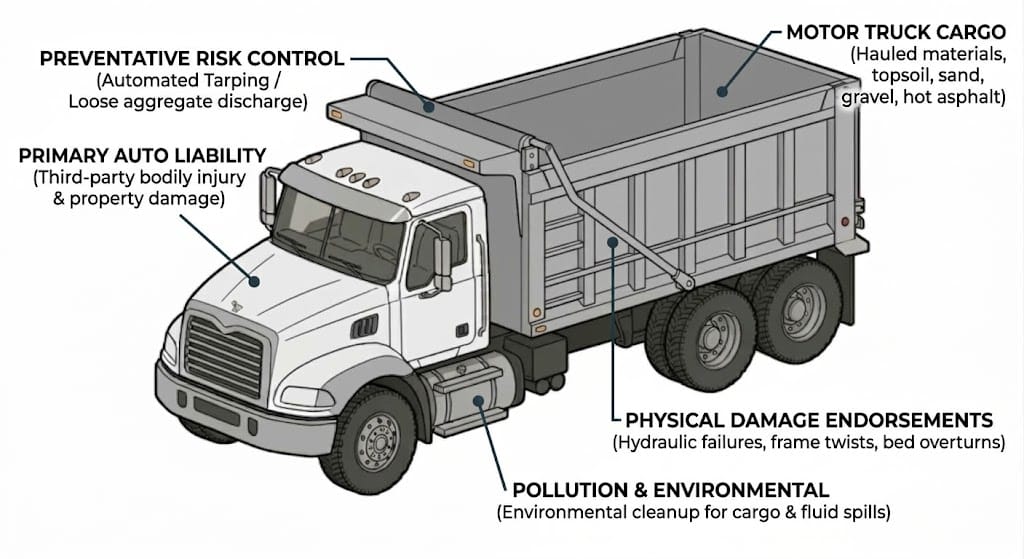
Properly covering a dump truck means putting together specific policy elements that handle heavy highway wrecks, equipment failures during a dump cycle, and job site accidents.
Primary Auto Liability
Primary auto liability pays for bodily injury and property damage when the truck is legally at fault for a wreck. Because a fully loaded tri-axle does a lot of damage in a crash, general contractors universally demand a minimum $1,000,000 combined single limit (CSL) to cover medical and property costs.
Beyond major collisions, the most common liability claim for dirt and gravel haulers is loose aggregate. When a rock falls off a truck bed and shatters a trailing car’s windshield, the trucking company is liable. Standard auto policies only pay if the driver is legally at fault, which leads to arguments over whether the rock actually fell from the bed (covered) or was just kicked up from the road by a tire (not covered). Dedicated dump truck policies often include specific provisions to handle these road debris claims without the hassle.
Overturn & Physical Damage
Physical damage covers the truck, the chassis, and the dump box. It splits into collision (crashes and rollovers) and comprehensive (fire, theft, vandalism, and weather).
For dump trucks, the biggest physical damage risk happens during the unloading cycle. Raising a 20-foot loaded box shifts the truck’s center of gravity. If the operator dumps on uneven or soft ground, the truck can list.
If it completely tips over, standard collision coverage kicks in. But if the truck stays upright and the shifting weight bends the frame rails or snaps the hydraulic cylinder, standard insurers usually deny the claim, classifying it as a mechanical breakdown. Covering a twisted frame without a rollover requires a specialized non-overturn endorsement.
Additionally, relying on standard actual cash value (ACV) settlements can be risky for specialized rigs. ACV applies heavy depreciation, which often falls short of replacing expensive custom additions like hardox steel bodies or auxiliary lift axles after a total loss. Agreed-value or stated-value policies solve this by insuring the truck for a specific, predetermined amount.
Environmental & Pollution Liability
Standard commercial auto policies contain strict pollution exclusions, but they do make an exception for the truck’s own operating fluids. If a dump truck crashes and ruptures its diesel tank or hydraulic lines, the standard policy pays for the cleanup.
However, the standard policy excludes spills of the actual cargo. If a truck dumps clean fill dirt on the highway, it is just a debris removal issue. But if it spills contaminated excavation soil or hot-mix asphalt (which contains petroleum), state environmental agencies mandate a hazmat cleanup. Covering hazardous cargo spills requires attaching a broadened transportation pollution liability endorsement (such as the CA 99 48) to the auto policy.
What Does Dump Truck Insurance NOT Cover?
While a dump truck policy covers the vehicle and the cargo in transit, it does not cover the broader operations of a construction or hauling business.
- Job site injuries: If a driver falls off the side rails while tarping a load, or a laborer is injured working around the truck, that falls under workers’ compensation insurance.
- General job site accidents: If an operator accidentally damages a newly poured foundation or strikes an underground utility line with an excavator, that is handled by general liability insurance, not the auto policy.
- Heavy construction equipment: The dump truck policy covers the truck itself. The loaders, excavators, and skid steers used to fill the trucks are covered under an inland marine or contractors equipment policy.
2026 Liability Market Snapshot: Escalating Limits
Across the transportation industry, massive jury awards—often called “nuclear verdicts”—are driving up the cost of claim settlements. Because of this, general contractors, state DOTs, and project owners are moving away from the old standard of a $1,000,000 liability limit.Earthmoving and paving subcontractors running Class 8 dump trucks are increasingly asked to provide proof of $2,000,000 to $5,000,000 in excess liability (commercial umbrella) coverage before they can haul a single load onto a project site. Without these higher limits, contractors are routinely locked out of bidding on municipal infrastructure and large commercial work.
To learn more about what truck policies do and do not cover for dump trucks and other vehicles in your construction fleet, see our guide to commercial truck insurance coverage.
Commercial Dump Truck Requirements
Heavy dump trucks operate under a different set of rules than standard business vehicles. Once a truck reaches specific weight limits, the operation falls under state and federal transportation laws. On top of statutory requirements, general contractors enforce their own insurance standards before allowing equipment on a job site.
Federal Requirements
Federal regulations apply to commercial motor vehicles operating in interstate commerce—meaning trucks that cross state lines or haul materials that originated out of state.
Regulations start at 10,001 pounds Gross Vehicle Weight Rating (GVWR). At this weight, the Federal Motor Carrier Safety Administration (FMCSA) requires a USDOT number, driver qualification files, and medical certificates. For trucks hauling non-hazardous loose materials like sand, gravel, or clean fill dirt, the federal minimum liability insurance limit is $750,000.
Rules increase significantly at 26,001 pounds GVWR. Any driver operating a vehicle at or above this threshold must hold a valid Commercial Driver’s License (CDL). The business must also register drivers in the FMCSA Drug and Alcohol Clearinghouse for pre-employment and random testing. Because tandem and tri-axle dump trucks routinely operate between 50,000 and 80,000 pounds fully loaded, they trigger full federal oversight.
State Requirements
Trucks that operate strictly within a single state fall under intrastate regulations. While many states adopt federal FMCSA standards directly, others run independent state DOT agencies with separate registration requirements.
Intrastate rules focus heavily on weight distribution and road safety. State highway patrols enforce gross vehicle weight limits and axle spacing rules under state bridge formulas. Local insurance agents file state-specific forms—such as a Form E—with the state department of transportation to verify the fleet maintains required liability limits.
Contractual Requirements
Federal and state laws set the baseline for legal road travel, but general contractors set higher limits for project access. Attempting to enter a commercial excavation site with only the $750,000 federal minimum will result in a work-stop order. Standard master service agreements in heavy civil construction require a minimum of $1,000,000 combined single limit (CSL) primary auto liability.
Contractors also mandate specific policy endorsements to protect the project owner and prime contractor from liability, and contractors must show proof of this coverage on a certificate of insurance (COI):
- Form MCS-90: Attaching a Form MCS-90 endorsement guarantees the insurer will pay public liability and environmental cleanup costs resulting from an accident, regardless of specific policy exclusions.
- Additional Insured: Adding the general contractor or project owner as an additional insured extends your auto liability protection to cover them for accidents caused by the dump truck on the job site.
- Waiver of Subrogation: Including a waiver of subrogation prevents your insurance company from seeking reimbursement from the general contractor after paying out a claim.
- Primary and Non-Contributory: Establishing primary and non-contributory status dictates that your dump truck policy pays first on a covered claim without seeking contribution from the general contractor’s liability policy.
For more detailed information on commercial truck requirements, including for dump trucks, box trucks, semis, and more, see our guide to commercial truck insurance requirements.
Commercial Auto vs. Dump Truck Insurance
A common mistake growing earthmoving contractors make is assuming their standard commercial auto policy covers any vehicle with the company logo on the door. In reality, insurance carriers view a Class 8 tri-axle dump truck entirely differently than a fleet of F-250 supervisor trucks or cargo vans.
Standard commercial auto policies price risk based on highway collisions. They expect the vehicle to navigate paved roads and carry standard tools. When you introduce an elevating steel bed on an uncompacted excavation pad, you introduce structural and liability hazards that a standard business auto policy simply is not priced to absorb.
| Standard Commercial Auto | Specialized Dump Truck Insurance | |
| Target Vehicle Types | Pickups, service vans, light flatbeds | Tandem-axle, tri-axle, quad-axle, super-dumps |
| Typical Weight Class | Class 1 to Class 6 (up to 26,000 lbs GVWR) | Class 7 to Class 8 (26,001 to 80,000+ lbs GVWR) |
| Operational Environment | Paved roads with incidental off-road access | Extensive rough-grade, quarry, and active job site duty |
| Loose Material Spills | Excluded under Care, Custody, or Control and standard Pollution clauses | Covered via specialized Cargo and Broadened Pollution endorsements |
| Non-Overturn Frame Damage | Excluded as mechanical breakdown or wear-and-tear | Covered via specialized physical damage or Inland Marine floaters |
If an operator hauls 20 tons of processed gravel under a standard commercial auto policy, any claim involving spilled aggregate on the highway, twisted chassis frames during discharge, or job site environmental cleanup will face almost certain denial.
Heavy Dump Trucks vs. Light Trucks Pulling Dump Trailers
Insuring a light truck pulling a dump trailer works completely differently than insuring a dedicated Class 7 or Class 8 dump truck. A residential site-prep contractor or landscaper often starts moving soil by hitching a dual-axle hydraulic dump trailer to a Class 3 pickup, like a Chevrolet Silverado 3500.
For this light-duty towing setup, contractors do not need a dedicated heavy dump truck insurance policy. The pickup remains scheduled on a standard commercial auto policy. The dump trailer is simply added to the schedule of covered vehicles for physical damage, and the liability coverage extends directly from the power unit while towing.
An integrated Class 7 or Class 8 dump truck is an entirely different operational risk. These vehicles feature heavy-duty front steering axles, power take-off (PTO) drive units, and pneumatic suspension systems built specifically to sustain severe structural stress while offloading heavy material. Because the hydraulic hoist and rigid steel body are permanently integrated into the commercial chassis, underwriters rate the entire unit under heavy transportation guidelines rather than standard business auto rules.
» Read More: Commercial Auto vs Commercial Truck Insurance
How Much Does Dump Truck Insurance Cost?
Commercial dump truck insurance typically costs between $4,000 and $12,000 or more per vehicle annually, depending on vehicle weight class, operational radius, commodity type, fleet size, and loss history. On a monthly cash flow basis, contractors should budget between $330 and $1,000 or more per power unit for full coverage including primary auto liability, physical damage, and cargo protection.
Single-truck owner-operators who are newly licensed or hauling higher-risk commodities like hot asphalt often fall at the higher end of this price range. Established earthmoving fleets that manage five or more units, maintain clean commercial driver records, and operate within a localized 50-mile radius can typically earn substantial price breaks.
| Dump Truck Configuration | Typical Weight Class (GVWR) | Primary Cargo Type | Estimated Annual Premium (Per Truck) |
| Single-Axle Dump Truck | Class 6 to 7 (19,501 to 33,000 lbs) | Clean fill dirt, sand, landscaping mulch | $3,500 to $6,500 |
| Tandem-Axle Dump Truck | Class 8 (33,001 to 54,000 lbs) | Processed gravel, crushed stone, subbase | $5,000 to $9,000 |
| Tri-Axle / Quad-Axle Dump Truck | Class 8 (54,001 to 70,000+ lbs) | Heavy aggregate, demolition rubble, asphalt | $7,500 to $12,000 |
| Super-Dump / Transfer Dump | Class 8 (80,000+ lbs with bridge axles) | High-volume quarry rock, infrastructure paving | $9,500 to $14,000+ |
Pricing Factors for Dump Trucks
Underwriters calculate dump truck insurance premiums based on operational radius, material classifications, vehicle weight ratings, and fleet scale:
- Fleet Size & Multi-Vehicle Discounts: Running multiple trucks lowers your cost per power unit. Insurers apply fleet credits starting at five power units because administrative overhead drops, and risk spreads across multiple vehicles. Single-truck owner-operators absorb maximum baseline rates, whereas mid-sized and large fleets secure multi-vehicle discounts that reduce per-truck liability costs.
- Radius of Operation: Operations that stay within a localized 50-mile perimeter of their principal yard or local quarry secure the most competitive rates. Underwriters favor local routes because drivers spend less time on congested interstates at sustained high speeds. Expanding into an intermediate radius (51 to 200 miles) or regional territory increases auto liability premiums due to higher highway collision exposure.
- Material Hauled: The physical characteristics and density of the cargo directly determine liability risk. Clean fill dirt, topsoil, and processed sand represent the lowest rating tier because spillage causes minimal structural damage. Transporting coarse gravel, crushed granite, and heavy riprap increases liability rates, as airborne stones dislodge at highway speeds, cracking windshields and damaging trailing vehicles. Hot-mix asphalt sits at a higher cost tier, hauled at temperatures exceeding 300°F, introducing thermal burn risks and mandatory environmental cleanups if an overturn occurs.
- GVWR & Axle Configurations: The Gross Vehicle Weight Rating determines both the physical damage replacement value and the destructive force of the vehicle in an impact. Heavy tri-axles, quad-axles, and super-dumps utilize auxiliary lift axles to legally operate at gross weights up to 80,000 pounds under bridge formula laws. Because these specialized rigs carry chassis values exceeding $200,000 and present massive bodily injury exposure during a crash, underwriters apply higher baseline rates across liability and physical damage lines.
How to Lower Your Dump Truck Insurance Premiums
Controlling dump truck insurance costs comes down to stopping small, routine claims. While a total rollover causes a major payout, a steady stream of $500 windshield claims from flying gravel ruins your claims record just as fast. Insurers track how often claims happen—not just how big they are—so eliminating minor road debris damage is the fastest way to earn lower rates.
To lower baseline premiums and qualify for preferred underwriting tiers, contractors typically focus on four operational adjustments:
- Dual-Facing Dashcams: Hardwiring commercial telematics with forward-facing and cab-facing cameras captures cloud-based video during incidents. This provides objective evidence that protects against fraudulent road debris claims by proving whether gravel actually fell from your bed or was kicked up by another vehicle. Implementing dashcams typically yields a 5% to 15% discount on auto liability lines.
- Automated Tarping Systems: Installing cab-operated electric roller tarps with vinyl or mesh screens mechanically seals loose aggregate inside the dump body in under 30 seconds. This eliminates projectile rock claims while keeping drivers off side rails and exterior ladders, reducing workers’ compensation fall risks and placing the fleet in preferred underwriting tiers.
- Strict Motor Vehicle Record (MVR) Screening: Mandating at least two years of verifiable CDL experience and enforcing strict hiring limits on traffic violations keeps high-risk drivers out of your trucks. Insurance carriers pull MVRs—the state-issued driving history showing moving violations, accidents, and suspensions—for every driver. Enforcing clean driving standards can earn a 10% to 25% fleet rate credit.
- Seasonal Lay-Up Endorsements: In northern regions where winter ground freezes halt earthmoving and paving work, contractors can suspend expensive over-the-road liability and collision coverages while keeping comprehensive coverage active to protect idle trucks against fire, theft, and weather damage. This reduces monthly premiums by 40% to 60% per unit during parked months.
Cheap Dump Truck Insurance Providers
For independent owner-operators and small site-prep contractors focused strictly on minimizing baseline insurance overhead, selecting a carrier with lower administrative friction or aggressive local rating models is the fastest path to lowering fixed costs.
| Company | Best For | AM Best Rating | Get a Quote |
|---|---|---|---|
|
Progressive
|
The cheapest entry point for new businesses with under two years of operating authority. | A+ | |
GEICO
|
Best pricing for small, local crews that stay strictly within a 50-mile radius. | A+ | |

biBERK
|
Lowest baseline rates for single-truck operators willing to buy direct online and skip the broker. | A+ |
*We may earn a commission when you click through these links.
Frequently Asked Questions
How much is dump truck insurance per month?
Commercial dump truck insurance typically costs between $330 and $1,000 per month per power unit. Single-truck owner-operators or those hauling higher-risk commodities like hot-mix asphalt usually fall at the higher end of this range. Because cash flow is critical for seasonal site-prep contractors, many carriers offer flexible monthly installment plans, though securing coverage generally requires a 10% to 20% down payment. Your exact monthly rate will ultimately depend on your truck’s Gross Vehicle Weight Rating (GVWR), your hauling radius, and the cleanliness of your drivers’ motor vehicle records (MVRs).
How much does $1,000,000 in dump truck liability insurance cost?
Securing a $1,000,000 Combined Single Limit (CSL) typically accounts for the largest portion of your overall policy cost, usually running between $2,500 and $6,000+ annually just for the liability coverage. While the Federal Motor Carrier Safety Administration (FMCSA) sets the federal minimum liability limit at only $750,000 for hauling non-hazardous loose materials, that minimum is rarely enough in the real world. Nearly all commercial general contractors, municipalities, and project owners mandate a $1,000,000 limit before they will allow your truck on a commercial job site or release project payouts.
Does my general liability policy cover my dump truck?
A commercial general liability (CGL) policy does not cover dump truck operations. Standard ISO general liability forms contain a total auto exclusion that blocks coverage for bodily injury and property damage resulting from the ownership, maintenance, or use of any land motor vehicle designed for travel on public roads.
While general liability protects your business from premises operations hazards—such as a visitor tripping over job site debris or an excavator striking an underground utility line—it explicitly excludes vehicle transit accidents regardless of whether they occur on a public highway or off-road on a private excavation pad.
Do I need a special endorsement to haul hot asphalt?
Transporting hot-mix asphalt requires specialized coverage—specifically the CA 99 48 endorsement (Broadened Transportation Pollution Liability)—because standard commercial auto forms exclude environmental cleanup and liability for petroleum-based contaminants released from transported cargo.
Hot asphalt is batched and hauled at temperatures between 275°F and 325°F. It contains petroleum hydrocarbon binders that present severe environmental hazards if spilled. While a broadened pollution endorsement covers environmental remediation, it does not cover thermal spoilage. If a mechanical breakdown causes the mix to cool and harden inside the dump bed, standard cargo policies deny the claim under exclusions for delay, temperature change, and mechanical failure.
What is bobtail insurance and do dump truck owners need it?
Bobtail insurance provides liability coverage for a commercial tractor when it is operated without an attached trailer, and it is rarely needed by straight dump truck owners.
Because standard Class 7 and Class 8 straight dump trucks feature a permanently mounted dump box fastened directly to the frame rails, they cannot decouple and never operate in a true bobtail configuration. The only aggregate haulers who require bobtail or non-trucking liability coverage are independent tractor owners pulling detachable pup trailers, end-dumps, belly dumps, or transfer trailers.
Can I get dump truck insurance for personal or farm use?
Insuring a dump truck strictly for personal use or farm work is a common compliance trap. Standard personal auto policies will immediately decline the vehicle because its weight and hydraulic hoist mechanisms exceed light-duty limits. At the same time, standard commercial auto carriers often reject personal-use applications because there is no registered business entity or verified commercial hauling history to underwrite.
When an owner buys an older single-axle dump truck solely for private acreage, carriers typically require scheduling it on a dedicated Farm and Ranch policy. However, the moment an operator hauls a load of gravel for a neighbor in exchange for cash, the vehicle is operating in commerce, which instantly voids a personal-use policy.
References & Additional Resources
- Federal Motor Carrier Safety Administration (FMCSA). The primary federal transportation agency that oversees commercial motor vehicle compliance, enforces safety regulations, and mandates public liability insurance filings for interstate motor carriers.
- Electronic Code of Federal Regulations (eCFR) Part 387. The official federal administrative code establishing regulatory minimum financial responsibility limits, filing mandates, and endorsement standards for commercial motor carriers of property, passengers, and hazardous commodities.
- American Transportation Research Institute (ATRI). Operational Costs of Trucking Annual Report. The leading source of financial data and operating metrics for the commercial trucking industry.
Related
Commercial auto insurance is a policy designed to cover liability and physical damage for vehicles used in business operations. [cc_button…
The best commercial auto insurance companies in 2026 are Progressive for newly licensed contractors, ERGO NEXT for specialty trades wanting…
In 2026, commercial auto insurance for a light-duty vehicle typically costs $250 to $400 per month. Because pricing is not…
Commercial auto insurance requirements are governed by three distinct authorities: state DMVs require basic split limits for vehicle registration, the…
Commercial auto insurance covers the vehicles owned or used by your business. It protects the company from liability claims if…
The main difference between commercial vs. personal auto insurance is intent: personal policies cover daily commuting, while commercial policies cover…

Based on our evaluation of coverage limits, replacement cost options, and claims processing speeds, the best contractors tools and equipment…

The Hartford, ERGO NEXT, and Hiscox are the best general liability insurance providers for contractors in 2026. Progressive, Thimble, and…
The best builders risk insurance companies for 2026 are Nationwide for general contractors, State Farm for homeowners and owner-builders, and…